

Repair histories are trustworthy when they create a logical vehicle-specific timeline, verify past-due services that matter, and have only known/verified gaps you can accept or fill. Absence of a repair order doesn’t confirm that maintenance wasn’t performed. However, don’t count an outstanding service item as having been done “just because” the seller claims the vehicle is “fully maintained.”
Match the records to the actual requirements
Select the vehicle's model year, engine, transmission, drivetrain, current mileage, and desired start date for time-based service. Choose the vehicle's specific manufacturer schedule, rather than a generic dealer schedule. An engine selection can determine if a vehicle needs a timing-belt-related service. A drivetrain selection can enable fluid-service items. Having a receipt for a mega-service package is only helpful if its included services satisfy the items that are due on this vehicle.
Include mileage-or-time-triggered services that are consequential (by interval). Use whichever trigger is listed in the schedule. Note the footnotes: an inspection does not substitute for replacement, and special-operating-conditions requirements apply only when conditions apply. Inquire about previous use if it could affect an interval. Do not presume severe service if there are no receipts. The 2016 Toyota Camry's guide lists inspections separately from replacements, and lists additional tasks if certain operating conditions apply.[1]
Cover repeat requirements as well as costly milestones. One recent oil-change receipt can prove that appointment; it can't prove a history of prior changes. Your audit should note what triggers each priority item to become due and if the records reflect the appropriate span of time. Unmatched receipts for optional waxings shouldn't be flagged as urgently as an undocumented repair already past due.
Reconcile the evidence, not the receipt count
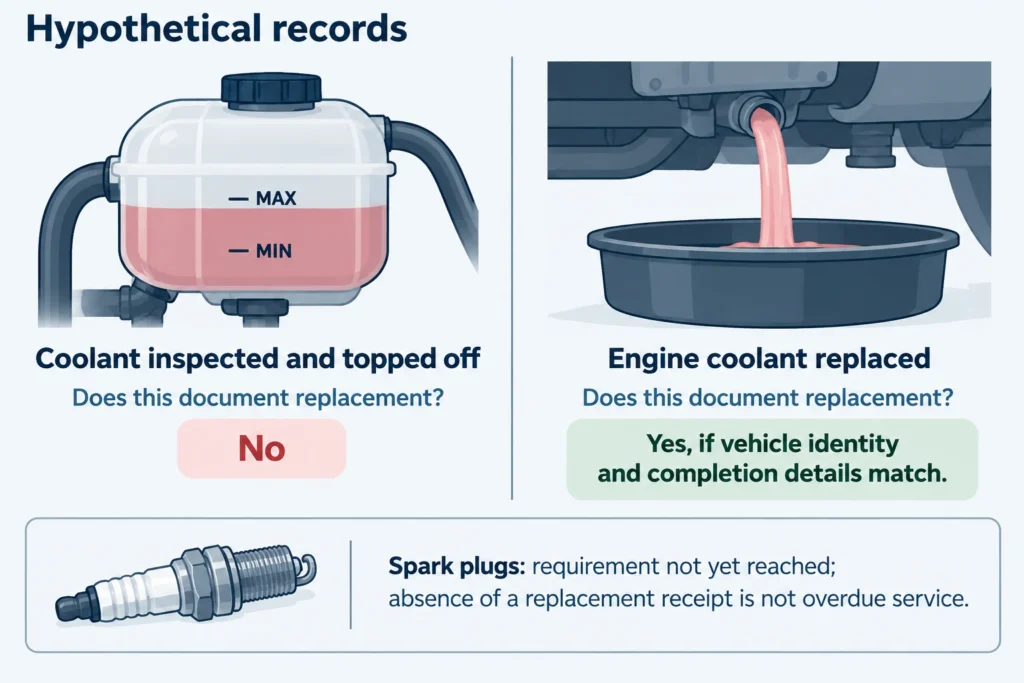
Sort by date. Match up VIN, mileage, and description of work performed. Group an invoice, app entry and history-report entry for the same visit into one service instead of three. Separate actual work performed from recommendations, estimates, and "customer says no." "Recommended coolant replacement" does not record that the coolant was replaced. Neither does "Checked coolant and topped off."
An itemized completed-work invoice proves specific service much better than "vehicle serviced." Search for identifiers, date & mileage, labor description and parts/fluid specifications as appropriate. Independent-shop invoices and well-documented DIY jobs both work; dealership letterhead does not magically make one better. For DIY, dated purchase receipts verify materials bought, and a contemporaneous log verifies claimed installation occurred. Neither individually proves all aspects of completion.
Electronic entries should be treated likewise. CARFAX Car Care will accept handwritten maintenance records or automatic records from affiliated shops; therefore a screenshot from an app won't always be considered third-party verification. On the other hand, CARFAX states that its history reports are based on information provided to them and do not reflect every service a vehicle has received. A valid receipt can verify that work was performed that isn't on a report; just because it's not on the report doesn't mean it wasn't done.[2][3]
For another important questionable entry, ask the seller to obtain the supporting invoice from the store where the work was performed. Some manufacturer websites offer another method of retrieval, such as Toyota linking service-history records to the VIN, but don't assume you'll have access or that it's all covered. Request that the seller pull records you can't access due to ownership or privacy restrictions, and don't assume the portal recorded all work done at independent shops.[5]
Scrutinize mileage voids, incorrect vehicle information and servicing mismatches prior to viewing them as fraud. Contact the source to verify the original entry was made; a keying error is not an unverified discrepancy. If you are unable to reconcile the issue, do not award credibility to that claim. Segregate your findings as completed verified, completed suspected, not completed and false evidence.
Hypothetical review of a 2016 Camry
Imagine a fictitious 2016 Camry equipped with the non-hybrid 2.5-liter engine that has 98,000 miles and 126 months elapsed on the relevant maintenance schedule. The seller has recent detailed oil-change receipts, previous non-specific service summaries, a coolant inspect/top off receipt and several car-wash receipts. Dates and mileage continue to increase sequentially. The seller mentions coolant was changed but the shop no longer exists so there's limited recourse to verify it.
| Requirement | Strongest available evidence | Conclusion and buying consequence |
|---|---|---|
| Oil and filter service under the applicable recurring schedule | Recent completed-work invoices identify the car, date, mileage, oil specification, and filter replacement. | Recent service is substantiated. Earlier generic summaries do not prove every previous oil-change interval; the older history remains uncertain. |
| Initial engine-coolant replacement: 100,000 miles or 120 months | An invoice says coolant was inspected and topped off; replacement is only asserted by the seller. | Already due by time at 126 months. Retrieve replacement documentation if possible; otherwise obtain a quote for the applicable coolant service. |
| Spark-plug replacement: 120,000 miles or 144 months | No replacement invoice. | Neither trigger has been reached at 98,000 miles and 126 months. Missing replacement paperwork is not a current catch-up obligation. |
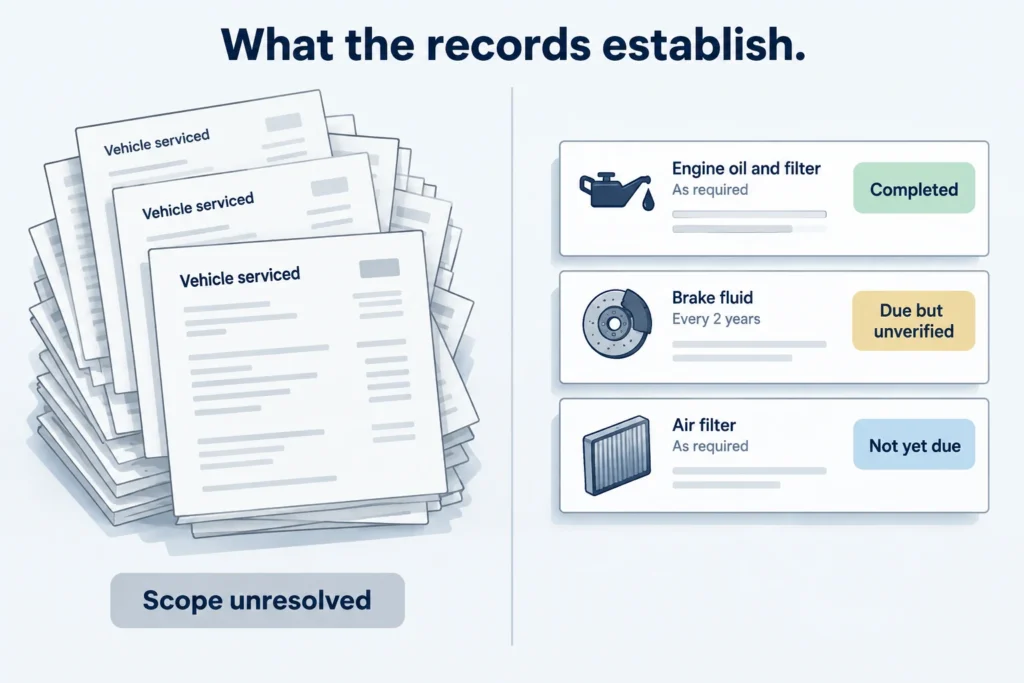
The car-wash tickets don't increase confidence in maintenance history. The coolant interval does though. It creates a very specific next step: find any saved replacement sticker, then research the cost of the warranted work if you haven't already confirmed it was done. Don't allow yourself to budget for the upcoming spark plugs just yet. Take it to the independent checker with the old oil-gap specifically called out; evaluate that concern independently of whether you want to live with that uncertainty. Purchasing coolant service this visit would eliminate that liability; it would not undo past oil service.
Separate current condition from service history
Submit your issues to an independent inspector prior to the appointment to allow the inspection to cover these concerns within reason or the inspection scope agreed upon. The FTC suggests consumers have the vehicle independently inspected regardless of whether it is described as certified/previously inspected by a dealer and have the inspection include a written report with estimates for repairs that are necessary. Request that the report clearly differentiate what was observed during inspection, what requires additional testing to give a proper assessment, and any historical information the consumer cannot verify.[4]
An inspection can reveal existing wear, leaks, abnormal operation and other evidence related to a documentation gap. Measuring remaining brake material, for example, inspects current brake wear even if there is no receipt for replacement. Inspection for coolant leak detects current condition, not if scheduled coolant replacement took place. Appearance of fluid does not document when it was replaced, nor what product was used.
Questions that remain historical even after normal inspection include: Was oil changed at each required interval? Did a fluid meet the specified standard? When was the timing belt replaced? Cosmetic appearance and uneventful drive cannot confirm those events occurred. Request which specific findings warrant further testing. Do not approve extensive testing to attempt to recreate a service history that no longer exists.
Price the obligation and the remaining uncertainty
Get job-by-job, vehicle-specific estimates for warranted catch-up work. Maintain three columns of issues: overdue preventive maintenance (PM) not substantiated, corrective work warranted by inspection results, and unknown previous history. The latter two categories should be able to be priced. The former may still exist once catch-up work has been addressed. Performing a new oil change job cannot prove that previous intervals were maintained.
Reference those quotes against purchase price plus ASAP work against your budget and other options. The FTC lists inspection estimates as fair negotiation proof, but there is no standard markup penalty for paperwork gaps. A capped coolant-service invoice may justify purchasing with contingency or renegotiated terms. Large rolling-service gaps with no documentation need their own risk assessment, beyond the value of one service.[4]
If the seller agrees to do work, get the precise scope in writing and don’t consider the gap closed until you receive a completed-work invoice that identifies the vehicle, date, mileage and relevant parts/fluid milages before you consider the gap bridged. "We'll service it" is not a promise with anything specific attached to it. Walk away if there are still unexplained consequential discrepancies, if the necessary work will leave you with inadequate repair reserves or if the uncertainty is greater than you can responsibly accept. Walk away if the seller won't allow an independent inspection. The FTC suggests you walk away and look for another seller.[4]
Sources and references
- Toyota Motor Sales, U.S.A.; manufacturer document reproduced by ManualMachine: 2016 Camry Warranty and Maintenance Guide
- CARFAX: CARFAX Customer Support Center
- CARFAX: CARFAX Car Care
- Federal Trade Commission: Buying a Used Car From a Dealer (2024-04)
- Toyota: Toyota Owners service-history dashboard