

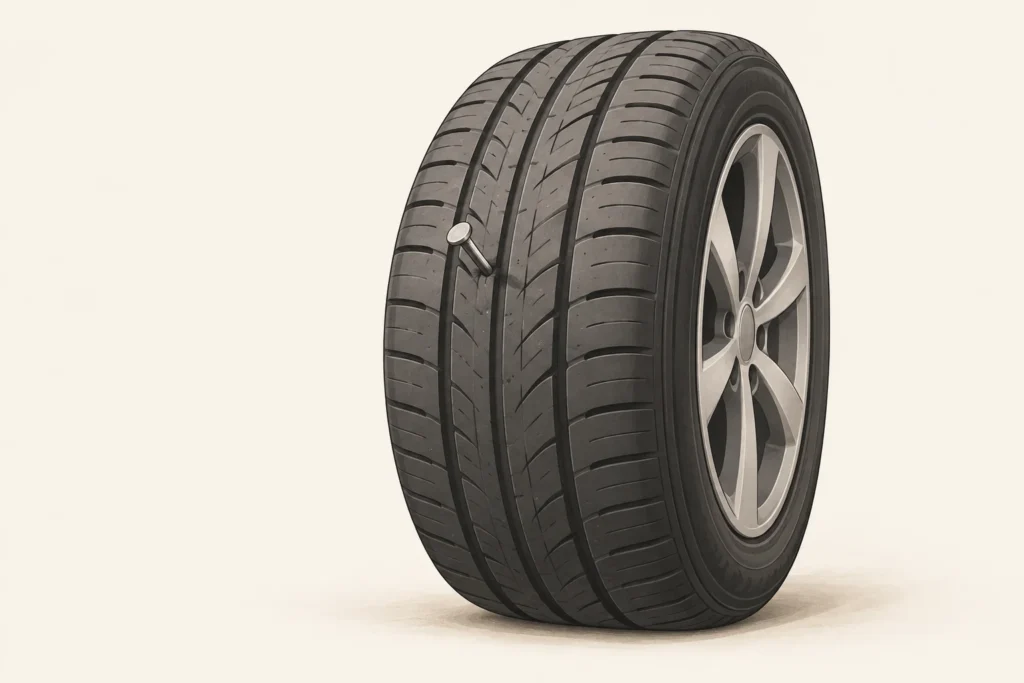
If a tire is damaged by a nail, it may be able to be repaired, as long as the damage is located in a repairable area of the tread, is 1/4 inch or less (6 mm) and is inspected on the inside of the tire. Some manufacturers will require you to replace the tire. Just because the tire has a nail in it doesn't mean it can be repaired, only that it can be checked for repair.[1]
Do not remove the nail or drive on the tire to see if it's holding air. If the tire is flat, very low or has any signs of damage, please use a road service or alternate tire if available. If using a temp tire or donut, please make sure it's applicable to your vehicle. Check tire psi and max speeds/distances you can travel. Just because a tire can hold air temporarily doesn't mean it can be repaired.[2][5]
Which inspection findings permit repair?
| Finding | Repair decision |
|---|---|
| Injury confined to permitted tread area and no greater than 1/4 inch (6 mm) | Potential candidate; internal inspection and applicable policy must also permit repair. |
| Injury involves sidewall, shoulder, or belt edge, including an angled path extending there | Outside repair criteria; replace. |
| Injury larger than the permitted limit | Replace rather than repair. |
| Internal structural damage from low-pressure operation | Replace; sealing the puncture cannot restore damaged structure. |
| Existing improper repair, or proposed repair would overlap another | USTMA excludes repair. |
| Prior proper repair, run-flat use, or injected sealant | Requires inspection and policy confirmation; the visible puncture alone cannot settle eligibility. |
Remember this is for the size of the damage, not how big the nail may be. Also keep in mind that just because the nail may be located in a repairable area of the tire doesn't mean the puncture didn't go at an angle towards the shoulder or belts. We cannot determine this by looking at a picture.[1]
What a complete permanent repair includes
A technician will have to remove the tire from the wheel to inspect the tire. Driving on an underinflated tire can cause damage to the tire. Just because it holds air once filled doesn't mean it's good.[1][2]
A proper repair should consist of a plug or material to fill the hole and a patch to seal the tire liner. Plugging the hole will help stop water from getting into your tires. Patching the tire liner will stop the tire from leaking air. You can use a combo patch/plug but it's not required to be one piece.[2]
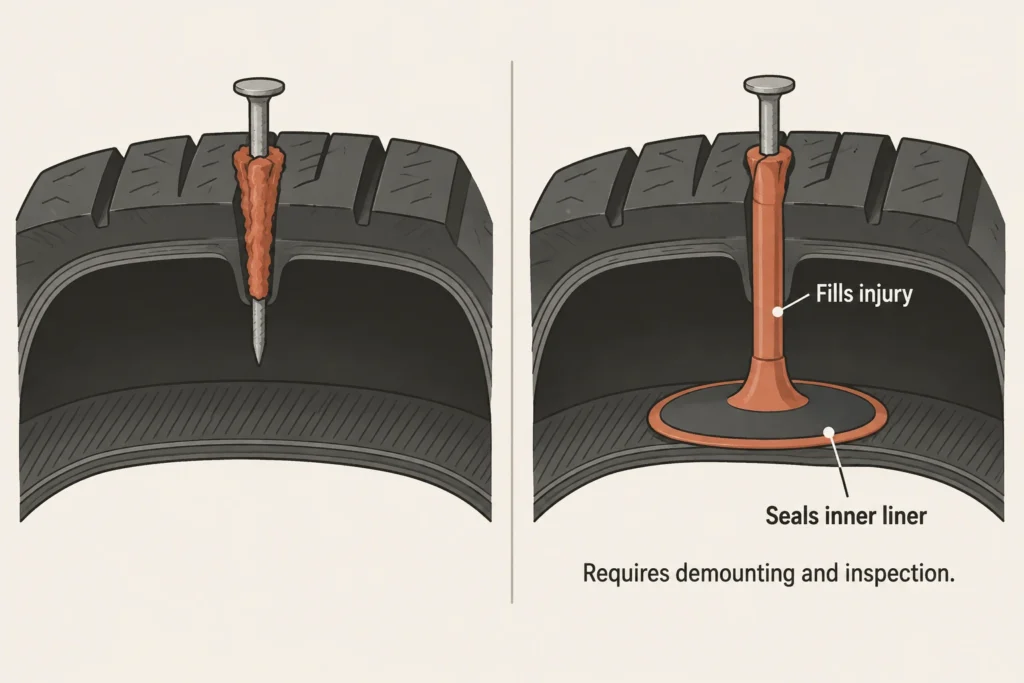
By only plugging the outside of your tire, you're not allowing for the tire to be inspected or applying a patch on the inside of your tire. By only patching the inside, you are leaving your hole open. Neither method will follow the USTMA standards for repairing a tire. Make sure you know what you're getting when someone tells you they can plug or patch your tire.[1][2]
When history or policy changes the answer
Let's say you have a 3mm injury to the center of the tread with no disqualifying findings on the inside. A normal tire would allow a full interior repair to save the tire. If you're inspecting a Pirelli run-flat and it had lost air pressure, Pirelli's US policy states that it must be replaced, even if it's a small hole and in the correct area.[1][4]
There are many different run-flat policies. The US Bridgestone policy allows for certain repairs to be made to their RFTs but will not allow repair of any tire that has been driven under 15psi, just to name one. This is a repair restriction, not a safe driving psi. You don't know what the pressure was at so you can't make that determination. There are also vehicle restrictions that may not allow a tire to be repaired.[3]
Always ask if there was a repair on the tire and what type of sealant was used. USTMA states to scrap a tire if there is an improper repair already on the tire and not to overlap repairs. It does not state how many repairs are allowed. Bridgestone's policy that was referenced states to replace the tire if injected emergency sealant/filler was used. Pirelli does not allow sealant in their sensorized tires. Don't compare injected sealant to the tire's self-sealing.[1][3][4]
What to ask before authorizing work
You should be asking what they found that will allow this tire to be repaired or why it cannot be repaired. What tire or vehicle policy is being used? Can the tire be demounted, inspected and repaired by plugging the injury and repairing the liner? Ask for a measurement of the injury or a finding of damage or a restriction when someone wants to replace a tire, not "I see a nail".
Know the difference between a shop refusing to repair due to a finding on inspection or manufacturers restriction and a shop that doesn't offer the service. You can have another shop that offers the service look at it but you should not disregard the finding or restriction.
Sources and references
- U.S. Tire Manufacturers Association: Tire Repair Basics
- U.S. Tire Manufacturers Association: Care and Service of Passenger and Light Truck Tires (2017)
- Bridgestone Americas Tire Operations: Tire Maintenance and Safety Manual, US replacement market (2024-01-01)
- Pirelli Tire LLC: Pirelli Original Equipment and Replacement Passenger and Light Truck Tires Limited Warranty and Tire Care and Service (2026-05-01)
- Ford Motor Company: Ford online owner's manual, temporary mobility kit instructions