

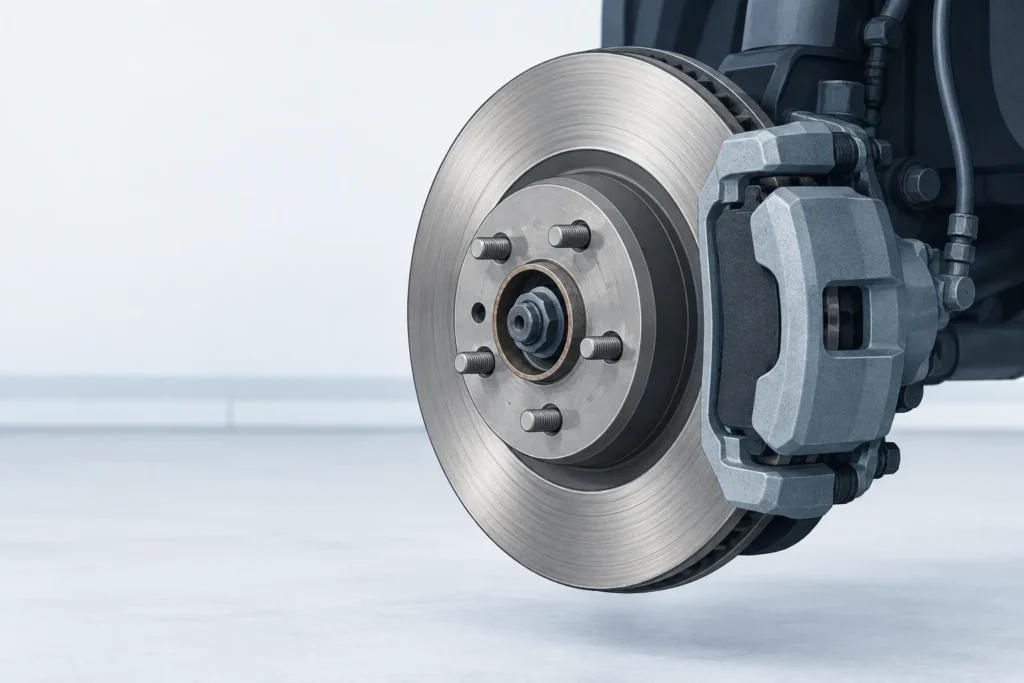
No, installing new brake pads does not automatically require replacing the rotors. Depending on your vehicle’s service procedure and the rotors’ condition, the right repair may be reuse, machining, or replacement. I wouldn’t accept “new pads need new rotors” as the whole explanation, but I wouldn’t delete the rotor charge just to make the estimate smaller, either.[1][3][4]
The distinction matters because manufacturers don’t all prescribe the same work. Chevrolet’s public guidance allows reuse when its stated condition criteria are met and the rotor is at least 1 mm above discard thickness. Mazda’s November 2025 service alert calls for machining with pad replacement within its listed applications, rather than automatically fitting new rotors. Neither example is a rule you can transfer to every car.[1][4]
Picture me, in an imagined example, comparing two estimates on my phone while my lunch break disappears. One says “premium brake package”; the other says “pads only.” I’m tempted by the smaller total, then annoyed that neither tells me what happens to the rotors. Instead of choosing a package name, I ask what condition each rotor is in and what procedure the price includes. Now there’s something useful to compare.
Three possible repairs, not three interchangeable prices
| Option | What supports it | What you’re paying for |
|---|---|---|
| Reuse | The procedure allows it, with acceptable thickness, surface condition, and required geometry checks. | Keeping a serviceable rotor without cutting away material. |
| Machine or resurface | Machining is permitted, the defect is correctable, and enough material remains to meet the prescribed entry and finished limits. | Labor to restore an acceptable friction surface and geometry. |
| Replace | Insufficient thickness, damage that cannot acceptably be corrected, or a procedural restriction rules out the alternatives. | A new rotor, plus the installation work needed for an acceptable finished repair. |
Machining, sometimes called turning, removes metal. It can correct suitable surface problems, but it isn’t a free reset: the rotor must have enough material for the cut and the required finished result. I’d compare actual installed quotes, not assume machining is cheaper because it uses the old part. Its labor charge may narrow or erase the difference, and an inexpensive option that fails the procedure isn’t an option at all.[2][3]
Why “above minimum” can still be an incomplete answer
Rotor thickness is the material left between the two friction faces. The discard limit is the threshold at which the part is removed from service. This is not about appearance of the part. Continuous use may cause excessive thinning and subsequently reduce the thermal and mechanical strength of the part.[2][5]
While "over the limit" does not resolve if machining is permissible, the limit specifies how thick the part can be left. The machining procedure may also require that extra material remain on the part before machining is performed. In GM's archived bulletin, the finished-thickness limit and the discard limit are explained and it is cautioned that the limit specified on the part may not be the limit being referred to. I would want the shop to identify the limit the part is being machined to over before reading. Otherwise, you do not know which limit is being referred to.[2]
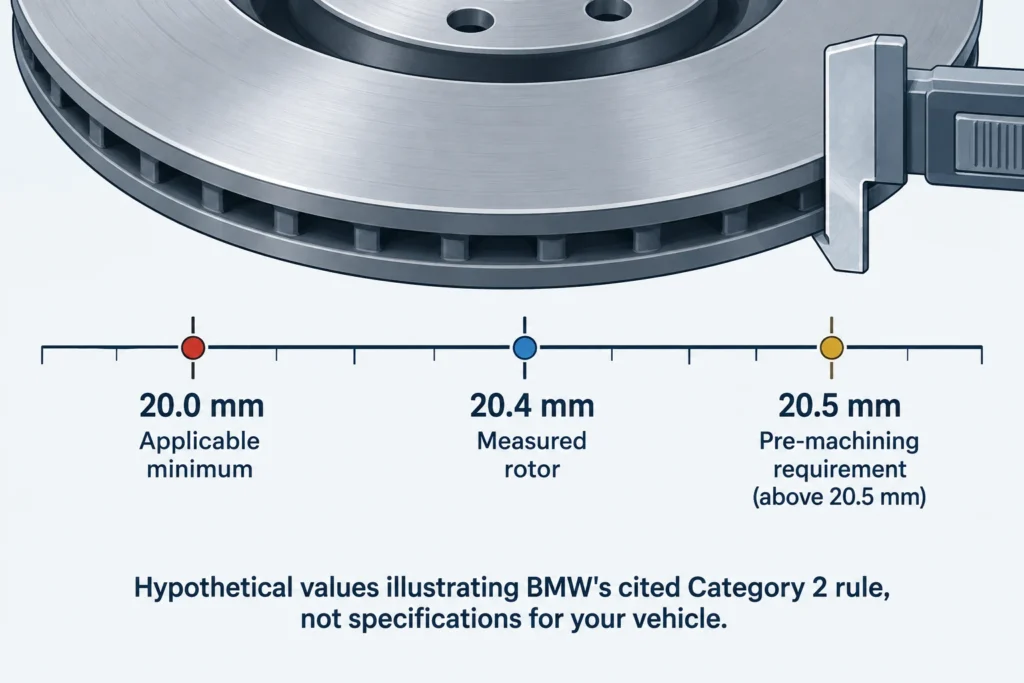
BMW has the old Category 2 procedure clearly documented. It shows, for example, that measured thickness must be greater than the applicable minimum by 0.5 mm before machining, and finished thickness after the process must be documented. With a hypothetical minimum of 20.0 mm, a 20.4 mm reading clears the minimum but fails the machining entry requirement of more than 20.5 mm. The small gap changes the available repair. The specs shown are not the specs for your car, and there are application and procedure exclusions in the bulletin. Like the GM example, it explains the difference, but is not current repair guidance for all vehicles.[2][3]
Enough metal doesn’t mean an acceptable rotor
Thickness variation across the friction surface of a rotor can cause vibration. Installed lateral runout of a rotor can cause uneven wear and other issues, so one adequate thickness reading does not address both questions.[1][2]
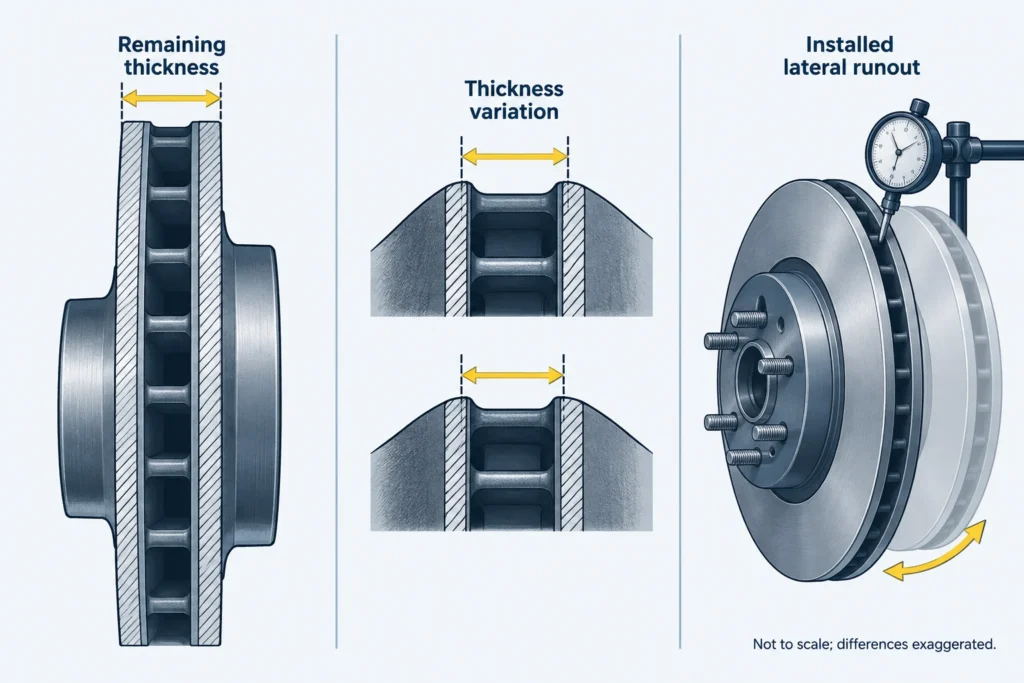
A thickness measurement can confirm a vibration, but it does not define the cause or prove a rotor is bad. Vibration can be caused by many factors including but not limited to dirty mounting interfaces, and a hub that is not clean. A new rotor does not address those issues.[1][2][4]
All visible marks should be considered. Not every line should be disqualifying for scoring. What’s important is if there is an acceptable friction surface left after the removal of corrosion, grooves, or wear, or if it can be corrected with the material allowed. There are cases where heat damage is so extreme it destroys the rotor, and in Mazda’s judder guidance, heat cracking is an example of extreme heat damage where they would replace the rotor. A color change does not always mean that’s the case.[3][4]
You can ask the customer to describe the problem and post pictures. You do not need to become the person with the tools to answer the question. A quick look through the wheel can not answer this question. Leave disassembly, measurements, and diagnosis to a competent person. Request the person connect the finding to the proposed repair.
Turn the rotor charge into a specific explanation
Ask, “For each rotor you are recommending replacement, what measurement, defect, or vehicle specific requirement supports that it cannot be reused or machined?” This is not an accusatory question, and I like this question because it allows a repair to stand on its own justification instead of making a guess as to whether a larger bill is justified.
- Thickness readings based on rotor position, including any applicable discard limits and finished thickness or pre-machining requirements.
- For vibration-related work, include the applicable thickness-variation or installed-runout readings and their limits.
- For damage, include location and type of scoring, corrosion, cracking, or excessive heat damage, not just “worn rotors.”
- The procedure that applies to your VIN, brake package and rotor construction, with reuse, machining or replacement specified in the quote.
If more than one repair meets the applicable requirements, then compare the total installed cost and the warranty terms. Replacement may be a purchasing preference, and that should be discussed. I would pay for new rotors if that is what the condition or the procedure calls for. If reuse or machining is also allowed, you should understand what the additional cost buys before making a decision.
Sources and references
- Chevrolet: Brake Part Service and Repair
- General Motors; hosted by NHTSA: 00-05-22-002N: Disc Brake Warranty Service and Procedures (2013-06)
- BMW of North America; hosted by NHTSA: SI B34 10 16: Brake Pad Maintenance Services, Brake Disc Resurfacing Guidelines (2018-09-10)
- Mazda North American Operations; hosted by NHTSA: SA-055/25: Brake Noise, Judder and Dragging Diagnosis and Servicing (2025-11-25)
- Brembo: Minimum Brake Disc Thickness