

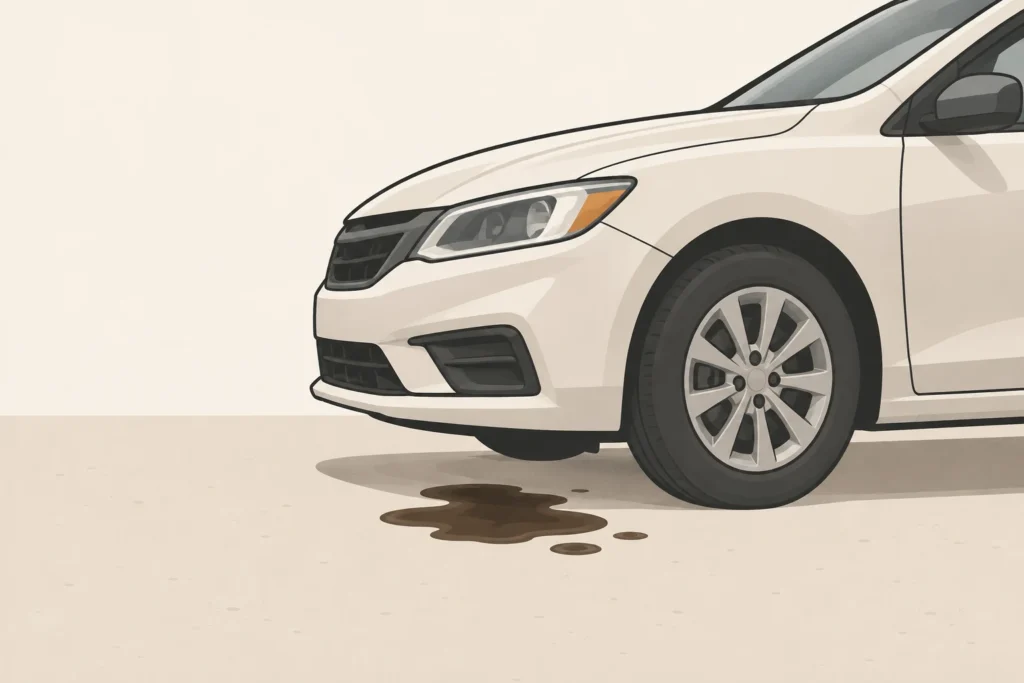
If you see an oil-pressure warning when the engine is on, turn off the engine after pulling over safely, even if the dipstick reads normal. Active significant loss justifies recovery instead of a test drive, as does suspected oil on hot exhaust components. Smoke means pull over and evaluate risk before proceeding; suspected fire means evacuate the vehicle and call 911. Old stains by themselves without accompanying fresh leaks or a level drop are a much less urgent observation, not automatic clearance to drive.[1][3][4][5]
If you believe your vehicle is on fire, turn off the engine after stopping safely, evacuate all occupants, and do not open the hood or return to the vehicle. The US Fire Administration recommends moving to a location at least 100 feet away from traffic, calling 911, and waiting for help. Don’t check your oil level if you believe your engine may be on fire.[5]
Read pressure and level separately
The dipstick indicates how much oil is in the engine, not whether there is enough oil pressure for safe operation. Ford’s instructions tell the driver to stop and turn off the engine if an oil-pressure warning comes on while driving, and describe a warning despite a sufficient oil level as a malfunction that needs repair. Assume there is a problem rather than guessing you have a bad sensor or restarting repeatedly to see if the warning goes away.[1]
Know what message you are seeing: oil pressure, low oil level, and oil change are different warnings. Refer to your vehicle’s manual to decipher the warnings; the icon may not be distinct enough to know what is displayed. An illuminated lamp with the ignition on and engine off is also a different condition than one that appears while the engine is on.[1]
Imagine a driver notices a new oil spot on the ground and adds oil until the dipstick reads normal. On the prior drive, the oil-pressure warning came on. Excited about the full dipstick, that driver re-checks the oil level and it still reads normal. That second dipstick check only answers the quantity question. It does not provide a definitive answer to why the warning came on. Requesting a tow instead of driving is the correct outcome. Performing a successful top-off does not override the previous warning.[1]
Establish whether the evidence is fresh
Old stains or dusty residue on their own do not prove active loss. Nearby drops, wetness returning after wiping, or newly deposited fluid beneath the vehicle are better indicators of leakage. GM’s service information differentiates between seepage/staining and leakage with droplets or fluid transfer onto other parts. Understanding that difference may eliminate unnecessary part replacement. However, GM’s definitions of seepage versus leakage are service information published for that company’s vehicles and are not intended as testing methods to universally determine if a car is safe to drive.[3]
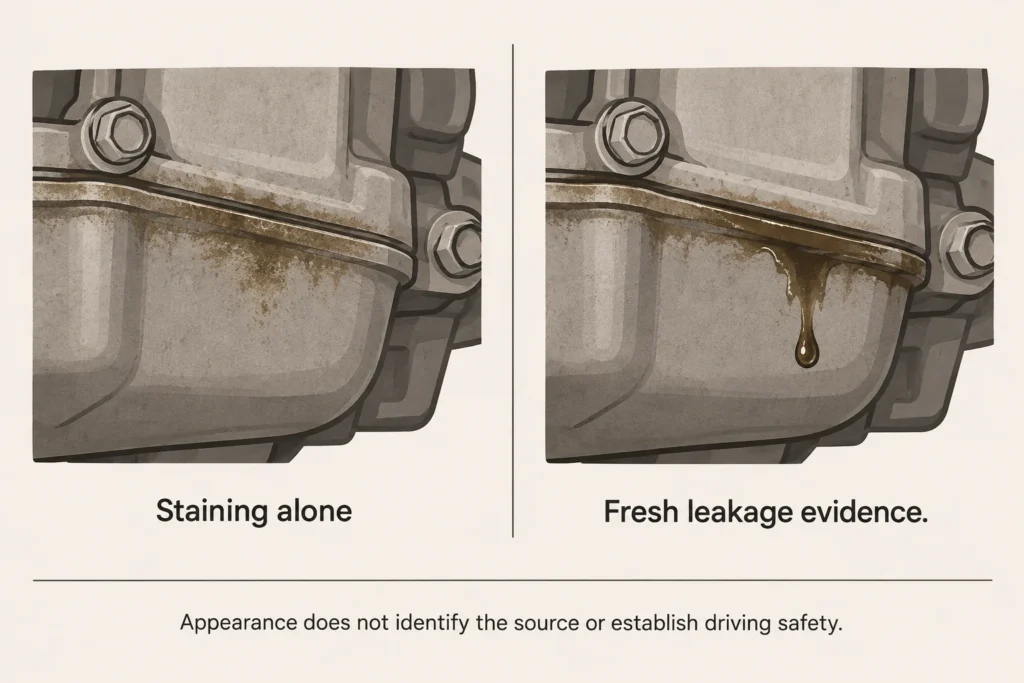
Checking underneath should only be done from safely outside the vehicle with the engine off. Capture photos of visible fluid and watch for reappearance during a period you know the car was parked. Do not crawl under a vehicle that is not raised on jackstands, reach near hot engine parts, or start the engine to repeat the observed leak. Color and location of a spot can’t always reveal its source, and a clean parking lot doesn’t guarantee there was no leak while driving.[3]
Verify the same ground clearance, engine off/on requirement, and wait time for drain-back before comparing readings. Clean off the dipstick and ensure it is fully seated at the tip before reading the painted markers. Ford references checking before starting the engine or waiting 15 minutes after shutdown; that amount is an example and should not be treated as necessarily applicable to your vehicle. If a procedure calls for running the engine in a situation you do not feel is safe, request roadside service.[2]
Write down the level, date, mileage, and amount and type if you added oil according to your vehicle’s minimum and full marks. Repeating the check over time and seeing the level go down proves there is a loss of quantity. It does not prove the leak is externally accessible. If the dipstick reads below minimum or shows no oil when checked properly, don’t start the engine to conduct further investigation. Demonstrating proper oil quantity still leaves open how fast it will continue to leak and where it is going.[2]
Leak location changes the risk
Engine oil leaking onto an exhaust manifold has been documented by NHTSA recall filings as causing fires. That does not mean your oil leak will automatically lead to fire. However, if you observe fresh oil and smoke or smell something burning, shut down and investigate before driving, especially if you can’t see where the leak is going. Smoke and smell coming from your vehicle when the engine is off are not necessarily an indication of fire.[4]
Choose transport and request evidence
Have your vehicle towed if you received a pressure warning with the engine running, suspect rapid or significant loss, see the dipstick level quickly decrease after checking, or think oil is going onto hot parts. Only a lack of warning, old stains, verified proper level with no recent loss, and no smoke or odors when starting or driving indicate it may be safer to schedule service rather than immediate recovery. A drive to the shop may be reasonable if little or no leakage is suspected, but there is no defined puddle size, drip rate, or mileage that automatically means you can drive.
Provide the technician with the exact warning received and when, service records near that mileage that list the level, how much was added/re-filled and what type of oil, any photos you took, and a description if you recently had the oil serviced. Request identification of where the oil is going from operating surfaces before agreeing to replacement parts. If a pressure warning appeared on your dashboard, ask for the conditions under which the pressure was tested, what the reading was, and what specification it should meet instead of simply verifying the oil level is full.
Sources and references
- Ford Motor Company: 2025 F-150 Owner's Manual: Engine Oil, Warning Lamps
- Ford Motor Company: Owner's Manual: Checking the Engine Oil Level
- General Motors; hosted by NHTSA: Bulletin 15-00-89-004D: Differences Between Fluid Leakage and Seepage (2022-02)
- National Highway Traffic Safety Administration: NHTSA acknowledgment of Hyundai recall 19V-538
- US Fire Administration: Vehicle Fire Safety