

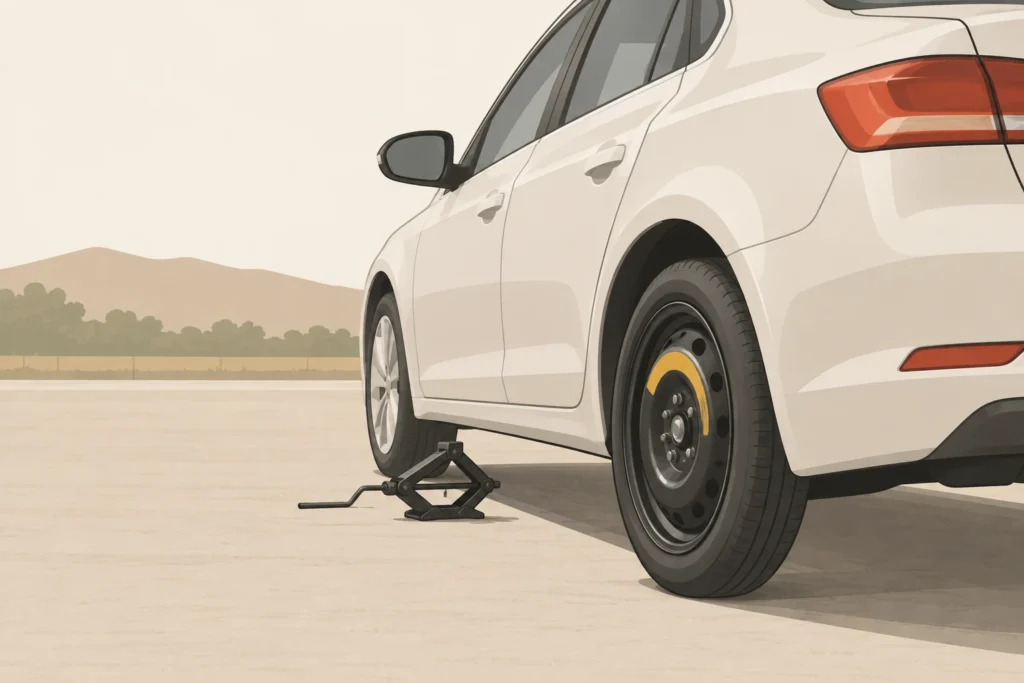
Just because your tire service appointment isn't until next week doesn't mean you can use your unapproved temporary spare for a normal week of driving. The questions are different when a vehicle has been parked for days versus used for daily commuting. Approval for use is based upon the type of installed spare and its condition as well as the vehicle and tire information regarding speed rating, distance limitations, inflation pressure and mounted position, not just how many days have passed.[2][4]
Identify the spare before planning travel
A temporary spare is meant to be limited-emergency-use equipment. Even replacements that appear to be normal wheels can be temporary or mismatched full-size spares. Only an actual matching full-size spare is considered normal-use equipment depending on its condition and your vehicle's tire standards. Consult the markings on the installed tire and the owner's manual spare designation; appearance alone does not determine allowance.[1]
For example, the 2012 Ford F-150 Owner’s Guide distinguishes a labeled full-size temporary spare with a 50-mph ceiling from an unlabeled full-size dissimilar spare with a 70-mph ceiling. Those are limits for that vehicle’s specified spare categories, not numbers to transfer to another car. If someone substituted a spare, confirm that its tire size and wheel assembly are approved for your exact vehicle before relying on the original spare instructions.[1]
Pressure and condition can rule out driving
Refer to your vehicle documentation for the spare-specific cold inflation requirement, and then read the installed spare's markings. Don't default to matching normal road-tire pressure or blindly use a generic sidewall maximum as your operating target. Michelin recommends that temporary-spare users follow the sidewall inflation, speed and mileage limitations. Should the vehicle requirement and installed tire markings seem to conflict, consult with a qualified tire service to verify both the assembly and required pressure; selecting the lower number won't magically fix the conflict.[3][4]
Trust a pressure gauge, not looks. Per NHTSA, "cold" means the tires have not been on a vehicle which has been driven for at least 3 hours. Fix an underinflated spare prior to driving on it. Cracks, bulges, visible damage, or frequent loss of pressure warrant evaluation instead of re-inflation and more miles. Minimal tread wear does not equate to good condition: rarely driven spares can still deteriorate.[3]
Speed is only one restriction
Verify the speed limit, any mileage credit, emergency language, specific axle placement, and payload/towing/drivetrain operation restrictions. All that apply must be met. If multiple instructions allow the same operation but differ numerically, the more restrictive applies. An "X" in place of a mileage maximum does not void the condition to only temporarily use the spare and to get serviced quickly.[1][2][4]
Axle placement can change whether the current installation is acceptable. The 2024 Mazda3 manual requires its temporary spare at the rear; when a front tire needs replacement, it directs moving a regular rear tire forward and installing the spare at the rear. That is a Mazda3 instruction, not a universal rear-placement rule. AWD or 4WD restrictions likewise require the exact vehicle instructions, not an assumption that every compact spare damages the drivetrain or needs the same procedure.[1][2]
Limited traction will alter handling, braking, stability and dry/wet or summer/winter tire performance. The speed limit is not necessarily a safe driving speed for current conditions. Increase following distance. Avoid sudden steering or braking maneuvers. If you experience new vibration, abnormal tire noise, or loss of control, STOP AS SAFELY AS POSSIBLE AND ARRANGE FOR ASSISTANCE. Do NOT continue driving to see if it goes away.[1][2][3]
Does the planned travel fit the instructions?
Suppose the spare has already traveled 12 miles. Five 16-mile round-trip commutes add 80 miles, followed by an 8-mile trip to tire service: 100 miles altogether. Initially, keeping the appointment and commuting below the speed ceiling may seem acceptable. But if the applicable instructions are those for the 2024 Mazda3, emergency use only, for a very short period, with extended use prohibited, the commute plan does not fit, even though that manual page supplies no numeric distance allowance.[2]
Evaluate the direct 8-mile service journey separately: verify pressure, condition, compatibility, axle placement, and every applicable limit, then choose a route that fits them. Its shorter distance does not itself certify safety. If those requirements are satisfied, a restricted service trip may be appropriate; ordinary weekly use is a different proposal.
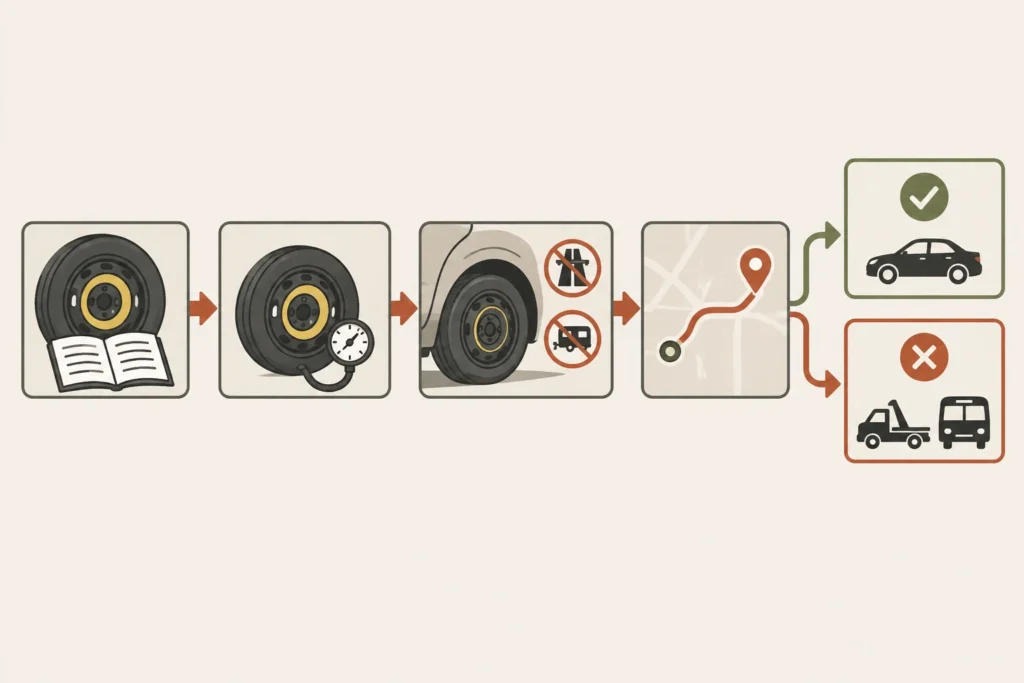
If routing, installation, or condition cannot allow for requirements to be met, utilize alternate transportation while making arrangements for towing or mobile tire service. Alternately, leave the car parked and transport the removed wheel to the shop via another vehicle; inquire if the shop can service that wheel separately, and what will be required to reinstall it. Appointment delay does not have to equal more spare-tire driving.
Sources and references
- Ford Motor Company: 2012 F-150 Owner's Guide, second printing, pages 347-349
- Mazda North American Operations: 2024 Mazda3 Owner's Manual, Spare Tire
- National Highway Traffic Safety Administration: TireWise, Tires
- Michelin USA: Symptom: Damage that Requires Repair (2026-04-21)