

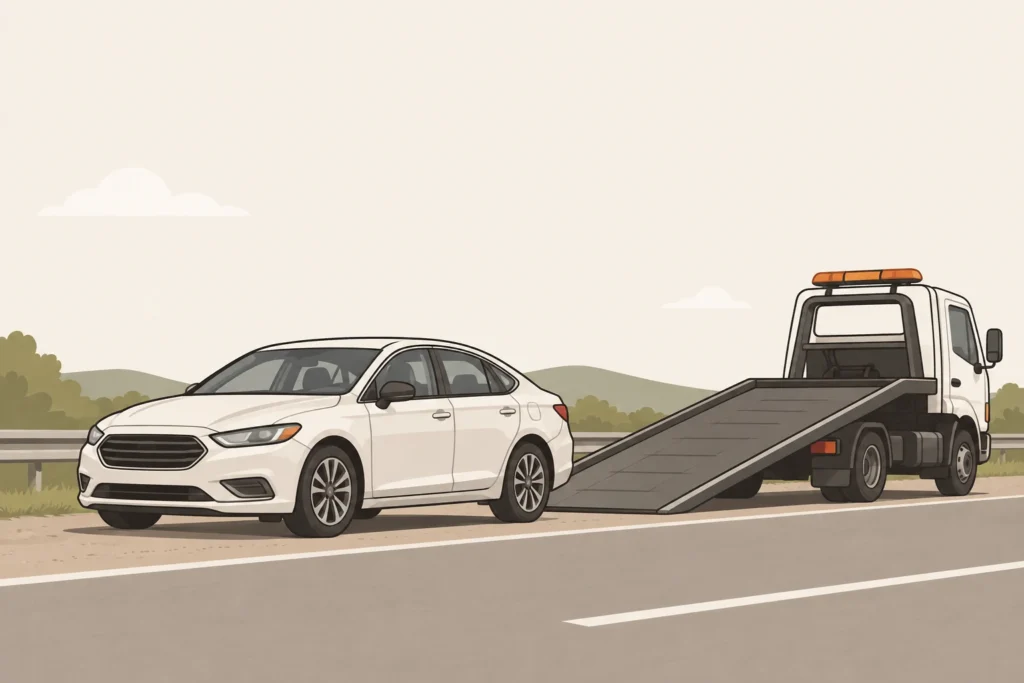
1. Steer and brake toward safety
Maintain control of the car. Use hazard lights if control allows. Move away from traffic along a safe path. If you are having trouble steering or braking, expect the situation to get worse. More force will be required to apply the brakes and to steer. The more control of the car is lost, the greater the safe distance that must be maintained, and the higher the force required to steer and brake. Reduced control of the car does not mean that complete control is lost.[1][2][3]
Apply constant, firm pressure to the brake pedal rather than pumping it. In a system that retains stored brake assistance, repeated applications can consume that reserve, while the engine is not running. A harder pedal may require a significantly greater effort; however, do not assume that means the brake system is failing.[3]
Do not include a standard key-turn, start-button, gear selection, or rolling restart maneuver. An engine stall and intentional ignition shut-off are distinct actions: Ford warns that shutting off the ignition while the vehicle is in motion can disable electrical circuits, including airbags. The emergency instructions for your vehicle determine whether a restart in motion is permitted, and in which situations. The primary goal is a controlled stop, preferably in a position outside active travel lanes, not a restart of the engine at operating speed.[1][2]
2. Protect occupants and summon help
Secure the vehicle using your parking procedure and assess the situation before evaluating the vehicle. Should you be stopped in an active lane and be in danger of being struck, contact 911 and advise them of the blockage. If you are safely off the roadway, contact roadside assistance and give the road, direction of travel, the nearest exit or mile marker, and whether you are in a travel lane or on the shoulder.[4][5]
In the absence of an emergency, the default when on a freeway is to stay in the vehicle, with the seat belt on. This is not a hard and fast rule. If it becomes necessary to evacuate and a safe route is available, avoid traffic and get to a safe location. Do not cross through active lanes of traffic. Follow the directions of the dispatcher. If they tell you to leave the vehicle, do not stand by it to investigate or try to push it through traffic.[4][5]
Suspected fire overrides the stay-inside default. Evacuate, move at least 100 feet away and clear of traffic, then call 911. Do not open the hood or trunk. If the vehicle is blocking a railroad crossing and tracks, evacuate all occupants away from the tracks, and call 911, only if a train is approaching. If a train is not approaching, call the railroad emergency number and provide the crossing identification. Do not try to restart the vehicle.[5][6]
3. Choose towing over uncertain travel
Better to have towing arranged for an unexplained moving stall than to take a test drive to assess engine reliability. Restarting confirms only that the engine can run again. It doesn’t explain the shutdown, and it doesn’t provide a safe, dependable distance. Re-entering the freeway after a restart on the shoulder would expose you to the same loss of power risk while merging or while traveling at speed.
Indications that towing is warranted include repeated stalls, rough running, abnormal steering or braking, new knocking or grinding, as well as oil pressure warnings and/or overheating while the engine is running. In these cases, the engine should be safely stopped and shut down. The engine should not continue to run to see if the warning clears. If there is a suspected fire, an evacuation response should take priority over a tow request.[6][7]
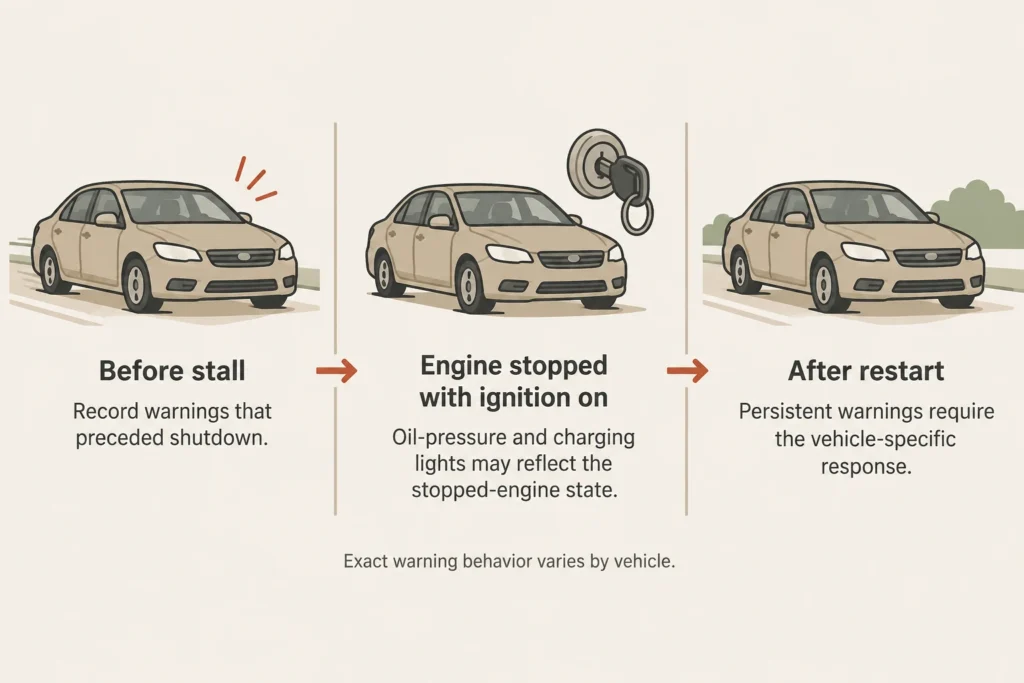
Incorrect interpretations of dashboard lights occur because of timing. Oil-pressure and charging lights come on with the ignition on and the engine stopped. They may come on after a stall, but their appearance doesn’t always mean the cause of the stall is known. A warning that occurs before a shutdown or remains after a restart carries more significance. Check your owner’s manual for the correct response to each dashboard light with the engine running, and don’t assume that every warning light that appears after a stall is a component failure.[7]
4. Record observations for the technician
Collect data after occupants are safe. Data may include speed (approximate), engine status (cold, warmed-up), braking, shutting down, stumbling, fuel level, and whether the dash and electrical equipment went dark. Also record any warnings given prior to shutdown with the engine stopped, and any warnings given after restart. If a restart occurs, record behavior and time to delay. Do not attempt to collect data if it may put an officer at risk.
This chronological complaint describes the exact year, model and engine of the vehicle. It requests a diagnosis for the failure, not a replacement based on an estimated component. The shop can check the VIN against recalls on the NHTSA website; however, a clean result does not mean the vehicle is not subject to a recall, nor does it explain the stall. Recently announced recalls may not include all of the affected VINs. In order to help the shop reproduce the failure, do not recreate the failure yourself.[8]
Sources and references
- Kia: If the engine stalls while driving
- Ford: Stopping the Engine When Your Vehicle is Moving
- Kia: Power brakes
- Pennsylvania Department of Transportation: PennDOT Reminds Motorists How to Stay Safe in Case of Emergency (2023-12-21)
- California Department of Motor Vehicles: Section 8: Safe Driving (Continued)
- US Fire Administration: Vehicle Fire Safety
- Kia: Warning lights
- National Highway Traffic Safety Administration: Check for Recalls: Vehicle, Car Seat, Tire, Equipment