

AC that becomes colder as you drive elevates condenser airflow as a key diagnostic branch. It still does not indicate a failed fan, low charge or bad compressor. First find out if the vents blow warmer air or if there is simply less air flow. Those are two different problems; neither means you should recharge or replace components by itself.[1][2]
Separate temperature from airflow
Maintain the same selected blower speed, vent mode, temperature setting and recirculation setting throughout your description of the change. The automatic climate control adjusts blower speed on its own, making the difference hard to notice. Make your observations while parked; don't try to memorize vent placements or write down notes while driving.
| Observation | Diagnostic direction |
|---|---|
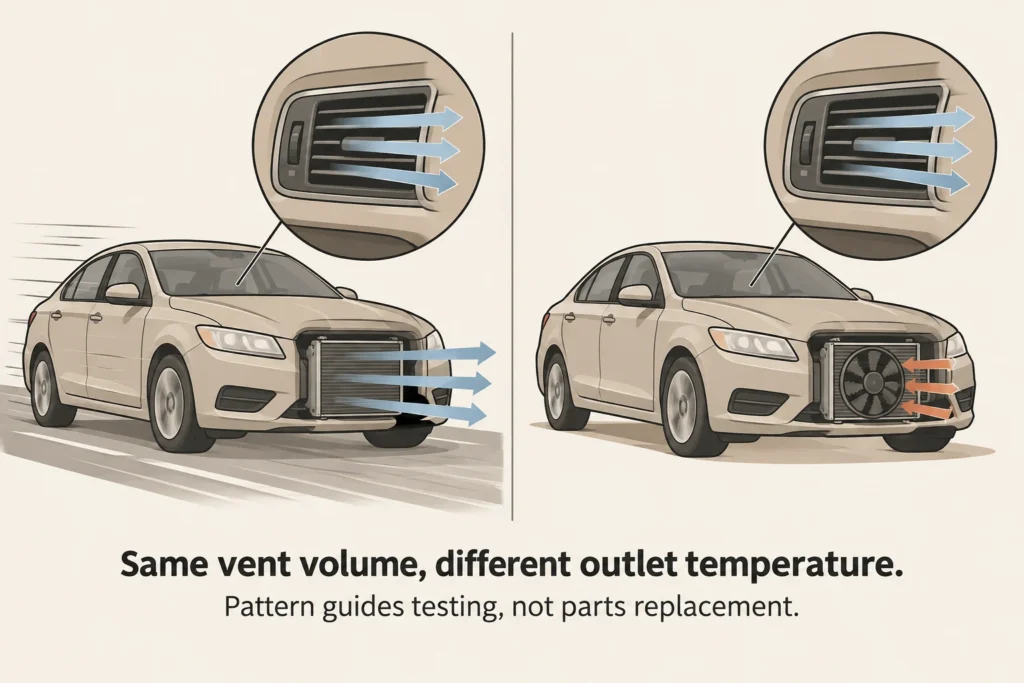
| Air volume stays similar, but outlet air becomes warmer when stopped | Investigate condenser heat rejection, refrigerant-system performance, and compressor/control behavior. |
| Airflow is weak from the start at a fixed blower setting | Investigate the cabin filter, blower operation, and cabin air path. |
| Airflow gradually fades after extended A/C use | Investigate a time-dependent restriction, including possible evaporator icing; a short test may miss it. |
| Warming begins when automatic stop-start shuts off the engine | Separate engine-off behavior from performance with the engine actually idling. |
A clogged cabin filter can cause decreased vent airflow. However, that doesn't explain why the outlet air only heats up while at stoplights. Evaporator icing becomes another possibility when airflow diminishes gradually: General Motors logged that issue on some 2016-2018 Cadillac CT6 models. Use that as evidence to look into when it happens, not to follow their instructions on unrelated vehicles.[2][3]
Why movement can improve cooling
The condenser rejects heat to the ambient air. Moving vehicles create airflow that is not present when stopped; thus, when stationary, the operation of the cooling fan becomes critical. Restricted airflow or debris between condenser and radiator can reduce heat rejection and raise condensing pressure. Just because the fan spins doesn't mean it is putting adequate airflow through the condenser. Diagnosis needs to determine what the fan is commanded to do and what it actually does.[1][2]
Drive-cycle changes also alter engine speed and operating conditions, so this contrast does not isolate airflow differences. Electrically controlled variable compressors need verification of both their control signal and response. Watching a compressor spin does not verify adequate cooling capacity is provided. Improved road-speed cooling performance also cannot verify the quantity of refrigerant. Both over- and undercharge conditions can reduce performance, notes EPA, so a simple top-off leaves you guessing as to how much charge already existed.[1][4]
Keep fingers, clothing, and tools clear of cooling fans. Fans may run after shutdown. Do not jumper relays, command fans on, hook up refrigerant gauges or add refrigerant as part of an owner's check. Paid motor-vehicle refrigerant service must be performed by EPA Section 609-certified technicians using approved refrigerant-handling equipment.[7][8]
Narrow the complaint before the visit
Decreasing vent volume at each stop with consistent temperature increases makes the cabin-airflow branch less likely. With the engine on, automatic engine-stops can't explain those occurrences. If cooling resumes shortly after restarting/recovering there, condenser airflow should be specifically tested, but the variation of engine speed rules out a fan conclusion from that fact alone. Provide the shop with those differences as well as how long the A/C has to run prior to the condition occurring.[1][2][5]
Record that separately if warming triggers automatic engine shutdown. Ford provides comfort-related restart logic for one of their stop-start implementations, but compressor design/restart strategy can differ. The important vehicle-specific details are whether cooling is maintained with the engine off and what cabin demand warrants a restart, instead of whether the vehicle simply has stop-start.[5]
What the shop should document
Ask for outlet temperatures and associated high- and low-side pressures at specified conditions: ambient temperature (and corresponding humidity), HVAC settings, engine speed (or operating mode), and time to stabilize. Kia’s technical service bulletin mentions humidity and control inputs; Mitsubishi’s Outlander PHEV procedure calls for continuous-idling mode and ~10 minutes of stabilization. These examples demonstrate why a temperature or pressure value by itself with no associated test conditions is not a pass/fail result you can port from one vehicle to another.[1][6]
Before giving approval for a fan or compressor, always ask "which commanded response failed?" or "which vehicle-specific diagnostic test failed?" For a charge recommendation, ask "how did you determine how much charge to add?" and "do you think an investigation for leaks is necessary?" Adding charge will not fix a leak. You should also verify the repair by revisiting the original warm-at-idle conditions with the same run time needed to recreate the complaint, instead of just showing cold air after servicing.[1][2][4]
Sources and references
- Kia Motors: Kia Tech Times, Vol. 18, No. 4: A/C Overview, pages 8-9 (2015)
- DENSO Europe: Seven steps of a complete A/C Service, Bulletin 05-AC-2025-EU (2025-07)
- General Motors: PIC6298: Decreased Air Flow from Vents after Extended Drive with Air Conditioning on (2017-08-10)
- US Environmental Protection Agency: Options for Recharging Your Air Conditioner
- Ford Motor Company: Owner's Manual: Unique Driving Characteristics, Auto-Start-Stop
- Mitsubishi Motors: TSB-24-33-001: Service Procedure Changes and Corrections, Service Manual Revision (2024-04)
- US Environmental Protection Agency: Regulatory Requirements for MVAC System Servicing
- Ford Motor Company: Owner's Manual: Maintenance, Engine Cooling Fan