

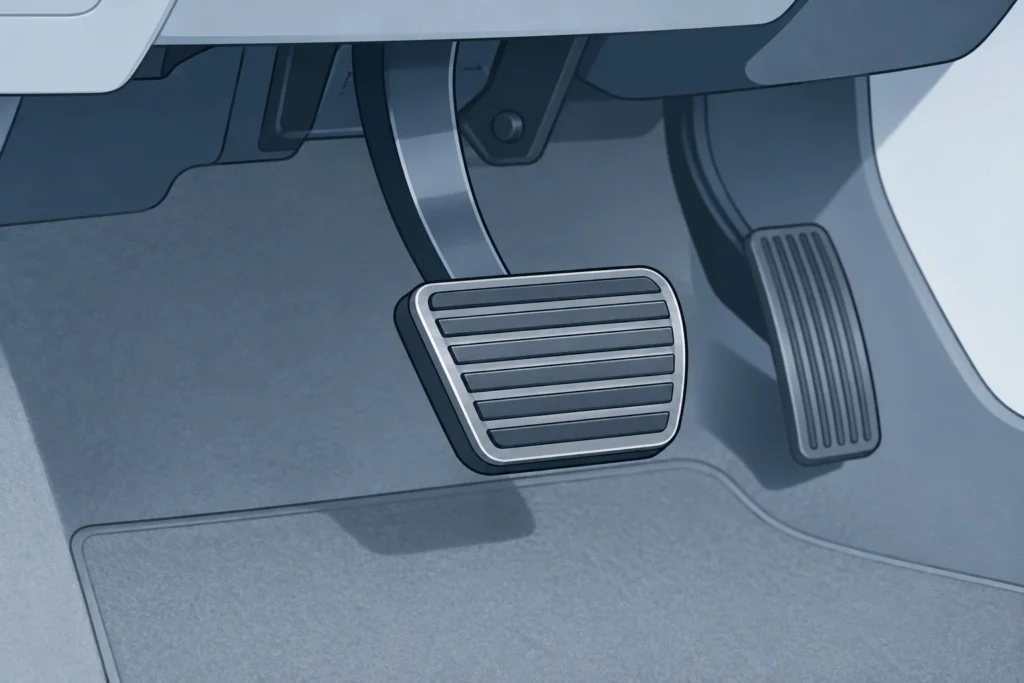
If your brake pedal continues to sink and the feel is unusual or unfamiliar, pull over safely and call for towing. Don't drive to a shop with this problem. A warning light isn't necessary to regard the change as serious.
Constant sinking can mean that the hydraulic system is not retaining pressure, however there are cases where working brake- assist operations have sunk the pedal as well. Tow enables you to make a safe decision rather than guessing at a faulty master cylinder.[2][3][6]
If you experience reduced braking power, pedal nears floorboard, inability to hold the vehicle stationary, or symptoms of brake- fluid leakage, towing is recommended ASAP. Just because your car braked normally prior to these conditions does NOT mean you will be able to stop safely the next time you need to. In fact, Mazda' service manual for the 2007 Mazda6 actually instructs owners not to drive the vehicle at all if the brakes fail — have it towed.[1][2]
Describe the movement, not just a soft pedal
"Sinking" refers to the progression of time: after actuation, the pedal moves further downward as you think you're applying constant pressure with your foot. "Sponginess" refers to the presence of a springy or compressible feeling; "sink" refers to how far your pedal travels before the brakes engage. The two feelings can coincide, but they're not synonymous. Air within a traditional hydraulic system can cause sponginess. Slow sink can be caused by external or internal leakage.[2]
Timing can change the interpretation. A conventional vacuum booster can move the pedal downward as assistance becomes available at engine startup. Honda documents slight pedal sinking when the 2023 Accord Hybrid’s power mode turns ON. Tesla documents further pedal depression as Model 3 Hold initially enables, accompanied by the Hold indicator. These are identified operating events, not permission to dismiss continuing travel because the car is a hybrid or EV.[3][5][6]
The relevant question for your specific year/model/brake setup is "Does this movement correspond to a known operation, trigger, and indicator?" rather than "Is some movement normal?" There is not a defined safe distance/sink rate across all these references. Write down what you already observed. Don't try startups, repeated hard stops, etc. to diagnose/test categorize it.
A full reservoir doesn’t settle the diagnosis
An external leak allows brake fluid to escape the hydraulic system. Internal bypass can allow fluid past a sealing surface without escaping the system. This also defeats pressure retention even though fluid level in the reservoir does not change. Ford's tech info for its conventional system addresses both conditions. Therefore normal fluid level does not rule out an internal problem, and lack of visible leak does not confirm master cylinder fault.[2][4]
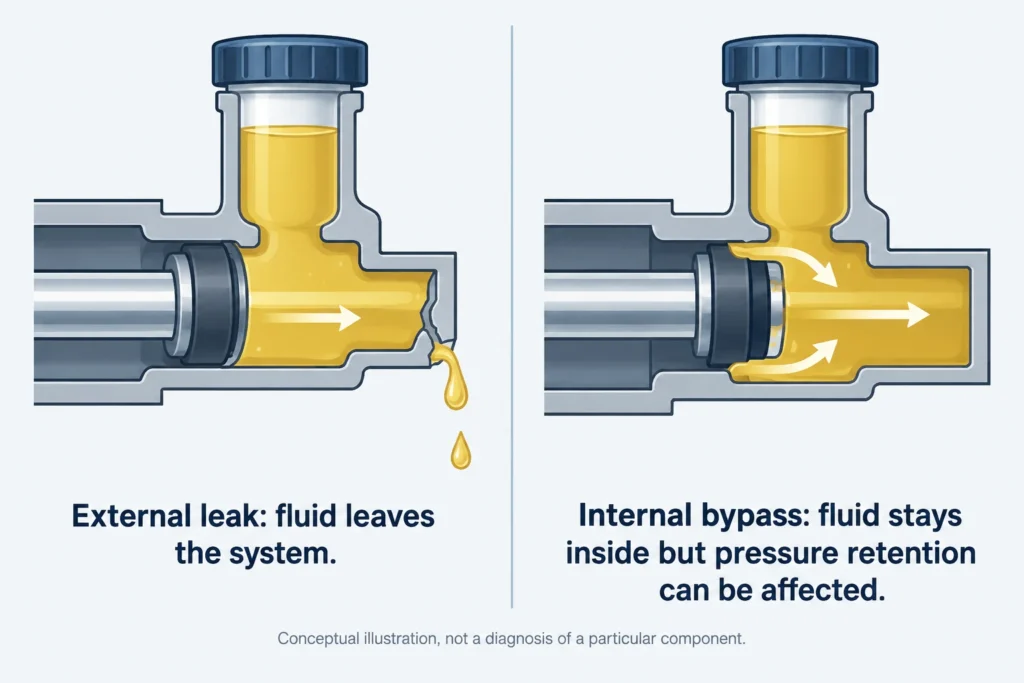
Clearing the codes isn't proof of anything, either. Ford detailed one example of how a hydraulic control unit valve failure could cause long pedal travel without setting any codes. Lengthy travel does not equal constant sinking, and that bulletin doesn't pertain to your car; it explains how "no codes" does not rule out a hydraulic brake issue by itself. Don't let that check there information override a new sinking pedal.[7]
What should support the repair?
Imagine you're at a stoplight and the pedal slowly starts to sink. Brake application has felt normal, there isn't any warning light on, and the reservoir doesn't look low, but none of that means your brakes are holding pressure. Applying while you're already holding won't necessarily transition to a startup or Hold event either. Get it towed instead of driving again to see if it reoccurs.
Write the shop: "Pedal felt normal at first. Then it went on down while my foot was on it at a stop. That has never happened before. No dash light that I could see." Then include vehicle information, any you noticed on startup or Hold connection, any loss of fluid, etc. Recent brake service etc. This allows the technician parameters to go on checking without making your statement into a parts request.
If the suggestion is a master cylinder, I'd request the printed external-leak check AND the corresponding pressure-retain or bypass-test result that qualifies it. I' d want more than "We didn't see a leak" before approving that repair.[4]
Ask for another hydraulic component what vehicle-specific test verifies the finding. For example, Ford’s referenced control-unit procedure required documented results of service functions. Those should be performed by a qualified brake technician, not an owner plugging lines or clamping hoses.[7]
Ask before you pick up the car how they verified the original complaint of sinking after repair and what required completion tests they passed. EC means that prescribed bleeding and electronic verification may be needed. Tesla's at least relevant Model 3 procedure lists a brake-stiffness test. The point of that completion test is for a reason, it's not an end-all master-cylinder diagnostic. Work should be linked by repair report to failed test and verification of the behavior that failed to meet-spec and brought the car in.[8]
Sources and references
- Mazda: 2007 Mazda6 Owner's Manual, brake warnings, printed pages 5-6 through 5-8
- Ford: 1994 Mustang Workshop Manual: Brake Master Cylinder diagnosis
- Ford: 1994 Mustang Workshop Manual: Brake Booster Functional Test
- Ford: 1994 Mustang Workshop Manual: Master Cylinder Bypass Condition, Check
- Honda: Turning on the Power, 2023 Accord Hybrid
- Tesla: Model 3: Normal Operating Sounds
- Ford; hosted by NHTSA: Ford Safety Recall 19S54, Supplement 2 (2021-05-21)
- Tesla: 2017-2023 Model 3 Service Manual: Brake Fluid Bleed, One Caliper (2026-08-28)