

Replacement of brake pads is required when measurement shows the thinnest pad has reached the applicable service limit, or if other conditions (noted in the inspection) warrant pad replacement. If no explanation is given, and you are only given an unexplained number, you should ask for clarification. You should request a second inspection if the explanation is still not sufficient. Normal feeling brakes do not discount documented wear, but “Pads Low” does not explain the cost of the service.[1][2][4]
There are exceptions to this. If the condition of the braking system is such that it compromises the vehicle’s safety, you should stop and arrange for a tow, and not drive to different facilities for competitive quotes. In such a case, it is better to not drive the vehicle at all. If you receive a brake system warning, stop in a safe location, and have the warning evaluated, prior to continuing to drive the vehicle.[5]
Which pad does that number describe?
Picture me, in an imagined service-counter exchange, holding an estimate that says only “rear pads low” while my ride home waits outside. I’m annoyed, not because the work must be unnecessary, but because I can’t tell what I’m approving. Instead of asking for a discount, I ask for the left and right inner and outer readings, in millimeters, and the applicable limit. That’s the missing information.
You would need the thickness of the friction material, not the metal backing plate, for the wheel and inner or outer pad identified, along with any localized thin areas. Averaging the thickness of the pads on an axle may hide the pad that needs replacing, and a quick look through the wheel may only show the thicker outer pad. This is not just a theoretical situation. In fact, Tesla’s inspection procedure states that both pads at each wheel need to be inspected and GM has a model-specific bulletin showing an exhausted inner pad on one side with the other pads still having material.[1][2][3]
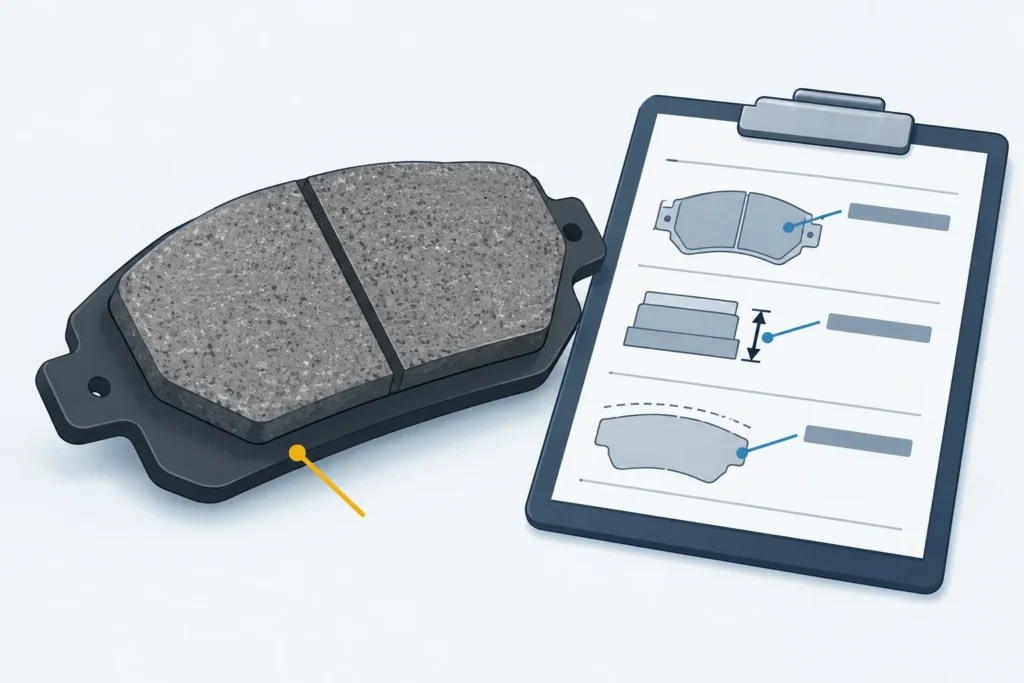
This changes the decision process. Let’s say you are inspecting a 2017-2023 non-Performance Model 3 rear axle. Take measurements of LH inner 1.5 mm, LH outer 4.5 mm, RH inner 4.0 mm and RH outer 4.5 mm. Tesla’s technical table gives that configuration a 2-mm rear limit, so the 1.5-mm inner pad supports replacement even though the other three are thicker. However, the uneven wear should also be examined and addressed. The worn pads should be replaced and the cause of the faster pad wear should also be addressed.[1][3]
A factory limit and an earlier recommendation aren't the same
This limit also needs to be matched to your vehicle, even manufacturer documentation leaves questions. For the 2017-2023 Model 3, Tesla’s comprehensive inspection includes a general 2-mm replacement note, but its technical table lists 2.8 mm for non-Performance front pads. I wouldn’t use the general note as permission to wait below that configuration-specific limit. Ask the shop which spec applies to your brakes and how they resolve conflicting instructions.[1][2]
Replacing the pads earlier than needed can still be useful, especially if the shop expects the pads to reach their limit before your next inspection or if there is heavy use soon. The reason I want to know is now, not why the shop does it based on a supposed factory requirement. MAP's public standards overview differentiates required services from suggested ones. It does not establish a universal pad replacement threshold.[4]
| Finding | Reasonable next decision |
|---|---|
| Limiting pad reaches the applicable limit, or another replacement condition is documented | Authorize supported replacement; address abnormal wear if present. |
| Pads remain above the limit, but the shop explains why waiting is impractical | Consider earlier replacement as a preventive recommendation. |
| Pads remain serviceable, with no unresolved abnormal condition | Agree on a documented recheck date and mileage. |
| Pad locations, measurements, or the applicable limit are missing or disputed | Request clarification; obtain a second inspection if the gap remains. |
Separate pad wear from the rest of the estimate
Unexpected variation in readings cannot be explained by caliper wear. Variation and reasons for it differ by brake design and wear pattern; addressing binding and hydraulic restriction comes before determining the cause and drawing parts conclusions, as explained in GM’s archival, model-specific bulletins. Be aware of what tests and diagnoses the shop claims to have performed before replacing parts. I don’t want you paying to replace a symptom when the true cause of the issue remains.[3]
Treat the rotor line on the estimate as another question, not the automatic conclusion of a worn pad order. Justification for replacement of the rotors could include measurable thickness against a limit, surface damage, etc. Findings from your vehicle’s IP may also be available. A justified pad replacement doesn’t justify every rotor quoted with it.[1][2][3]
If you wait, book the recheck
Bring the first report to a second inspection and ask the shop to explain the pad thickness findings and related specifications, not just give you a lower quote. If findings show pad thickness is within tolerance, agree on a recorded re-inspection date and odometer reading, whichever comes first, based on your use of the vehicle. Record which pad locations need to be reassessed. Just because a pad has a certain thickness, doesn’t mean it’s going to last that long, and “we’ll look at it later” doesn’t help.
Sources and references
- Tesla: 2017-2023 Model 3 Service Manual: Brakes
- Tesla: 2017-2023 Model 3 Service Manual: Comprehensive Vehicle Inspection (2026-09-29)
- General Motors; hosted by NHTSA: GM Bulletin 19-NA-116: Pulse, Grinding, Scraping Noise from Brakes, Uneven Front Brake Pad Wear (2020-11)
- Automotive Maintenance and Repair Association: AMRA: What We Do
- Tesla: Model 3 DIY Guide: Checking Brake Fluid