

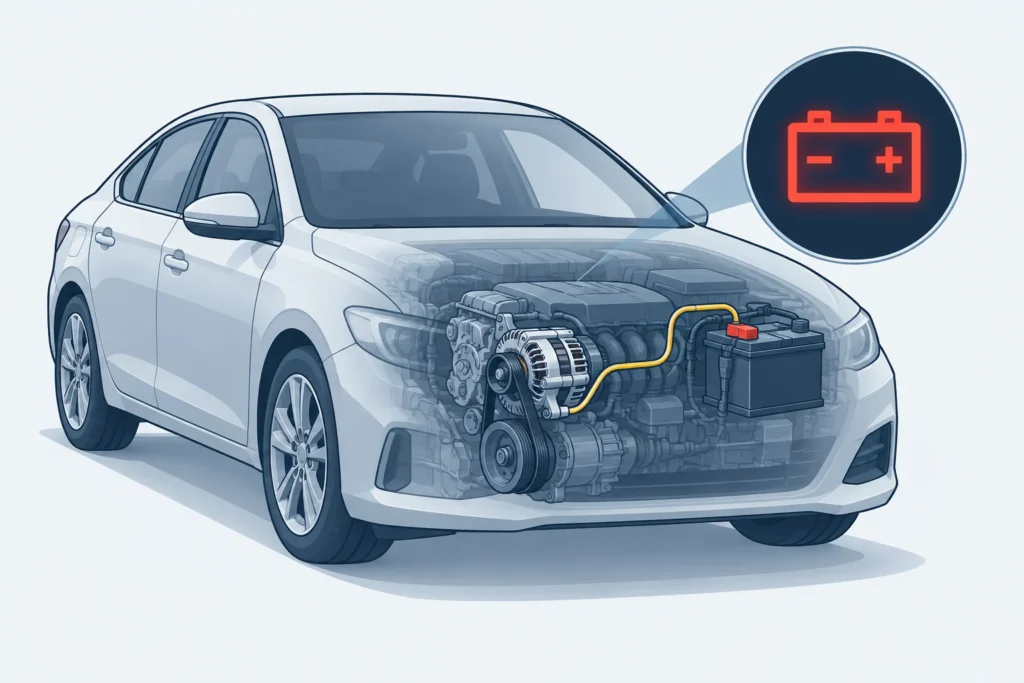
Don’t keep driving just because your car still feels normal. A battery warning while driving means the charging system has failed and not necessarily the battery has failed. Get off the road to a safe location. If you can’t resolve charging, get your car towed or assessed. A temperature warning, heavier steering, or engine that’s stumbling and losing power means you should pull over immediately.[1][2][5][6]
I wouldn’t promise you another five miles, or even the distance home, with a brand-new battery. Stored charge, electrical demand, and the fault itself vary. The light isn’t a countdown, and an engine that sounds fine now can still stop unexpectedly.[1][3]
The battery picture is a misleadingly specific clue
In most cases, the alternator is responsible for charging the battery, and providing power to the rest of the vehicle while it's running. A battery-shaped lamp lights up when the car is first turned on to let the driver know the charging system is still functioning. That lamp should go off once the engine starts running. A lamp that’s illuminated while driving means there is an issue with the charging system, or something is preventing the battery from being charged.[3][4]
A warning light is not an identifies the failed part, and when a charging system is not functioning, several components could be at fault. Replacing the battery is not going to resolve a slipping alternator belt or a bad connection.[3][4]
Picture me, in an imagined example, leaving the grocery store with frozen food in the trunk and a battery receipt still in the glove box. The light comes on, and my first reaction is annoyance: didn’t I just pay to fix this? I’m tempted to head home because the engine sounds fine. Instead, I take the next safe place to stop and arrange help. The receipt explains my surprise; it doesn’t explain the warning.
Not every car uses an alternator for this job. The Toyota Camry Hybrid described in Toyota’s documentation supplies low-voltage power through a DC/DC converter and can be operational in READY while its gasoline engine is stopped. Your powertrain matters before anyone names the failed part. Leave high-voltage components alone; this distinction helps explain the diagnosis, not give you something to inspect.[8]
What changes the stopping decision
Vehicle instructions aren’t interchangeable. Mazda’s 2024 MX-5 manual says to park safely immediately and not continue driving with the charging warning illuminated because the engine could stop. The consulted Ford Ranger manual says to switch off unnecessary electrical equipment and have the vehicle inspected immediately. Neither gives you a dependable distance to drive. Once stopped, look up the charging-warning entry for your exact year and powertrain, including any dashboard message, not just the icon.[1][2]
Upon locating a safe stopping place, reducing needless demand may mean turning off seat heaters or the audio system. Keep the headlights and defogging equipment on to improve visibility. Load reduction is not a repair. I wouldn't use it to warrant extending the trip.[2]
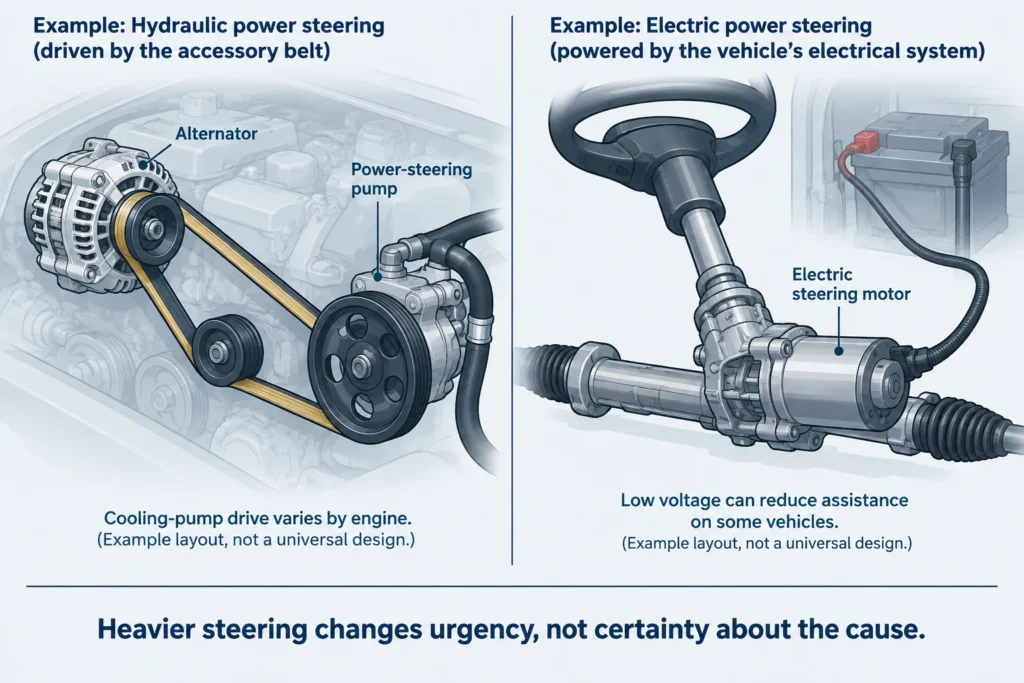
- A rising temperature gauge creates concern about cooling as well as charging. On some engines, the accessory drive turns the water pump; others use a different drive or an electric water pump. Stop and turn off the engine; the best course of action is to get a tow.
- Sudden, heavier steering reduces maneuverability. A low voltage condition can also reduce the level of steering assist on some vehicles. Stop safely and get a tow; the symptom does not determine the cause of the failure.
- New belt squealing or slapping in addition to a warning lamp suggests a drive problem worth investigating. Other symptoms such as a multiplying number of warnings, dimming lights, stumbling or a loss of power suggest a deteriorating condition and indicate an electrical problem. Don’t keep traveling to determine what happens next.
A disappearing light is useful information, not an all-clear
A successful restart does not mean charging is working properly; a charging system is sometimes intermittent. I would appreciate the quiet dashboard, but not at the expense of resetting the warning condition.[3][4]
While parked, note the message and what was happening when it appeared: idle speed or road speed, a warm engine, rain, electrical loads coming on, noise, steering changes, dimming, and temperature warnings. Mention any recent battery replacements. Photograph the dashboard while stopped. Don’t inspect belts while the engine is running, disconnect the battery as a charging system test, probe roadside wiring, or restart to reproduce the message. Your info can help the shop without turning the roadside into a testing location.[3][4]
Before buying parts, ask where charging failed
I’d like to know if the system is not producing enough power or if power is being lost on the circuit. The shop can determine that by comparing charging system output with your vehicle’s specifications, at the relevant operating conditions and loads, and checking the belt drive, if applicable, and measuring voltage drop on the positive and ground circuit while current is flowing. With some electronic systems, it may be necessary to check fault codes, commands, and input sensors, as well as communication. Your info can help the shop more than an alternator guess.[3][4][7]
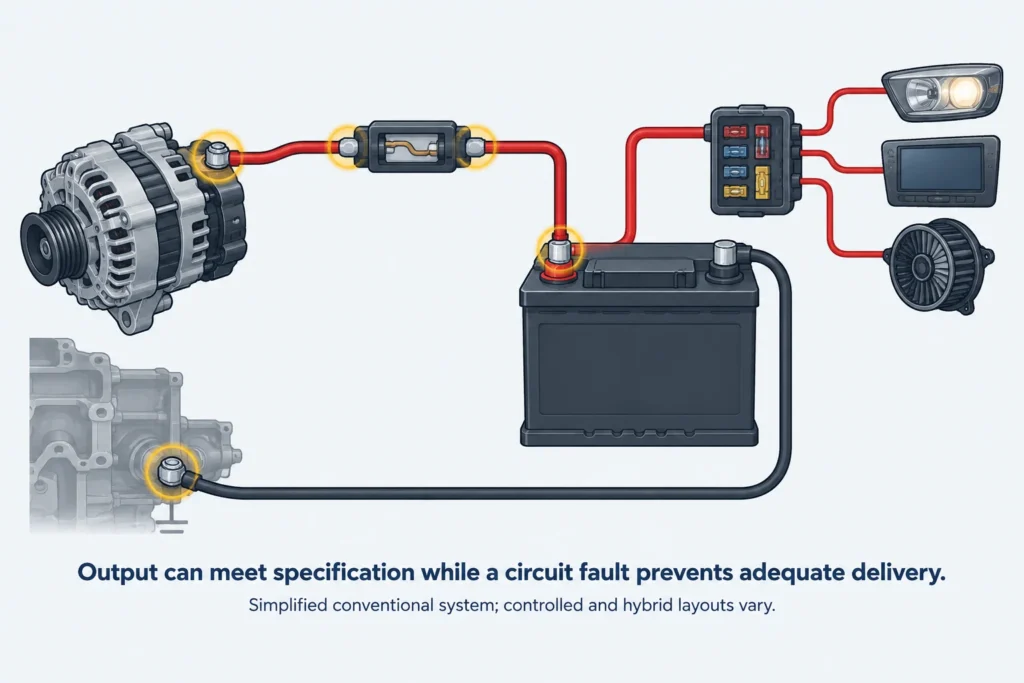
A bad connection can lose voltage under load even if the alternator is functioning correctly. If the output of the alternator is within specifications but a voltage drop test reveals the connection is bad, the bad connection needs to be repaired, not the alternator. Replacing the alternator would not be correct in this instance. These are the kind of checks and tests I would want done before paying for a new alternator.[3][4]
One reading is not a verdict. “GM bulletin 07-06-03-009C” documents an intent of 12.6-13.1 volts in fuel economy mode for the listed vehicles. This doesn’t make those readings right for all vehicles or justify an active warning. This shows why the technician needs the correct charging strategy and test procedure instead of just a memorized number.[7]
Before parts approval, I’d ask “Which test failed, and how does this part address that?” The battery also needs evaluation based on its state of charge. A completely discharged battery may need a charge and reassessment as opposed to being replaced. In the case of a repair, ask for charging and circuit evaluation under the same circumstances as the original concern. If the concern couldn’t be reproduced, the report should say that. “A passing test is a good thing; I just want to know if that test explained the original concern.”[3][4]
Sources and references
- Mazda USA: 2024 Mazda MX-5 Owner's Manual: charging-system warning
- Ford Motor Company: Ford Ranger Owner's Manual: warning lamps and indicators
- DENSO: Alternator troubleshooting (2022-03-31)
- DENSO: DENSO TechTip: Diagnosing Alternator Faults the Right Way (2026-05-20)
- Gates: Gates technical bulletin TSB_054_US: Pulley Alignment & Tension
- National Highway Traffic Safety Administration: NHTSA notice discussing Ford electric power-assisted steering and low system voltage (2018-06-21)
- General Motors; hosted by NHTSA: GM bulletin 07-06-03-009C: Voltmeter Gauge Fluctuation Due to Regulated Voltage Control (2015-01)
- Toyota: Toyota Camry Hybrid dismantling manual