

Tire replacement decisions rarely come down to mileage alone. A tire can wear out with plenty of miles left on the odometer, or it can become riskier with age even if the tread still looks decent at a glance. What matters is the tire’s actual condition: tread depth, visible damage, wear pattern, air retention, and age. NHTSA and the U.S. Tire Manufacturers Association both emphasize regular inspections because tires often show warning signs before they fail. (nhtsa.gov)
TL;DR
- Replace a passenger-vehicle tire when tread reaches 2/32 inch anywhere on the tread face or when the wear bars are flush with the tread. (nhtsa.gov)
- Do not wait for baldness if you see bulges, exposed cords, deep cuts, tread separation, or an unrepairable sidewall or shoulder puncture. (ustires.org)
- If you drive often in heavy rain or winter conditions, start planning earlier than the legal minimum. Wet-road performance declines before a tire reaches 2/32 inch, and winter tires are commonly replaced around 4/32 inch for better cold-weather grip. (michelinman.com)
- Uneven wear usually means the tire is not the only problem. Inflation, alignment, balance, suspension condition, and rotation habits all affect how quickly a replacement set will wear out. (nhtsa.gov)
- When replacing fewer than four tires, match the vehicle’s specified size, load index, and speed rating, and put the newer pair on the rear axle. AWD and 4WD vehicles may require stricter matching. (ustires.org)
The first hard line is tread depth, and that line is 2/32 inch
For passenger vehicles, 2/32 inch is the minimum tread-depth threshold that should trigger replacement. NHTSA says tires are not safe once tread is worn to 2/32 inch, and USTMA says to replace tires when 2/32 inch remains anywhere on the tread face. That “anywhere” part matters. A tire does not get a pass because one shoulder still looks usable if another area is already at the limit. (nhtsa.gov)
The simplest checks are the built-in treadwear indicators and the penny test. The wear bars sit in the grooves; when the tread surface is level with those bars, the tire is done. The penny test is a quick screen, but a tread-depth gauge is better because it gives a real number. Michelin also notes that depth should be checked at several points across the width of the tire, since uneven wear can leave one edge much lower than the rest. (nhtsa.gov)
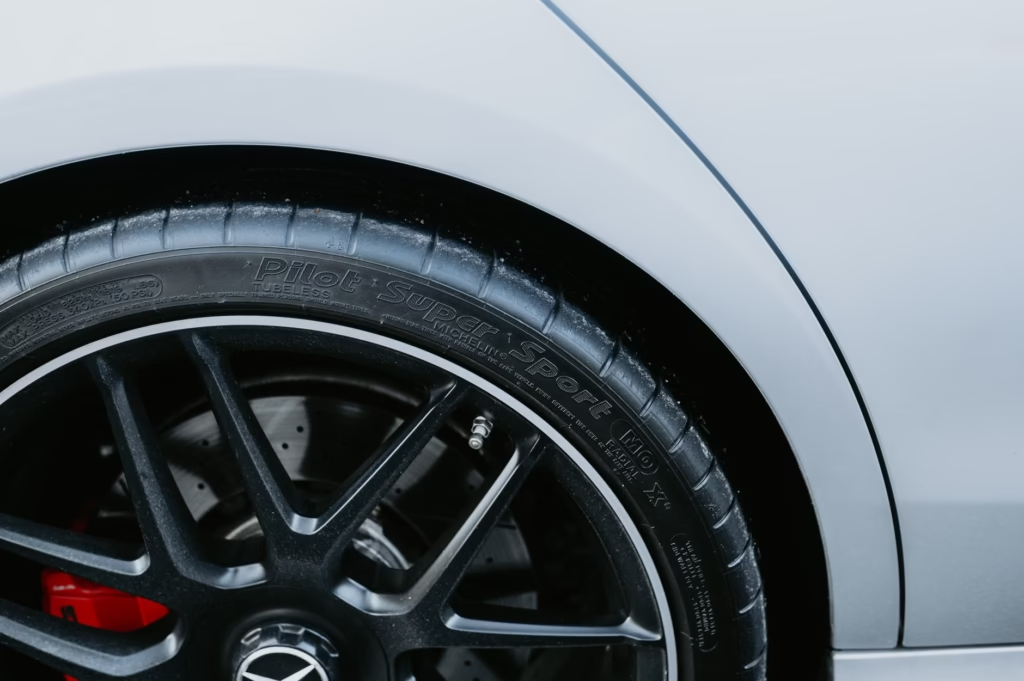
The legal minimum is not always the best practical minimum. Michelin notes that wet-road braking and hydroplaning resistance start to decline noticeably around 4/32 inch. That does not mean every driver must replace at 4/32, but it is a sensible planning point for anyone who drives at highway speeds in rain, commutes long distances, or wants time to shop calmly instead of waiting for an urgent replacement. For winter tires, many safety-minded replacement recommendations also land around 4/32 inch because snow and slush traction fall off before the final wear-bar limit. (michelinman.com)
A practical decision rule: the Tread, Trauma, Time check
A useful way to decide whether a tire needs replacement now, soon, or just closer monitoring is to run a quick Tread, Trauma, Time check. This is a simple editorial method, not an industry standard, but it lines up well with the way official guidance separates worn tires, damaged tires, and aging tires. (nhtsa.gov)
- Tread: Measure depth across each tire, not just one groove. If any spot has reached 2/32 inch or the wear bars are flush, replace the tire. If you are near 4/32 inch and regularly drive in heavy rain or on winter tires, start replacement planning sooner. (ustires.org)
- Trauma: Look for cuts, cracks, punctures, bulges, exposed cords, foreign objects, rapid air loss, or a new vibration or noise. USTMA and NHTSA both treat visible damage and performance changes as reasons for prompt professional inspection, and some damage means immediate replacement rather than repair. (ustires.org)
- Time: Age is not a universal expiration date, but it matters more on ultra-low-mileage vehicles and full-size spares. NHTSA says some vehicle and tire manufacturers recommend replacement at six to 10 years regardless of tread, while USTMA says no single maximum service life fits every tire because storage and use vary widely. The smart move is to read the DOT date code, check the owner’s manual and tire-maker guidance, and get older, lightly used tires inspected. (nhtsa.gov)
| What you find | Why it matters | What to do |
|---|---|---|
| Wear bars flush or 2/32 inch at any point | The tire is at the minimum replacement threshold | Replace now |
| About 4/32 inch and lots of wet-weather or winter driving | Grip margins are shrinking before the formal minimum | Plan replacement soon |
| One-sided, cupped, or patchy wear | The tire may be unsafe, and the vehicle may have alignment, inflation, or balance issues | Inspect promptly; replace the affected tire if depth or damage warrants it, and fix the cause |
| Bulge, bubble, exposed cords, deep cut, or tread separation | These point to structural damage | Replace immediately |
| Small nail in the center tread, tire not driven flat | This may be repairable, but only after internal inspection | Have a tire professional inspect it |
| Sidewall puncture or shoulder damage | This is outside the normal repairable zone | Replace |
| Older full-size spare or very low-mileage tire | Age can matter more than mileage here | Check date code and have it professionally evaluated |
The value of this check is that it prevents a common mistake: looking only at tread and missing everything else. Plenty of tires are replaced too late not because the driver ignored bald tread, but because the real warning sign was a bulge, a leak, a vibration, or a seven-year-old spare that still looked almost new. (ustires.org)
Uneven wear is not just cosmetic; it usually points to another problem
When a tire wears unevenly, replacement may be necessary, but the more important question is why it wore that way. If the cause is left alone, the next set can be ruined early too. NHTSA, USTMA, and Michelin all point to inflation, rotation, alignment, and balance as key drivers of tread life and tire safety. (nhtsa.gov)
- Both shoulders worn more than the center often suggest chronic underinflation. NHTSA warns that underinflation is the leading cause of tire failure, and Michelin links edge wear to low pressure. (nhtsa.gov)
- Center wear can point to overinflation, where the middle of the tread is carrying more of the load than the shoulders. (michelinman.com)
- One edge worn much faster than the other, especially with pulling or an off-center steering wheel, usually points to an alignment issue. (michelinman.com)
- Cupped or scalloped wear, often paired with vibration, can be related to wheel imbalance or suspension issues. (michelinman.com)
- A localized worn patch or separation-type wear is more serious than ordinary wear and can mean the tire should come out of service. USTMA includes localized spot wear due to separation among removal conditions. (ustires.org)
A realistic example helps here. Imagine a front-wheel-drive sedan with one front tire measuring 5/32 inch across most of the tread, but the inner shoulder is already at the wear bar and the car has started pulling slightly right. That tire is not halfway through its life. It is finished, because the lowest point controls the decision. And if the alignment is not corrected, the replacement tire may follow the same path surprisingly fast. (ustires.org)
Some punctures can be repaired. Many kinds of tire damage cannot.
A nail in a tire does not automatically mean you need a new set. But the repair window is narrower than many drivers assume. USTMA says a proper repair requires removing the tire from the wheel so the inside can be inspected. Continental likewise says repairs are limited to small punctures in the central tread area and are not appropriate when the internal structure has been compromised. (ustires.org)
- A puncture in the tread area may be repairable if it is small and the tire has not suffered internal damage. Continental uses a 6 mm, or roughly 1/4 inch, cutoff for repairable punctures in the tread zone. (continental-tires.com)
- Sidewall punctures, shoulder damage, bulges, bubbles, and exposed cords are replacement problems, not repair problems. (continental-tires.com)
- A plug-only fix is not considered a proper repair by USTMA guidance, which specifically lists improper repair among common damage examples. (ustires.org)
- A tire worn to 2/32 inch is already at the end of service, so repairing it does not solve the bigger problem. Michelin says worn tires below that threshold should not be repaired. (michelinman.com)
- If the tire was driven while very low or flat, a pothole or curb impact may have damaged the sidewall or belts even if the outside looks only mildly scuffed. That requires inspection and often replacement. (continental-tires.com)
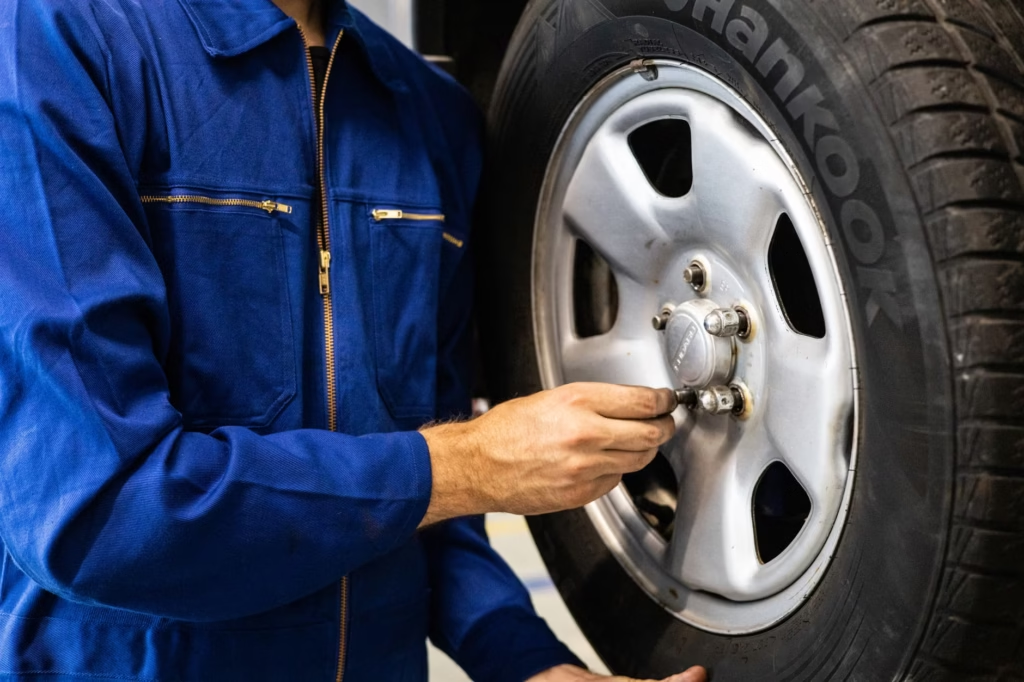
Do not treat a sidewall bubble like a minor nuisance. A bulge usually means internal structural failure, and continuing to drive on it carries a very different risk from driving on a simple tread puncture. (continental-tires.com)
Whether to replace one, two, or all four tires depends on the vehicle and the wear gap
The cleanest answer is still the simplest one: a matched set of four is best for overall performance. USTMA recommends replacing all four at the same time for optimal performance. If that is not feasible and you are replacing only two, USTMA says the newer pair should go on the rear axle to reduce the risk of rear hydroplaning and oversteer. Michelin gives the same rear-axle advice. (ustires.org)
Replacing just one tire is where people get into trouble. USTMA says a single replacement can negatively affect suspension, transmission, and treadwear, and if a one-tire replacement cannot be avoided, it should be paired with the tire that has the deepest tread and installed on the rear axle. Michelin adds an important caution for AWD and 4WD vehicles: significant circumference or tread-depth differences can stress drivetrain components, so the owner’s manual and manufacturer guidance matter more than price convenience here. If an AWD crossover loses one tire to a pothole, the cheapest fix may not be one tire. Depending on the remaining tread depth and the vehicle’s rules, the correct fix could be one closely matched tire, a pair, or a full set. (ustires.org)
A 10-minute inspection you can do before a trip or before ordering tires
- Check pressure cold. Use the pressure on the driver’s door placard or in the owner’s manual, not the maximum pressure molded on the tire sidewall. NHTSA also notes that TPMS warnings usually appear only after a tire is significantly underinflated, so TPMS is not a substitute for manual checks. (nhtsa.gov)
- Measure tread in three places across each tire: inner edge, center, and outer edge. Write down the lowest reading. If any location is at 2/32 inch, replacement is due. (ustires.org)
- Inspect the tread and sidewalls for cuts, punctures, bulges, scrapes, cracks, embedded objects, and exposed cords. USTMA and NHTSA both recommend checking sidewalls as well as tread during monthly inspections. (ustires.org)
- Read the DOT date code on each tire and the spare. The last four digits show the week and year of manufacture. Age deserves extra attention on low-mileage vehicles and full-size spares. (nhtsa.gov)
- Pay attention to what the vehicle is telling you while driving. Pulling, recurring pressure loss, vibration, or new tire noise can point to internal damage, imbalance, or alignment trouble and should trigger a professional inspection. (ustires.org)
- If replacement time has arrived, verify the correct tire size, load index, and speed rating from the placard, owner’s manual, or manufacturer recommendation before shopping. (ustires.org)
Mistakes that shorten tire life or create false confidence
- Relying on mileage alone. USTMA says there is no single calendar age or mileage rule that accurately predicts the service life of every tire. (ustires.org)
- Ignoring the spare. NHTSA warns that full-size spares age too and should not be treated as permanent replacements for worn tires except in emergencies. (nhtsa.gov)
- Inflating to the number on the sidewall. NHTSA is explicit that this is the tire’s maximum pressure, not the vehicle’s recommended setting. (nhtsa.gov)
- Buying tires without fixing the cause of uneven wear. Alignment, balance, inflation, and suspension issues can destroy a new set early. (michelinman.com)
- Mixing tire types casually. Michelin advises against mixing brands, models, constructions, or speed ratings because emergency handling can become inconsistent. (michelinman.com)
- Using a DIY plug as a permanent solution. Continental treats an external plug as, at best, an emergency measure to reach proper service, not a long-term repair. (continental-tires.com)
When you do buy replacements, match the vehicle before chasing deals
Replacement tires should match the vehicle’s recommended size, load index, and speed rating unless the manufacturer specifically approves an alternative. USTMA and NHTSA both point drivers back to the owner’s manual and the Tire and Loading Information label for that reason. For most drivers, the safest default is also the least complicated one: four matching tires of the proper specification, rotated and inflated on schedule. If rain or winter traction is a recurring concern, start shopping before the tires are at the absolute minimum so the decision can be made on performance and fit, not urgency. (ustires.org)
Tires usually tell you when they are done, but they do not all say it the same way. Sometimes the answer is obvious, like wear bars or a sidewall bubble. Sometimes it is quieter, like an aging spare, a vibration after a pothole strike, or one inner edge wearing faster than the rest. If there is a practical takeaway, it is this: check tires monthly, measure instead of guessing, and treat damage and odd wear patterns as seriously as low tread. That approach helps you replace tires neither too early nor too late. (nhtsa.gov)
Frequently asked questions
How many miles should a set of tires last?
There is no reliable single mileage number. Tire life depends on the tire itself, driving style, load, temperature, inflation, rotation, alignment, and road conditions. USTMA’s guidance is to judge serviceability by condition and inspection, not by a universal mileage rule. (ustires.org)
Is the penny test enough to decide?
It is fine as a quick screen, and NHTSA still uses it as a consumer check. But a tread-depth gauge is more precise, and Michelin recommends checking several points across the tire because depth can vary across the tread. (nhtsa.gov)
How old is too old if the tread still looks good?
There is no single age cutoff that fits every tire. NHTSA says some vehicle and tire manufacturers recommend replacement at six to 10 years regardless of tread, while USTMA says service life cannot be predicted accurately by calendar age alone. Age matters more on low-mileage vehicles and full-size spares, so check the DOT code and follow the vehicle and tire maker’s guidance. (nhtsa.gov)
Can I replace just one tire on an AWD vehicle?
Maybe, but only if the remaining tires, tread-depth difference, and vehicle requirements allow it. Michelin says AWD and 4WD systems are sensitive to circumference differences, so one-tire replacement requires close matching and the owner’s manual should be checked first. (michelinman.com)
Do newer tires go on the front or the rear if I replace only two?
On the rear. USTMA and Michelin both recommend installing the deeper-tread pair on the rear axle because rear traction loss, especially in wet conditions, is harder to recover from. (ustires.org)
Are small sidewall cracks always an automatic replacement?
Not every surface mark means the tire is about to fail, but sidewall cracking deserves respect. NHTSA and USTMA both include cuts, cracks, bulges, and related sidewall damage among the conditions that should be inspected closely, and deep cracks, bulges, or exposed cords are strong replacement signals. When in doubt, have a tire professional inspect the tire rather than guessing from appearance alone. (nhtsa.gov)
References
- NHTSA Tire Safety Ratings and Awareness (TireWise) – https://www.nhtsa.gov/vehicle-safety/tires
- NHTSA Summer Driving Tips – https://www.nhtsa.gov/summer-driving-tips
- U.S. Tire Manufacturers Association: Replacing Tires – https://www.ustires.org/tire-care-safety/replacing-tires
- U.S. Tire Manufacturers Association: Tire Repair Basics – https://www.ustires.org/tire-care-safety/tire-repair-basics
- U.S. Tire Manufacturers Association: Tire Facts – https://www.ustires.org/tires-101/tire-facts
- U.S. Tire Manufacturers Association: Care and Service of Passenger and Light Truck Tires – https://www.ustires.org/sites/default/files/2024-08/Care%20and%20Service%20of%20Passenger%20and%20Light%20Truck%20Tires%202017_0.pdf
- Michelin USA: Tire Tread Depth – https://www.michelinman.com/auto/auto-tips-and-advice/tires-101/tire-tread-depth
- Michelin USA: FAQs – https://www.michelinman.com/auto/assistance/michelin-faqs
- Michelin USA: Mixing Tires, Safety, Winter Tires & AWD – https://www.michelinman.com/auto/auto-tips-and-advice/tire-buying-guide/mixing-tire-brands
- Michelin USA: When to Replace Tires – https://www.michelinman.com/auto/auto-tips-and-advice/tire-buying-guide/when-do-i-need-new-tires
- Continental Tires: Tire Repair – https://www.continental-tires.com/tire-knowledge/tire-repair/