

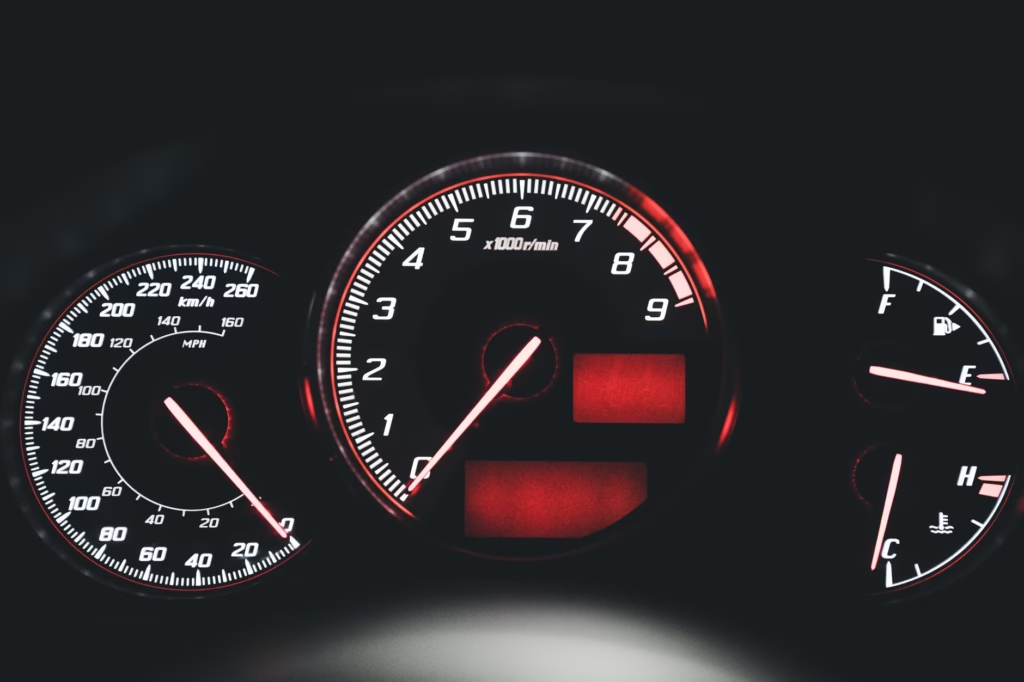
Dashboard warnings are not all equal. A seat-belt reminder and a low-oil-pressure light share the same instrument cluster, but not the same consequences. Toyota notes that red icons generally indicate conditions requiring immediate attention, and it also reminds drivers that the exact symbols and meanings vary by vehicle, which is why the owner’s manual is the final authority. (toyota.com)
The expensive mistake is not failing to recognize every symbol instantly. It is talking yourself into waiting. Many serious warning lights come on while the car still starts, idles, and rolls down the road. Some mean stop safely right away. Others mean the vehicle can still move, but an important safety, steering, braking, emissions, or tire-pressure system may no longer be working properly. Official guidance from Honda, Toyota, NHTSA, and EPA supports the same basic habit: read the message, notice how the vehicle feels, and act before the problem escalates. (techinfo.honda.com)
TL;DR
- Brake, oil pressure, coolant temperature, and charging warnings belong in the pull-over-now category, even if the car still runs. (toyota.com)
- A steady check-engine light and a flashing one are not the same; flashing usually signals detected misfire and higher urgency. (techinfo.honda.com)
- ABS, SRS, EPS, and stability-control warnings may not stop the car from moving, but they can remove important crash-avoidance or occupant-protection systems. (techinfo.honda.com)
- TPMS, transmission, and general message warnings are often minimized because the car still feels mostly normal, but they still require prompt attention. (nhtsa.gov)
A quick triage chart for 12 dashboard warnings that deserve action
Use this chart as a starting point, not a substitute for your vehicle’s manual. The icon shape, wording, and exact threshold can differ by make, model, and model year. (toyota.com)
| Warning light | What it usually points to | How urgent is it? | Smart first move |
|---|---|---|---|
| Brake system warning | Low brake fluid, parking brake issue, or a brake-system fault | Stop safely now | Confirm the parking brake is fully released. If pedal feel is abnormal or the light stays on, do not keep driving. (techinfo.honda.com) |
| Engine temperature / high coolant temperature | Engine overheating or coolant-temperature problem | Stop safely now | Pull over, turn off A/C, and stop before heat causes bigger damage. (toyota.com) |
| Low engine oil pressure | Oil pressure too low to protect the engine properly | Stop safely now | Shut the engine off and check the oil only after parking safely and waiting. (techinfo.honda.com) |
| Charging system / battery | Charging-system fault, often more than just an old battery | Stop safely now or very soon | Reduce electrical load and do not assume the car can go far on battery power alone. (techinfo.honda.com) |
| Check engine / malfunction indicator lamp | Emissions or engine-control fault; flashing usually means misfire | Prompt if steady; immediate if flashing | Avoid hard driving. If flashing or running rough, pull over and arrange service. (techinfo.honda.com) |
| ABS warning | Anti-lock braking system fault | High | Brakes may still work normally, but anti-lock function may be unavailable. Get it checked promptly. (techinfo.honda.com) |
| Airbag / SRS warning | Fault in airbags or seat-belt tensioners | High | Drive only as needed and schedule diagnosis quickly; crash protection may be reduced. (techinfo.honda.com) |
| TPMS / low tire pressure | One or more tires significantly underinflated; flashing often means TPMS fault | High if handling feels wrong; otherwise soon | Inspect the tires, check pressure with a gauge, and look for a puncture or sidewall damage. (nhtsa.gov) |
| Power steering / EPS | Electric power steering fault or reduced assist | High | If steering feels heavy, stop. If a restart does not clear it, have it inspected immediately. (owners.honda.com) |
| Stability control / traction control stays on | ESC/VSA/traction system fault or deactivation | Moderate to high | Treat a steady light differently from a blinking one; steady means reduced safety margin in slippery conditions. (techinfo.honda.com) |
| Transmission system / transmission temperature | Transmission fault, overheating, or reduced-performance mode | High | Avoid hard acceleration. Stop if gear selection is affected or the display says not to drive. (techinfo.honda.com) |
| Master warning / system message indicator | A separate cluster message is pointing to the real problem | Depends on message | Read the message before cycling the ignition, then follow that instruction first. (techinfo.honda.com) |
One nuance many drivers miss: a safety-system light that never appears during startup can also signal a problem. Toyota and Honda both indicate that lights such as ABS and SRS should illuminate briefly for a self-check; if they do not, that can mean the system is not available. (toyota.com)
Use the stop-safely triage before deciding to keep driving
- Get out of the travel lane first. A warning light is not a reason to stop somewhere unsafe if the vehicle is still controllable.
- Read the icon and any text message before turning the vehicle off. Many newer dashboards pair a general warning lamp with a specific message on the display. (techinfo.honda.com)
- Decide whether the car has lost a core function: braking, cooling, lubrication, charging, steering, gear selection, or tire pressure. Those systems deserve the highest caution. (toyota.com)
- Notice whether the light is steady or flashing. Flashing check-engine and flashing TPMS warnings generally mean something different, and often more urgent, than a steady light. (techinfo.honda.com)
- Escalate paired warnings. Brake plus ABS, or a general warning indicator plus a text alert, is more serious than treating each signal in isolation. (techinfo.honda.com)
- If the vehicle feels wrong, believe the symptom more than your hope. A soft brake pedal, heavy steering, overheating, rough running, a burning smell, or loss of power all argue against continuing the trip.
A realistic example helps. Imagine one driver gets a steady check-engine light right after refueling, and the engine continues to idle and accelerate normally. Another gets a flashing check-engine light, rough running, and vibration. Both vehicles need attention, but the second driver should stop thinking in terms of convenience and start thinking in terms of breakdown risk. Honda explicitly distinguishes a steady malfunction lamp from a blinking misfire warning. (techinfo.honda.com)
Lights that can lead to immediate damage or braking trouble
1) Brake system warning light
This is the light to take seriously. It can be something simple, such as a parking brake that is not fully released, but official Honda and Toyota guidance also ties it to low brake fluid or a brake-system malfunction. If the pedal feels soft, sinks lower than usual, or the red brake warning appears with the ABS light, urgency goes up sharply. The car may still roll, but that does not mean it still has full braking reserve. Confirm the parking brake first; if that is not the answer, stop safely and do not gamble on “one more short drive.” (techinfo.honda.com)
2) Engine temperature or high coolant temperature warning
An overheating engine is the classic small problem that becomes a large repair because the driver keeps pushing for the next exit. Toyota’s guidance is straightforward: high coolant temperature means stop the vehicle in a safe place. Honda’s overheating guidance similarly tells drivers to pull over, turn off accessories, and manage the situation before continuing. If steam, a hot smell, or a red temperature indication appears, treat that as a mechanical emergency, not a suggestion. (toyota.com)

Do not open a hot cooling-system cap just to “check quickly.” Manufacturer overheating instructions warn about burn risk when inspecting under the hood after an overheat event. (toyota.com)
3) Low engine oil pressure warning
This warning is more serious than many drivers realize because it is about pressure, not simply being due for an oil top-off. Honda says to park safely, stop the engine, wait, and then check the oil level. Toyota and Lexus manual guidance also makes an important distinction: a low oil pressure light is not designed merely to report low oil level, and continued operation can cause serious mechanical damage very quickly. In practical terms, this is not a “drive home and deal with it later” light. (techinfo.honda.com)
4) Charging system or battery warning light
Drivers often misread the battery symbol as proof that the battery itself is worn out. Sometimes that is true, but the more important point is that the vehicle may not be charging properly. Toyota says a charging-system warning requires stopping in a safe place, and Honda says to contact a dealer immediately. Older Toyota and Lexus manual language also explains the practical problem: the engine may continue to run only until battery power is depleted. Turn off nonessential electrical loads, but do not assume you have a long grace period. (toyota.com)
Lights that may leave the car running while taking away important protection
5) Check engine or malfunction indicator lamp
The check-engine light is easy to dismiss because the car often feels normal at first. EPA guidance explains why that is misleading: the OBD system monitors emissions-related components and turns the light on when it detects a fault. Honda adds a crucial distinction for drivers: a steady lamp can indicate an emissions-system problem or even a loose or missing fuel cap, while a blinking lamp indicates detected engine misfire. That is why “it still drives fine” is not a diagnosis. The light is a report that the car’s computers saw something worth flagging. (nepis.epa.gov)
Here is the practical rule: a steady light usually means minimize hard acceleration, high speed, and heavy load until the car is checked. A flashing light means stop treating the vehicle as trustworthy transportation. If it is flashing and the engine is stumbling, shaking, or smelling hot, pull over and arrange repair rather than trying to finish the errand list. (techinfo.honda.com)
6) ABS warning light
An ABS light does not always mean you are about to lose all braking. Honda’s guidance is more specific: normal braking may still be available, but anti-lock function may not be. That matters because ABS is designed to help limit wheel lockup and preserve steering control during hard braking. In dry, calm commuting, that loss may not be obvious. In rain, snow, gravel, or an emergency stop, it matters a lot. If the ABS light appears with the red brake warning, treat the situation as more urgent than ABS alone. (techinfo.honda.com)
7) Airbag or SRS warning light
The SRS light is one of the easiest warnings to postpone because nothing seems to change while driving. But Honda states plainly that if the indicator stays on, comes on at the wrong time, or does not come on during startup, the airbags or seat-belt tensioners may not work properly when needed. Toyota’s warning-light guidance makes the same point for safety-system lights generally. This is a drivability-light mismatch: the car may drive exactly the same while crash protection is reduced. (techinfo.honda.com)
8) Power steering or EPS warning light
An EPS warning can feel abstract until the steering suddenly gets heavy at low speed or in parking maneuvers. Honda guidance says to stop the vehicle in a safe place, restart it, and if the indicator stays on, have the vehicle inspected immediately. That is a good example of why dashboard lights should be tied to vehicle feel. If the steering effort changes, if steering assist comes and goes, or if the car feels harder to place accurately, the warning deserves more respect than its often-amber color suggests. (owners.honda.com)
9) Stability control or traction control warning that stays on
This one causes confusion because a blinking traction- or stability-control light can be completely normal when the system is actively correcting wheel slip. Honda’s VSA/ESC guidance distinguishes that normal behavior from a light that stays on, which can mean the system has a fault or is deactivated. On a dry suburban road, that might feel harmless. In wet weather, snow, gravel, or a sudden avoidance maneuver, it means the car may no longer have the electronic safety net you expected. (techinfo.honda.com)
Warnings people dismiss because the vehicle still feels almost normal
10) Tire pressure monitoring system (TPMS) warning
TPMS is easy to shrug off because the tire can look fine from the outside. NHTSA says underinflated tires are visually difficult to detect, and it notes that the TPMS symbol comes on when at least one tire is significantly underinflated. The agency also explains a common cold-weather pattern: the light can come on briefly in the morning and go out after the tires warm up, which still points to marginally low pressure. A flashing-then-solid TPMS warning is different again, because it can indicate a system malfunction rather than a simple inflation problem. (nhtsa.gov)

11) Transmission system or transmission temperature warning
Transmission warnings vary more by brand than some other lights, but the underlying message is similar: the vehicle may still move while the transmission is protecting itself or losing normal function. Honda guidance for transmission indicators says blinking can mean a transmission-system problem, reduced performance, or a need to avoid sudden starts and acceleration. Some messages escalate further and tell the driver to stop in a safe place immediately or warn that the vehicle can no longer be driven normally. If gear selection acts strangely, the engine revs flare, or the message says not to drive, do not force the issue. (techinfo.honda.com)
12) Master warning light or system message indicator
Modern cars increasingly use a general warning symbol, often a triangle or message indicator, to tell you to read the actual text alert. That makes this one deceptively easy to ignore. Honda says its system message indicator comes on with a beep and a message on the driver information display, while Toyota says a warning message should be followed with the appropriate correction procedure and checked again if it returns. The mistake is shutting the car off, restarting it, and assuming the problem has vanished before reading what the vehicle tried to tell you. (techinfo.honda.com)
Common mistakes that turn a warning light into a bigger repair
- Treating color as the whole diagnosis. Red usually means immediate attention, but some amber warnings still represent lost braking, steering, stability, or safety-system protection. (toyota.com)
- Assuming a disappearing TPMS light fixed itself. NHTSA says marginally low pressure can dip below the threshold overnight and rise again after driving, but the tires still need checking. (nhtsa.gov)
- Confusing oil pressure with oil level. A pressure light is an emergency warning, not a routine maintenance reminder. (techinfo.honda.com)
- Driving with a flashing check-engine light the way you would drive with a steady one. Honda treats a blinking MIL as a misfire warning with higher urgency. (techinfo.honda.com)
- Ignoring the second light. Brake plus ABS, or a general warning indicator plus a message, often changes the seriousness of the situation. (techinfo.honda.com)
- Using TPMS as a substitute for a tire gauge and regular inspections. NHTSA explicitly says it is not a replacement for normal tire maintenance. (nhtsa.gov)
What to do after you park
- Photograph the warning light and any message on the cluster before cycling the ignition. If the light disappears, you still have a record for diagnosis.
- Check only what is safe and obvious: parking brake position, an obvious flat tire, a visible fluid leak under the vehicle, or oil level after waiting on level ground if the oil-pressure warning appeared. (techinfo.honda.com)
- Do not touch the cooling system while it is hot. Wait for it to cool before any under-hood inspection related to overheating. (toyota.com)
- If braking, steering, transmission behavior, or engine temperature feels abnormal, default to a tow instead of a test drive. (techinfo.honda.com)
- Write down what happened: highway or city speed, weather, whether the light was steady or flashing, and whether the engine, brakes, steering, or shifting felt different. That context often matters as much as the light itself.
- If the warning returns, treat the recurrence as proof that the issue is active, even if restarting cleared it once.
The general rule is simple: if the warning involves the ability to stop, steer, cool, lubricate, charge, or keep the tires properly inflated, caution should outrank convenience. A tow bill can be annoying. So can a missed appointment. Both are easier to live with than preventable engine damage or an emergency stop with a disabled safety system.
FAQ
Can I keep driving if the warning light is yellow instead of red?
Sometimes, but yellow does not mean harmless. Toyota says yellow icons indicate an item of importance and are not necessarily a warning, yet Honda also uses amber for systems that can require immediate inspection. The better question is what function the vehicle may have lost, not what color the icon is. (toyota.com)
Why did my TPMS light go out after a few miles?
NHTSA says that can happen when a tire is marginally low overnight, then warms up and rises above the warning threshold while driving. The light going out does not mean the tire pressure is correct. Check it with a gauge. (nhtsa.gov)
If the SRS or ABS light never comes on during startup, is that normal?
No. Toyota and Honda both indicate that safety-system lights should illuminate briefly during startup checks. If they do not, the system may not be available to protect you properly. (toyota.com)
Can a loose gas cap really trigger the check-engine light?
Yes, on some vehicles. Honda lists a loose or missing fuel-fill cap as one reason the malfunction indicator lamp can come on. That is one reason a steady check-engine light should be diagnosed instead of guessed at. (techinfo.honda.com)
Should I trust a generic dashboard-light chart or my owner’s manual?
Use the chart for quick triage, but trust the manual for the final meaning. Toyota’s warning-light guidance specifically tells owners to use the vehicle manual because symbol sets and messages vary by model. (toyota.com)
The practical takeaway
The smartest way to think about dashboard warnings is not “Which lights are scary?” but “Which systems can I no longer assume are working?” If the answer involves brakes, engine cooling, oil pressure, charging, steering, tires, airbags, or transmission operation, do not normalize it because the car still moves. Read the message, judge how the vehicle feels, and make the next decision conservatively. That is how minor faults stay minor.
References
- Toyota Owners – Dashboard Warning Lights Explained – https://www.toyota.com/owners/warning-lights/?msockid=3e0d9839aa876338193a8ed1ab0062f5
- Toyota Owners – 2023 Corolla Cross: If a warning light turns on or a warning buzzer sounds – https://www.toyota.com/owners/warranty-owners-manuals/digital/article/corolla-cross/2023/om0a039u/ch07se020404/
- NHTSA TireWise – Tire Safety Ratings and Awareness – https://www.nhtsa.gov/vehicle-safety/tires
- Honda Owner’s Manual – HR-V 2025: Indicator Coming On/Blinking – https://techinfo.honda.com/rjanisis/pubs/OM/AH/A3V02525IOM/enu/details/131237047-15984.html
- Honda Owner’s Manual – Integra 2024: Indicators – https://techinfo.honda.com/rjanisis/pubs/OM/AH/B3S52424IOM/enu/details/131236047-3664.html
- Honda Owner’s Manual – Integra 2024: Airbag System Indicators – https://techinfo.honda.com/rjanisis/pubs/OM/AH/B3S52424IOM/enu/details/131236047-2979.html
- Honda Owner’s Manual – Accord 2025: Vehicle Stability Assist (VSA), aka ESC, System – https://techinfo.honda.com/rjanisis/pubs/OM/AH/A30A2525IOM/enu/details/131244047-11837.html
- EPA – On-Board Diagnostic (OBD) Regulations and Requirements: Questions and Answer – https://nepis.epa.gov/Exe/ZyPDF.cgi/P100LW9G.PDF?Dockey=P100LW9G.PDF
- Honda Owners – 2021 Odyssey: Tire Pressure Monitoring System / EPS guidance PDF – https://owners.honda.com/utility/download?path=%2Fstatic%2Fpdfs%2F2021%2FOdyssey%2F2021_Odyssey_Tire_Pressure_Monitoring_System.PDF
- Honda Owner’s Manual – CR-V Hybrid 2025: Indicators – https://techinfo.honda.com/rjanisis/pubs/OM/AH/A3D42525IOM/enu/details/131220047-334546.html
- Toyota Owners – 2025 RAV4 Hybrid: If a warning message is displayed – https://www.toyota.com/owners/warranty-owners-manuals/digital/article/rav4-hv/2025/om0r193u/ch07se020404/