

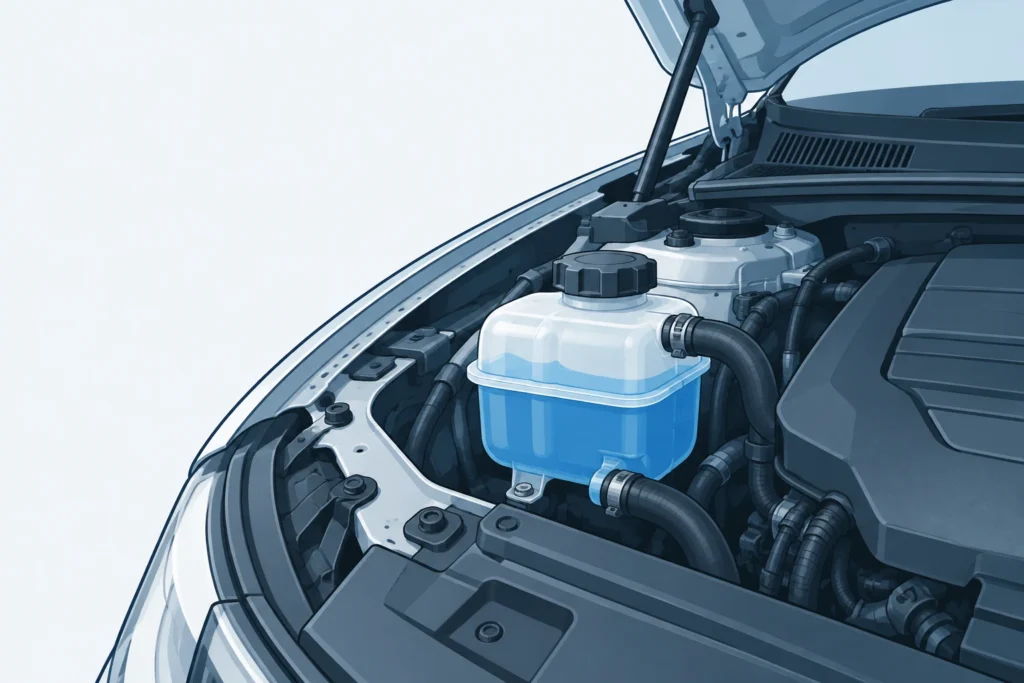
Drain-and-fill can properly replace coolant if it's done using the particular vehicle's specified procedure. Simply draining the radiator doesn't translate to the same thing, and topping off with premixed 50/50 will not necessarily yield a 50/50 solution. A fluid exchange exchanges coolant; a chemical cleaning corrects a known issue. Specify approval of the procedure, coolant type, and verification of completion, not the term "flush".[1][4]
What stays behind changes the result
Let's say you have a quote with a water rinse plus 50/50 premix. In our imaginary 8-quart system, let's say you have 4 quarts of rinse water left after draining. When you add 4 quarts of premix you are only putting 2 quarts of antifreeze into the system: 2÷8=25% antifreeze after everything mixes thoroughly. You are short by half if you need 50% in the vehicle. The shop needs to know how much to put in to actually reach the vehicle's required concentration, with math that takes into consideration the water that will stay after draining and proof that the final mixture is correct.
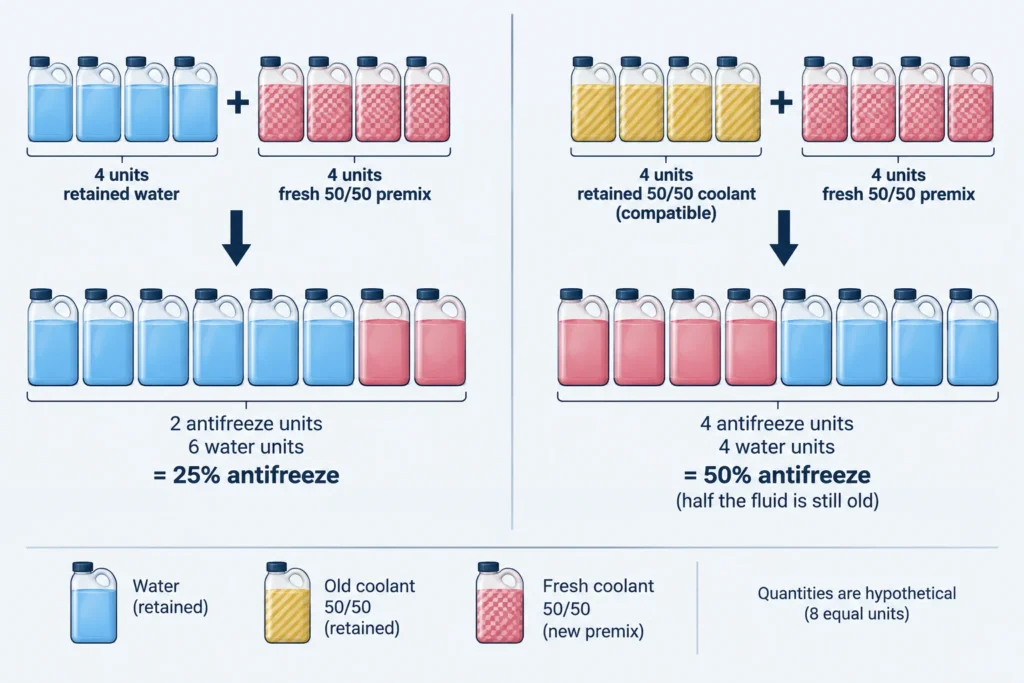
Now let's change one assumption: that the remaining 4 quarts are 50/50 coolant, not water. They already have 2 quarts of antifreeze in them; the new premix will contribute a second 2. Now 4/8 = 50%, even though half the fluid is old. Correctness of concentration and completeness of replacement are two separate issues. The numbers here are meant to demonstrate the math, not how much coolant your car actually keeps.
Ask what drain points and cooling circuit the procedure encompasses. How is retained fluid dealt with? How is air evacuated? Vacuum filling by itself doesn't imply thorough old-fluid removal: GM's highly limited contamination service update procedure lists draining/rinsing separately from vacuum-tool use & final refill.[5]
Separate the label from the requirement
A drain-and-fill drains coolant from designated drain locations and refills the system. An exchange exchanges fluid with an additional exchange process; ask them how they do it instead of guessing that it forces fluid in at high pressure or takes everything out. Chemical cleaning introduces a cleaner into the system to combat contamination/deposits. Shops may refer to any of these as a "flush," so don't assume the name means chemicals were added.
Use the model year, engine, and relevant cooling circuit to identify the schedule. For example, Toyota’s 2022 Camry guide specifies initial engine-coolant replacement at 100,000 miles or 120 months, then every 50,000 miles or 60 months, whichever comes first. Inverter coolant has a different initial interval. Toyota describes routine replacement as draining and refilling; the maintenance guide does not supply the complete factory service procedure.[1]
What coolant you use is as important as how often you change it. Toyota links those intervals to its Super Long Life Coolant or a specified equivalent formulation. Ford's 2024 Bronco Sport owner's manual cautions that "all makes and models" of coolant may not meet Ford's specifications. Ask what the actual product is and what specification it meets; a marketing name or matching color isn't proof of compatibility.[1][3]
When routine service becomes diagnosis
Delayed service or lost records can be reasons for instituting a written alternate baseline; neither is itself evidence chemical flushing is warranted. Unknown coolant necessitates determining compatibility as well as a replacement method to clear up uncertainty. Color alone should not be a service trigger: Ford lists an expected progression from orange to pink or light red that does not by itself trigger replacement or flushing.[2]
Oil contamination, repeated loss of coolant or overheating changes the scenario. Ask for diagnosis before assuming a flush will cure the problem. Finding oil in coolant doesn't automatically pinpoint an oil cooler or head-gasket problem. GM's oil contamination bulletin talks about mixing corrective flushing with repair and replacement of contaminated parts, and warns about using detergents not proven effective. This isn't a tune-up procedure to prevent oil contamination on every vehicle.[3][4]
Owners' inspections should not include opening an operating pressurized system: escaping steam and coolant will produce serious burns. Filling and degassing should be done following the vehicle-specific procedure as well; general descriptions of drain-and-fill do not constitute DIY guidance.[2]
What the estimate should specify
- Purpose: scheduled replacement, correction of incompatible fluid, or cleaning for a documented condition.
- Route taken and extent of circuit worked on (drain and fill/exchange), handling of retained fluid and inclusion of rinse or chemicals.
- Coolant product and spec, premix or concentrate, desired final concentration, and a cleaner if needed and your justification for it.
- Vehicle-specific filling and venting, final mix and level, leak and normal operating temperature checks.
- Price: Break down routine service, cleaning, diagnosis and any repairs you want to quote separately so we can get multiple quotes to compare.
Sources and references
- Toyota: 2022 Camry Warranty & Maintenance Guide
- Ford: Engine Coolant Check
- Ford: 2024 Bronco Sport Owner’s Manual, Adding Coolant
- General Motors; hosted by NHTSA: Bulletin 25-NA-052, Version 2, Information on Flushing Oil Contamination from Cooling System (2025-03-25)
- General Motors; hosted by NHTSA: Service Update N232430450, Possible Engine Coolant Contamination (2024-08-14)