

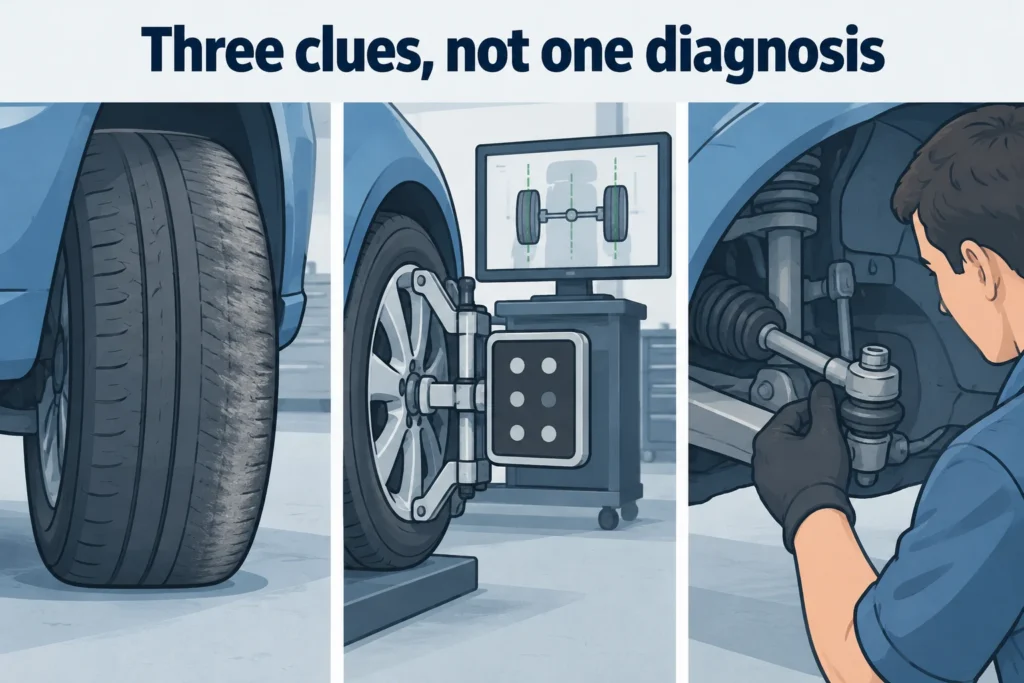
Not all cases of uneven tire wear are an indication of misalignment and should not be assumed to be so automatically. I’d authorize an adjustment to alignment based on actual measurements that are out of specification for your car, or based on the manufacturer’s recommendations. In the meantime, the condition of the tire, the alignment reading and the status of the suspension are three different items that need to be evaluated.[2][4][7]
Picture me in an imagined tire-shop waiting room, trying to answer a work message while an estimate arrives with “alignment recommended” circled. The technician shows me the worn edge of one of the tires. I’m irritated that I have to make another decision, but crossing out the recommendation doesn’t tell me anything either. I ask for the measurements and inspection findings before deciding what to buy.
The tire records the past; the machine measures today
Existing tread loss reflects miles driven under earlier conditions. Today’s readings describe the geometry during the check. A tire may still show damage from a problem already corrected, and rotation may have moved it away from the wheel position where the wear developed. Adjustment cannot put rubber back or promise to erase noise from an already irregular tread.[2][3][7]
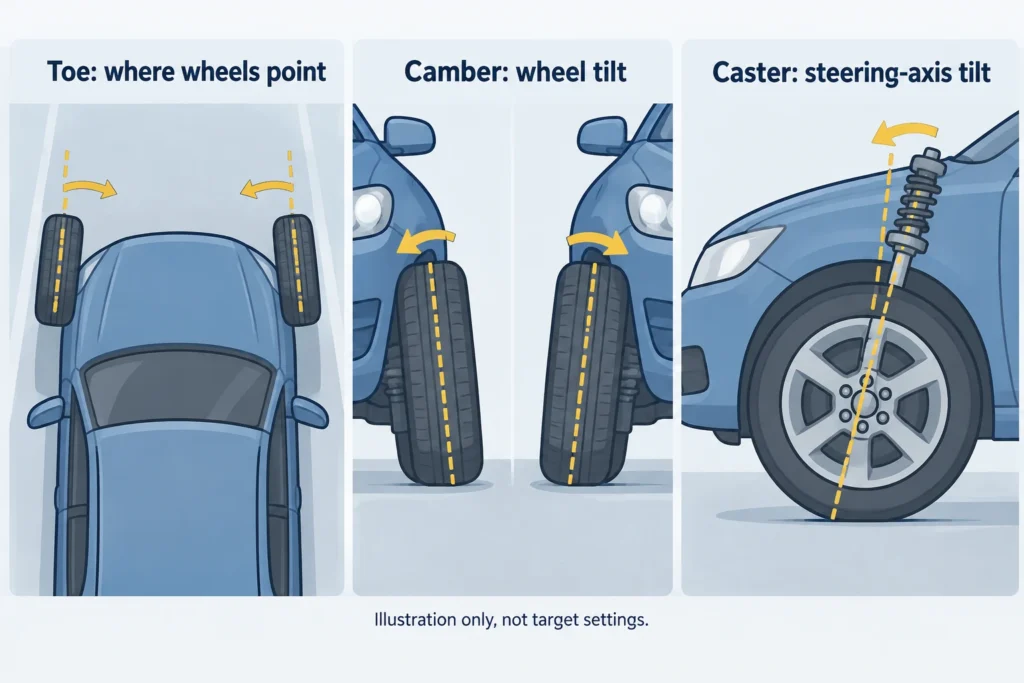
I don’t know whether the photographed camber or toe is out of spec. Camber is how far a wheel is tipped inward or outward from the vertical (when viewed from the side of the car). Toe is how far the wheels point inward or outward from the vehicle’s direction of travel (when viewed from above). Tilted camber or improper toe can cause edge wear on the tires. As parts wear they can also change how the suspension and tire interact with each other, and therefore change the geometry of the suspension.[2][3][4]
Feathering is when the edges of the treads develop a sawtooth pattern. According to Michelin, feathering is caused by improper toe or worn suspension bushings. However, GM has an archived bulletin saying mild cases of feathering don’t need an alignment. I don’t think feathering warrants an alignment, but I wouldn’t also buy an adjustment because of this. How bad the feathering is, if it is worsening, and what measurements are showing are way more important than whether feathering is “allowed” by a certain company.[2][3]
Wear on both shoulders can also be due to a variety of reasons such as driving, inflation, and tire fitment. If a car has run-flat tires, tell the shop about prior alignment and suspension work.
A tire with low air pressure will wear on the shoulders. Cold pressure should be checked and adjusted according to what is recommended on the tire door label. However, a correct reading will not explain how the tire was inflated in the past.[1][3]
A pull, a crooked steering wheel, and a shake aren’t the same complaint
Describe what you’ve already noticed in ordinary driving: continuing steering correction, a visibly off-center wheel while the car travels straight, or vibration at a particular speed. If it pulls only while braking, say so. You don’t need to release the wheel or deliberately recreate a pull to give the technician useful information.
I’d pause at an alignment recommendation based only on a shake. GM cautions against treating ordinary vibration as an alignment problem. Toyota’s bulletin also separates a true pull from steering-wheel offset and describes how road crown or tire-generated sideways force can make a car pull even when its geometry is within specification. Those are scoped manufacturer examples, not universal procedures; the shop needs guidance applicable to your vehicle. The useful question is what the proposed adjustment would actually correct.[2][4]
Read the numbers before trusting the colors
Request to see the pre-adjustment readings with applicable limits, and obtain the final report when adjustment is made. Toe and camber affect wear. Caster (forward and backward tilt of the steering axis when viewed from the side) affects steering feel. Don’t stop at the front axle; the effect of the rear wheels directing the car (rear wheel steering and track) affects front wheel steering.[2][4][5]
One green box is not the entire report. Total toe combines the two readings on an axle, so, to some degree, opposing toe adjustments can balance. In Hunter’s sample, the individual front toe readings are shown in red and total front toe is shown in green. The green total does not justify each individual wheel reading is correct or steering has been centered. Ask which individual reading prompted the adjustment.[5]
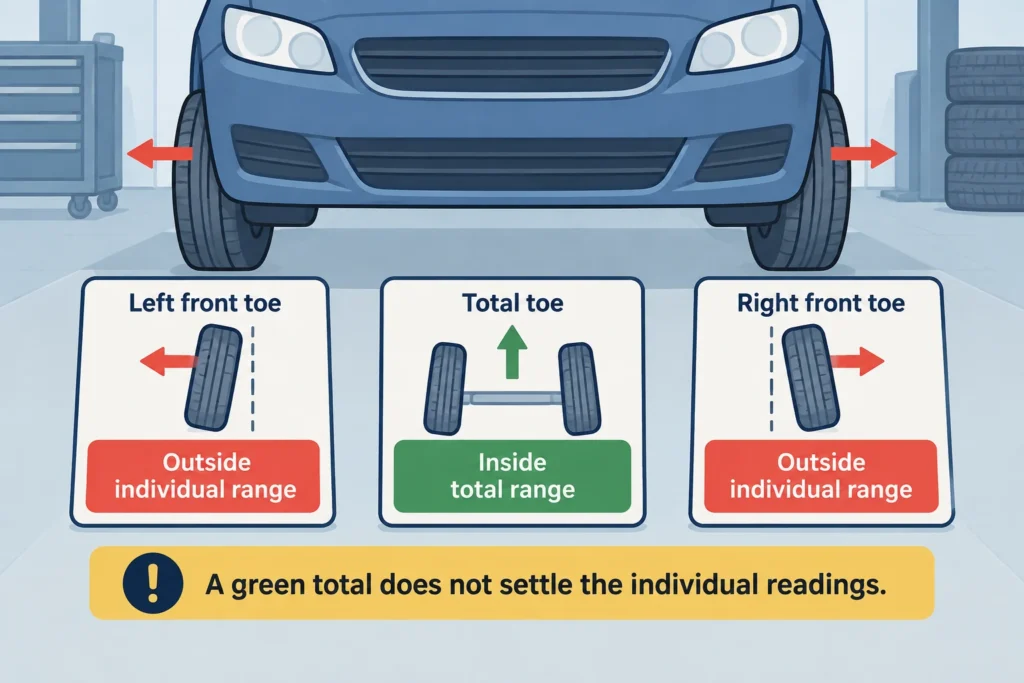
I find the colors helpful after I learn what they are comparing. The colors don’t always reflect the correct specifications. For example, Tesla’s 2017-2023 Model 3 documents describe specifications with and without ballast, and address pressure, ride height, rolling compensation and a caster sweep. The compensation accounts for the effects of wheel and target misalignment. The caster sweep is the amount of caster as the wheel turns. For your car, the specified setup is needed, not a default Tesla setup.[6][7]
You can ask directly, “Are these the current specs for my car, with the required pressures, load, and ride height?” That separates the paperwork from the vehicle without accusing anybody of foul play. Even a perfectly obtained all-green report can’t explain historical wear, rule out a tire-caused pull, or take the place of a component inspection.[2][4][6][7]
Sometimes the right purchase comes before alignment
It might be acceptable to pay for an adjustment to bring the vehicle into spec to pass, given the steering joint has worn or deteriorated bushings and other suspension parts. The wheel can move as forces change, and a static reading on the alignment machine might give a false sense of security. GM’s documented procedure states that prior to an alignment, a check of steering and suspension parts should be performed to ensure that there is no bearing play or other wear or damage. I’d want the shop to list the failed part, provide the nature and extent of the play, or describe the wear and/or damage, and explain why suspension work comes prior to alignment, instead of just listing “suspension work” on the estimate.[2][3]
“That angle isn’t adjustable” also needs more explanation. There are referenced procedures that allow some camber or caster corrections with positioning of components, even without a camber or caster adjuster. Another vehicle may need an investigation for damage or incorrect ride height. As for your specific vehicle, find out what correction the manufacturer allows. A red reading does not warrant aftermarket parts or hardware.[2][6][7]
Approve the finding, not the service label
- Readings outside the acceptable limits, sound components: The manufacturer-permitted correction is approved, final readings are requested.
- Readings within limits, pull or unusual wear: Ask for a diagnosis to separate component effects, tire, and road. Adjustment is not the only answer.
- Documented loose or damaged component: approve the justified, prerequisite component repair.
- The sales staff said a “wear pattern” indicated an adjustment was needed. Ask for measurements and inspection findings before making any purchases.
Tire replacement is a different decision. An unsafe tire needs replacement regardless of geometry. Fitting new tires does not, by itself, indicate that an adjustment is necessary.[1][2][7]
I would prefer to pay for the adjustment now rather than let worn tires lose their alignment. Ask for the before and after report and anything else the shop completed to correct your vehicle. If irregular wear remains on the tires you're keeping, have the shop document progression of the irregular wear at future inspections. Adjusting the geometry of the suspension doesn't change the loss of rubber on the tires.[1][2][7]
Sources and references
- National Highway Traffic Safety Administration: TireWise: Tire Safety Ratings and Awareness
- General Motors, hosted by NHTSA: 05-03-07-009H: Wheel Alignment Specifications, Requirements and Recommendations for GM Vehicles (2015-10)
- Michelin USA: Michelin FAQs
- Toyota Motor Sales, USA, hosted by NHTSA: T-SB-0063-20: Vehicle Pull, Steering Wheel Off Center, and Alignment Best Practices (2020-06-23)
- Hunter Engineering Company: Hunter Safety System Alignment sample printouts
- Tesla: 2017-2023 Model 3 Service Manual: Wheel Alignment
- Tesla: 2017-2023 Model 3 Service Manual: Four Wheel Alignment Check and Adjust