

In many cases, yes, but for the most part, short trips don't necessarily require every service be performed more frequently. Whether they do depends on how your vehicle defines short-trip use (how hot it gets, how often you make short trips, etc.), and what maintenance items that definition impacts. Annual mileage can also play a factor; you may become overdue just by the passage of time. Additionally, there can often be a blanket "severe- service package" of services that includes things your driving may not actually necessitate.
The short-trip definition changes the answer
Consider repeated four-mile trips in mild weather. The US maintenance guide for the 2024 non-hybrid Toyota Camry, including Camry AWD, identifies repeated trips of less than five miles in temperatures below 32°F as a special operating condition. It also qualifies the additional maintenance by predominant use. Those mild-weather trips, by themselves, don’t meet that particular cold-short-trip definition.[1]
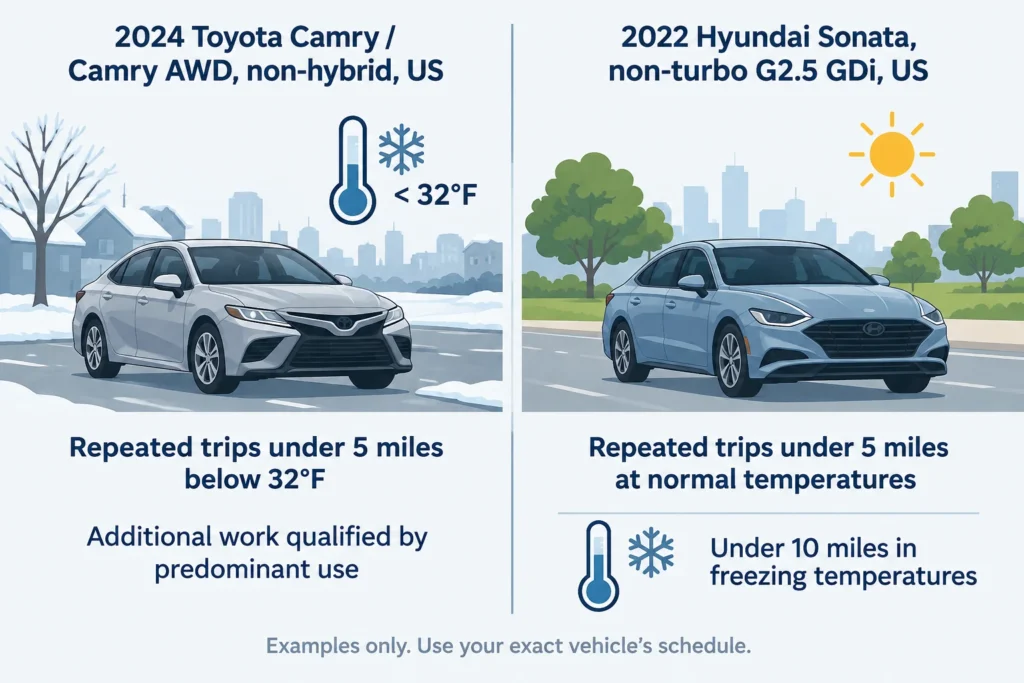
For example, for a US-market 2022 Hyundai Sonata equipped with the naturally aspirated Smartstream G2.5 GDi engine, the definition changes. Severe use condition A involves doing short trips of less than five miles multiple times per day under normal temperatures, or less than 10 miles under freezing temperatures. Four mile trips can therefore qualify under severe use if done repeatedly, without needing freezing weather to apply. These definitions should not be applied to other model years, hybrid variants, or powertrains.[2]
Locate the maintenance schedule for your specific year, engine, transmission and drivetrain for US-market vehicles. Read the operating-condition definitions AND the footnotes at the bottom of the maintenance schedule. If a search result tells you that a manufacturer defines “short trips” as severe, but doesn't provide the whole schedule: disregard it. It may leave out a temperature caveat or refer you to another schedule for another group of products.
Why gentle driving can still matter
Even when short trips put minimal demand on engine power, repeated cold starting allows fuel dilution of engine oil. Although a scientific discussion of fuel lubricant interactions can illuminate why the extent and consequences differ among engine configuration, fuel and lubricant choice, and operating conditions, it can't provide a definitive minimum trip-length or service interval.[4]
Different conditions qualify you for different work. Cold start-short trip driving, in the Camry manual, requires additional oil service. Dusty-road use and towing/loading each qualify you for different maintenance tasks, including select chassis/driveline inspections and AWD fluid service that depends on which equipment you have. Just because you qualify for one condition doesn't mean your car has experienced the others.[1]
Idling, towing, dusty roads and extreme temperatures should be logged separately from miles traveled when comparing actual use to the schedule. These categories can exist independently of each other. Many hours of idling during a short commute may qualify you for multiple conditions; a short commute that takes place on unpaved roads does not automatically qualify you for dusty road filtration service.
Follow the condition into the service rows
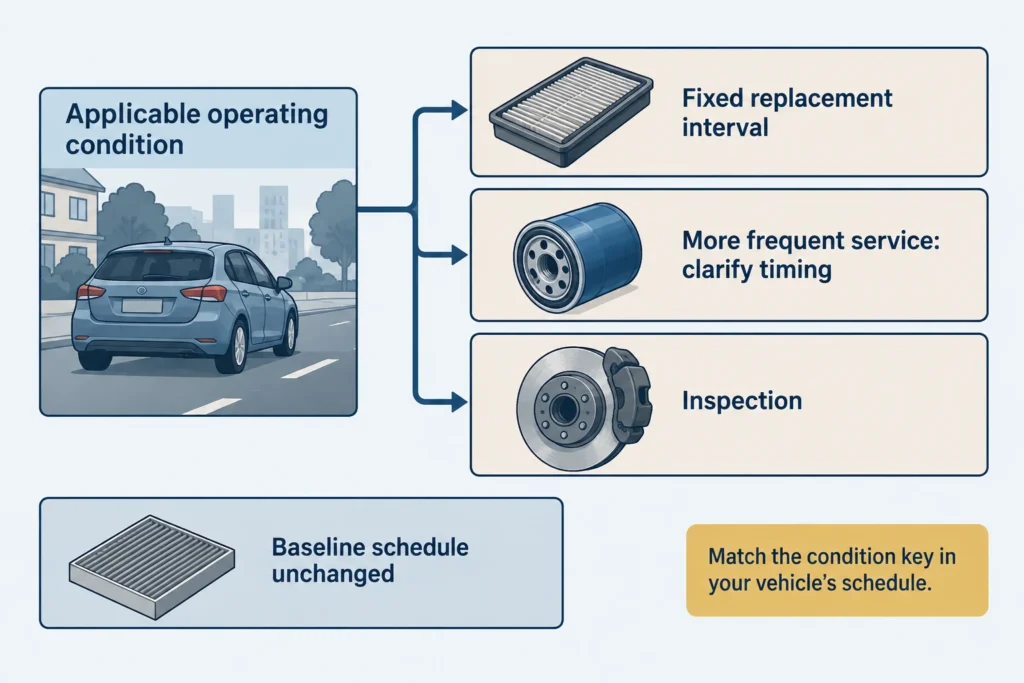
If your schedule has condition letters, locate your letter in each line of maintenance items. If your guide is set up by milestone, read downward through the extra work described under that condition at that mileage/date. Use the normal schedule as your base, and modify only the associated items, not the entire list.
The Sonata example illustrates how important this can be beyond oil. Condition A includes oil/filter change @ 5,000 miles/6 months and automatic transmission fluid change @ 60,000 miles. The normal schedule shows no automatic transmission fluid service for this powertrain. Classifying as short trip creates a transmission maintenance requirement an owner viewing only the normal table would overlook.[2]
"That Sonata' has spark plugs that Hyundai says should be replaced more often under condition A but does not provide a numerical severe-use interval. Please provide the Hyundai service documentation that supports the interval you have specified instead of guessing at a replacement mileage."[2]
The accelerated engine-air-filter and climate-control-air-filter requirements apply to other conditions, not condition A.[2]
Maintain the distinction between inspection and replacement as well. Condition-based inspection may trigger a replaceable item due; it does not automatically trigger an entire new component due regardless of what the inspection finds. Similarly, "more often" is not carte blanche to cut an interval in half. A recommended periodic service should specify if its timing is based on a published factory interval, other servicing recommendation, or a recorded condition discovered on the vehicle.
A low-mileage owner’s next service
Suppose that 2022 Sonata G2.5 GDi has 62,000 miles and routinely makes three-mile trips in mild weather. Its last verified oil service was seven months and 2,800 miles ago. The owner has no transmission-fluid receipt and is offered an all-inclusive severe-service visit.
Waiting until the car has reached 2,800 miles would exceed the six-month time oil limit. Purchasing every accelerated interval would be overkill. Each repeated 3 mile trip helps to set up condition A, but they each still require individual due-dates and completions.[2]
| Service | Applicable requirement | Decision with these facts |
|---|---|---|
| Engine oil and filter | 5,000 miles or six months, whichever comes first | Due by time: seven months have passed despite only 2,800 miles. |
| Automatic transmission fluid | Replace at 60,000 miles under condition A | Verify whether the required service was completed. If it remains outstanding, arrange it. |
| Spark plugs | Replace more frequently; no numerical severe interval supplied | Obtain a vehicle-specific basis for timing rather than assuming replacement is due now. |
| Engine and climate-control air filters | Condition A does not select the accelerated rows | Follow the baseline requirements unless another qualifying condition or inspection finding supports earlier work. |
Absence of a transmission receipt does not prove that the fluid was not replaced. Ask the service shop or prior owner for service records specifically showing the actual fluid serviced, date and mileage. An entry stating that "maintenance was performed" does not prove it was done. If that doesn't clarify it, then address performing what is still required and note that previous service was attempted, but cannot be proven that it did or did not happen.
Mixed driving, reminders, and uncertain records
If your intended use is mixed, then explain what pattern is actually requested by the manufacturer. List out average distances for trips taken, temperature extremes experienced, and frequency of qualifying trips within a reasonable sample time period. Account for seasonal variations. If the wording used in the guide is "predominantly" or "repeatedly" without an established percentage parameter, do not arbitrarily use 50% or presume that one long weekly trip voids the short trips that occur throughout the week. Ask how that particular language applies to the pattern you just listed.
An oil-life display responds to a more specific question. Ford says this about their oil-life monitor on the 2025 Escape: "Your oil timing will be computed based on how you drive your vehicle. Your scheduled maintenance items and time limits will be monitored separately." It does not mean you're cleared for transmission fluid, filters, spark plugs, or anything else that has it's own schedule. Not every dashboard maintenance icon performs that adaptive computation either.[3]
If you're not sure if your trips apply, confirm what trips you are counting with the temp/frequency definition in your driving record prior to setting trips to permanently shorter distances. If you know the requirement obviously applies to you and you're unsure if you've completed it, check your service history. These two inquiries are proved by different documentation.
Maintain the qualifier, interval/inspection required, last completed date/mileage, and next due indicator for each affected service. Keep both mileage and time if they apply. Leave blank what doesn't apply for clarification instead of converting a shop's temporary suggestion into a permanent factory mandate.
Sources and references
- Toyota Motor Sales, U.S.A., Inc.: 2024 Toyota Camry Warranty & Maintenance Guide
- Hyundai Motor America: 2022 Hyundai Sonata Owner's Manual
- Ford Motor Company: 2025 Ford Escape Owner's Manual, Normal Scheduled Maintenance
- Lubricants; author Robert Ian Taylor: Fuel-Lubricant Interactions: Critical Review of Recent Work (2021-09-14)