

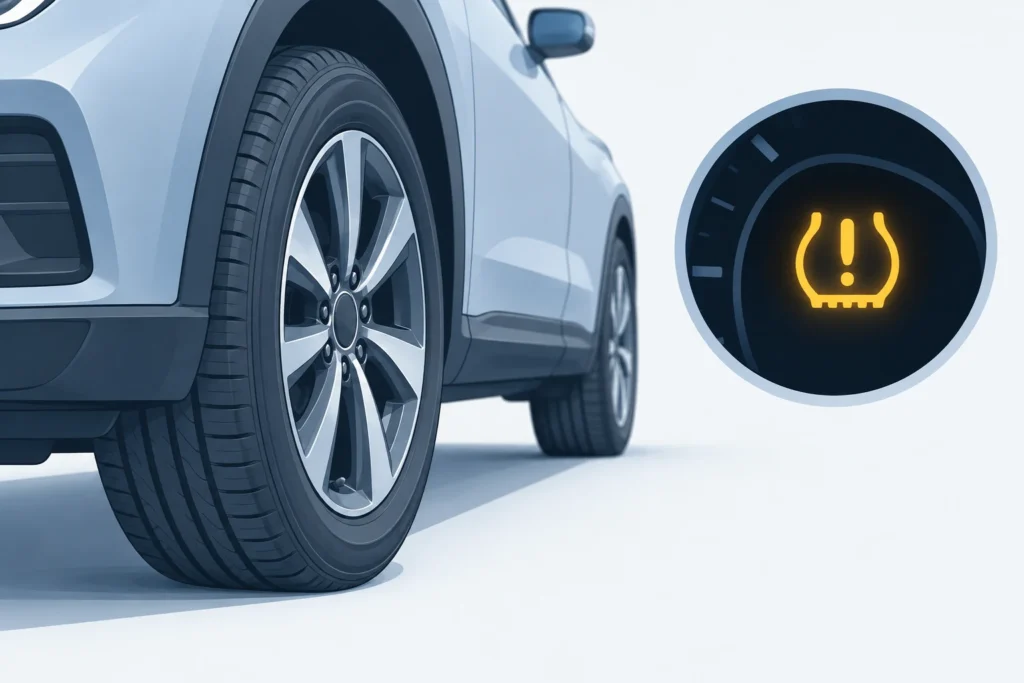
If your tire-pressure light blinks for 60-90 seconds then remains illuminated, this usually means you have a tire-pressure monitoring system (TPMS) failure. If the warning light remains on and does not blink beforehand, this usually means your tires are substantially underinflated. Always check what your specific vehicle warns you about in the owner's manual, but check your tire pressures regardless: a sensor failure can prevent low pressure from being noticed.[1][3]
The sequence matters more than the final light
If you discover the light while driving away, the constant-on presence of the light does not indicate if it blinked previously. When parked and waiting for another startup, after checking the normal startup lamp pattern, observe how long it flashes and what message accompanies it. The typical fault sequence repeats upon startup while the problem is present. Don't wait to check a suspicious tire to watch another startup.[1][4]
A quick start-up flash or alternative blink sequence isn't automatically indicative of the same problem. Search your vehicle's TPMS malfunction description based on your specific model year, which may include a standalone malfunction indicator or a message on your dashboard. The 60-90-second detail is referring to the typical integrated warning light, not all variations of display.[1]
Let the tire findings determine urgency
An apparently normal tire can be underinflated. Don't rely on a radial tire looking as if it has air in it as a pressure test. Check each road tire with a pressure gauge. Compare the gauge reading to the vehicle manufacturer's recommended cold pressure typically found on a placard on the driver's door jamb. Often there is a different recommendation for front and rear tires. The maximum pressure molded on the tire sidewall is not your vehicle's inflation goal.[1][2]
To ensure an apples-to-apples comparison, it's best to check cold tires before driving or after the car has been parked for at least three hours. Never let air out of a warm tire to reach the cold specification. If a warm tire is under even the specified pressure, add air instead of allowing it to stay low, then recheck and adjust when cold.[1]
Pull over when you have a flat tire, a bulge or cords showing, rapid loss of pressure, or driving feels off. Inflate it at your own risk. Don't drive to see your TPMS technician. Inflating it back to normal pressure will not certify that the tire is safe to drive after being driven flat or severely underinflated. Schedule a leak & damage inspection if your tire needs repeated air additions. Don't consider repeat top-offs your "repair".[1][2]
Assuming pressures are accurate, tires show no obvious signs of failure, and the vehicle handles as expected, a malfunction indicator by itself does not indicate an imminent tire failure. Schedule TPMS testing according to the vehicle's guidance and rely on gauge readings when monitoring is unavailable. There is no single PSI threshold or number of miles remaining that supersedes the actual condition of the tire.
A low tire and a monitoring fault can coexist
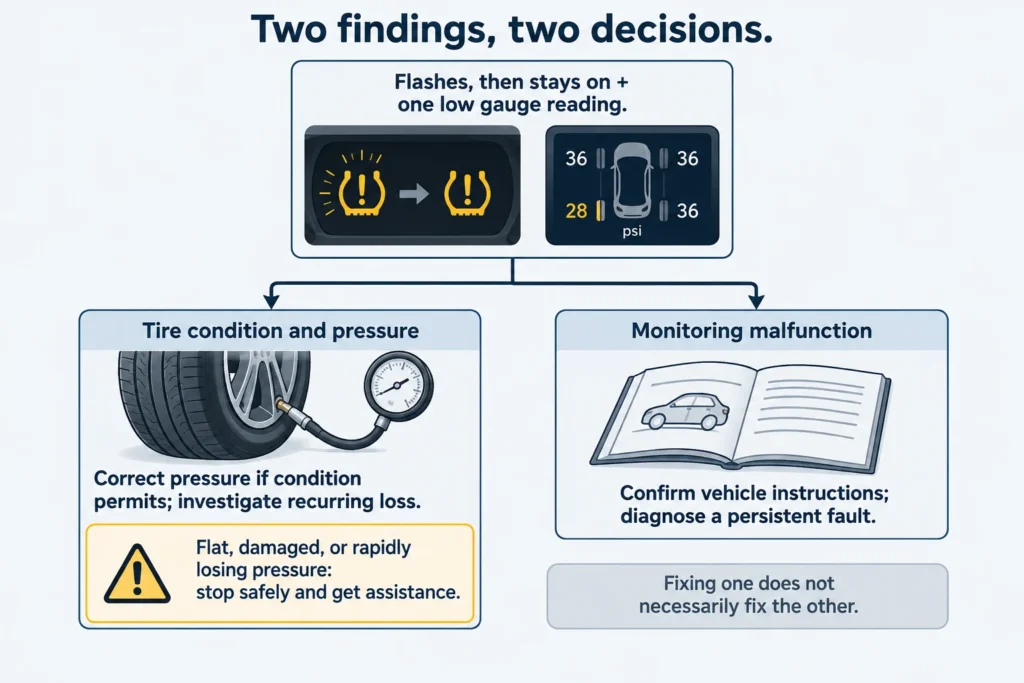
Say the placard on a vehicle reads 35 psi cold at all 4 positions. Three tires read 35 psi, but one reads 27 psi. You could assume the low tire was responsible for the warning. However, if the lamp blinked for a minute before staying illuminated, that fact lends weight to a monitor malfunction too. The low pressure existed; it does not account for the malfunction code sequence.[1][3]
If possible, remedy the underinflated tire's pressure and identify the cause of recurring loss. Independently follow the vehicle's TPMS guidelines and obtain a diagnosis if the system is faulty. Inflating that tire may not correct the monitoring issue just as repairing TPMS may not resolve the loss. These sample readings are not intended to be an all-inclusive standard for safe driving.
Reset instructions depend on the system
Not every TPMS uses pressure sensors inside the wheels. The US-market 2023 Honda Civic Sedan uses an indirect system and requires calibration after pressure adjustment, tire rotation, or tire replacement. Its instructions require setting the correct cold pressures first. Calibration is not a substitute for inflation; beginning it with incorrect pressures undermines the intended baseline.[3]
By contrast, GM’s January 2022 bulletin for its covered direct-sensor systems distinguishes pressure correction from sensor-ID learning: correcting pressure alone does not require relearning, while rotation or sensor replacement does. Neither example supplies a reset procedure for every vehicle. Verify whether your exact system requires pressure correction, calibration, or sensor-ID learning for the work performed.[4]
The malfunction lamp will not pinpoint which sensor failed or provide justification for replacing all sensors. With a direct system, replacements should be made based on appropriate diagnostic criteria including sensor response, learned-ID, etc. GM's bulletin also cautions that incorrect activation-tool placement may result in false findings. An observed "no response" must be supported by a properly conducted test to be used as justification for replacement.[4]
Sources and references
- National Highway Traffic Safety Administration: Tire Safety Ratings and Awareness, TireWise
- U.S. Tire Manufacturers Association: Care and Service of Passenger and Light Truck Tires (2017-06-28)
- American Honda Motor Co.: 2023 Civic Sedan, Tire Pressure Monitoring System
- General Motors: GM Bulletin 07-03-16-004D, TPM System Overview and Diagnosing TPM Concerns (2022-01)