

If you have an ABS issue, you will still be able to brake normally. This could be why your car feels fine when braking, but it's not guaranteed that you should be driving with that light on. Look for other brake issues and feel if your car is braking differently than normal. Make sure you follow the instructions that go along with your vehicle's make and model.[1]
What ordinary stops cannot tell you
When braking normally, your foot applies force to the brake pedal which will create braking force on the wheels. With ABS, the vehicle has electronics that read when the wheels are about to lock up. It will release pressure from the brakes to keep your car from losing traction and allow you to steer. You may not need that function when coming to a stop slowly. So just because your brakes feel normal does not mean your ABS is working. Do not try to slam your brakes on or skid your car to see if it's working.[3]
As an example, if you read up on the 2025 Hyundai Sonata Hybrid, it will tell you that your brakes will still function hydraulically if there is an issue with your ABS, and to have it inspected if the warning light stays on. This explains what you're able to use on that vehicle. This is not saying you should drive any vehicle with the ABS light on. Also, having the light come on during a startup check is different than it staying on.[1]
Read the warning combination
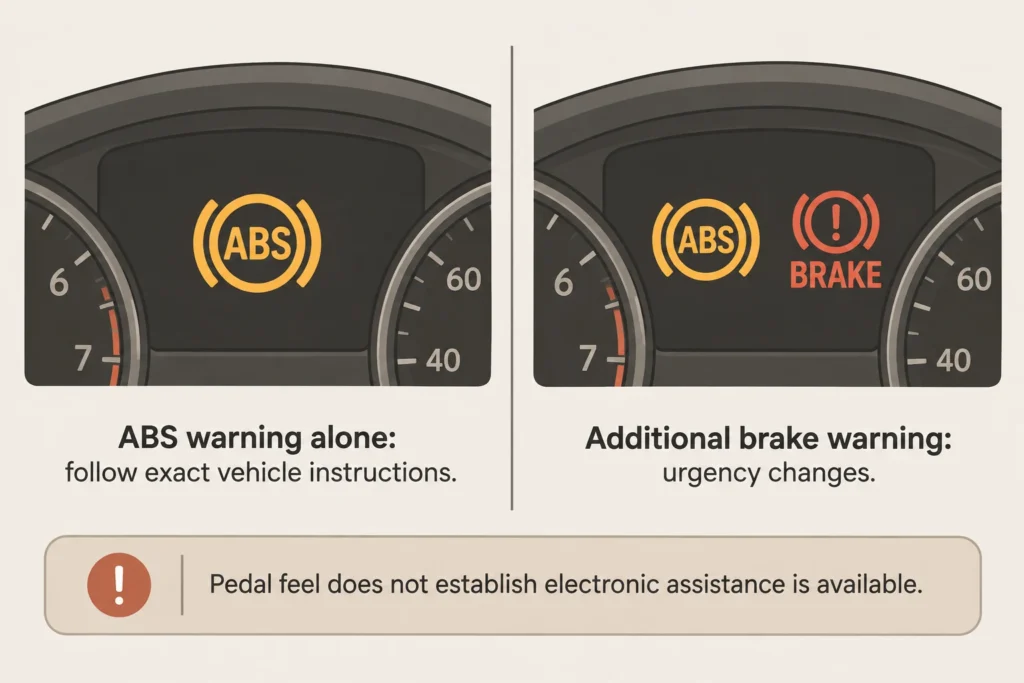
Once you're parked in a safe area, learn what your vehicle's warnings actually look like. Research the warning light for ABS as well as any brake warnings on your specific vehicle. What matters is if the warnings tell you to pull over and what brake features may be compromised and how soon you need to have it looked at, not just whether it's the word brake.
| Warning or finding | What changes the interpretation | Immediate response |
|---|---|---|
| ABS alone; braking feels unchanged | The Sonata Hybrid manual says hydraulic braking remains available with an ABS malfunction. Anti-lock intervention may not be. | Follow your exact manual and arrange diagnosis. This combination alone does not clear the vehicle for driving. |
| ABS plus red brake-system warning | The Sonata Hybrid manual identifies this combination as a possible electronic brake-force distribution problem; braking may behave abnormally. | Do not treat it as an ABS-only fault. If braking is abnormal, stop safely and arrange recovery; follow the combined-warning instructions. |
| Red brake-system warning or stop message | The 2023 Toyota Tundra manual directs the driver to stop safely for its red brake-system warning. | Follow the stop instruction. Do not substitute normal pedal feel for the required response. |
| New soft or sinking pedal, longer travel, reduced braking, or pronounced pulling | A braking abnormality overrides reassurance from an ABS-only lamp. | Stop safely and arrange towing rather than continuing to assess the brakes in traffic. |
| ABS plus stability or traction warning | Related electronic functions may also be unavailable; the exact losses depend on vehicle design. | Read each warning’s instructions. Do not assume stability or traction assistance remains active. |
Conditions can change the travel decision
There is some information that can be shared between ABS, stability control and traction control. Therefore, there could be other issues besides ABS that are affecting your car. However, the ABS light will not tell you all of those things; you will need to know what warnings your vehicle is giving you and/or what diagnostics say.[4][5]
If only the ABS light is on and there is no change in feel to the pedal and your service manual states to have it looked at but not to pull over, driving to a shop over a wet road will not tell you if the ability to lock your wheels in an emergency will be provided. Use other means of travel or have it towed. This goes for snowy roads, icy roads, heavy traffic and mountain roads. No set amount of miles or mph is going to keep you out of that situation.
Assume your braking distance will not always be increased by a certain distance. As mentioned earlier, it depends on what surface you're driving on. There will be some scenarios where your braking distance will be decreased. Having ABS can still benefit you. So if you're unsure what you're told to do when you see that warning, get it towed.[3]
What diagnosis should establish
Make sure you're able to scan your specific car's ABS. You may scan your car for engine codes and get no codes; that does not mean your car was scanned for ABS. Have the shop save the codes and info they are able to get before clearing them. Do not jump to pulling your battery and clearing codes to turn off the light.[5][6]
If a code pertains to a wheel speed sensor, it does not mean your sensor is bad. Stellantis has a process to diagnose if it's the sensor, the circuit or the source that is giving off the code. If you're going to pay money to replace a sensor, make sure they tell you what led them to believe it's the sensor and not the circuit.[5]
Have a picture of your dash with the vehicle parked. Note if the light comes on right away or after driving, any change to your pedal or brakes, and whether you have had any work done on your brakes, tires or wheels recently. Make sure they provide you with the saved codes. Ask what tests were performed to support replacing what you're being charged for and how they will make sure your issue is resolved.
Sources and references
- Hyundai: 2025 Sonata Hybrid owner's manual, Warning and indicator lights
- Toyota: 2023 Tundra owner's manual, If a warning light turns on or a warning buzzer sounds
- National Highway Traffic Safety Administration: NHTSA Light Vehicle ABS Performance Test Development, DOT HS 809 747 (2005-06)
- National Highway Traffic Safety Administration: National Motor Vehicle Crash Causation Survey Field Manual, equipment descriptions (2008-10-29)
- Stellantis; archived by NHTSA: Warranty Operations Newsletter, Volume 10, Issue 9, Generic Procedure for Wheel Speed Sensor Trouble Codes (2024-10-02)
- Bosch Automotive Service Solutions: Bosch OBD1100 operating instructions, revision A (2017-03)