

Pull over and stop the engine if the oil-pressure warning light comes on. Oil level tells you the amount of oil in the system, while oil pressure indicates the lubrication system is able to maintain the required pressure to keep the engine parts separated. Adding the recommended oil to the system will not clear that warning, therefore driving with that condition can be very detrimental to the engine. There is no accepted normal oil-loss rate. The important things to monitor are the amount of oil lost, and how often the oil is lost.[1][2][4][5]
Prior to consumption arithmetic, a properly checked dipstick that is either dry or below the minimum needs attention. Do not run the engine to warm it up for another reading. Adding the recommended oil will not give the total deficiency of the oil in the system. A dry dipstick does not always indicate a critical condition of the lubrication system. If you hear knocking or get a pressure warning, it is always advisable to switch off the engine and contact your mechanic.[1][2]
Give the next bottle of oil a mileage record
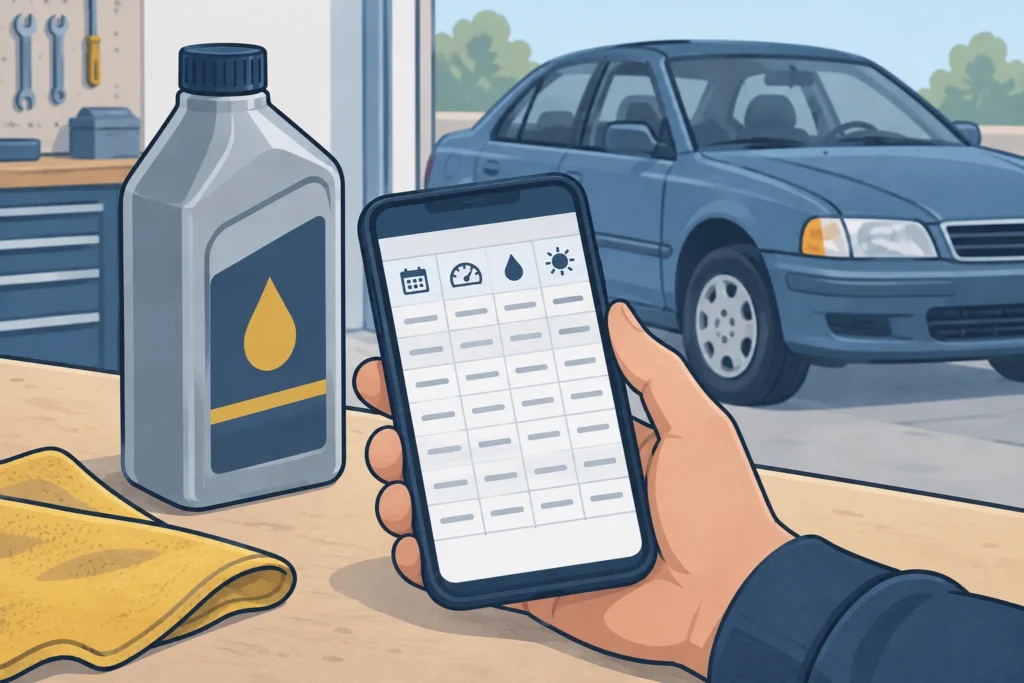
Picture me in an imagined parking-lot scene, holding a half-used oil bottle and trying to remember whether the last top-up was before or after a weekend trip. I’m annoyed: I’ve bought the oil but lost the useful information. Instead of guessing “about a quart a month,” I photograph the odometer and write down the amount added. That’s the habit worth borrowing.
The record is only useful if the readings are comparable. Use the conditions specified for your model year and engine as closely as possible: level ground, specified temperature, shutdown wait and method (dipstick or electronic display). For example, the Ford cited 2025 E-Series manual, allows for a pre-start check or check after warming the engine and waiting 15 minutes after shutdown. It also states not to add oil within the acceptable range. Borrow the idea of consistency not another vehicle’s procedure.[1]
Along with each reading note conditions, date, odometer, amount added, and if it applies, approved oil viscosity. Don’t guess a dipstick mark is a quart. The cited 2025 Camry manual states 1.6 US quarts between its low and refill upper limit marks. One low reading after service does not equal consumption, because you don’t know if the original fill was correct.[1][3][4]
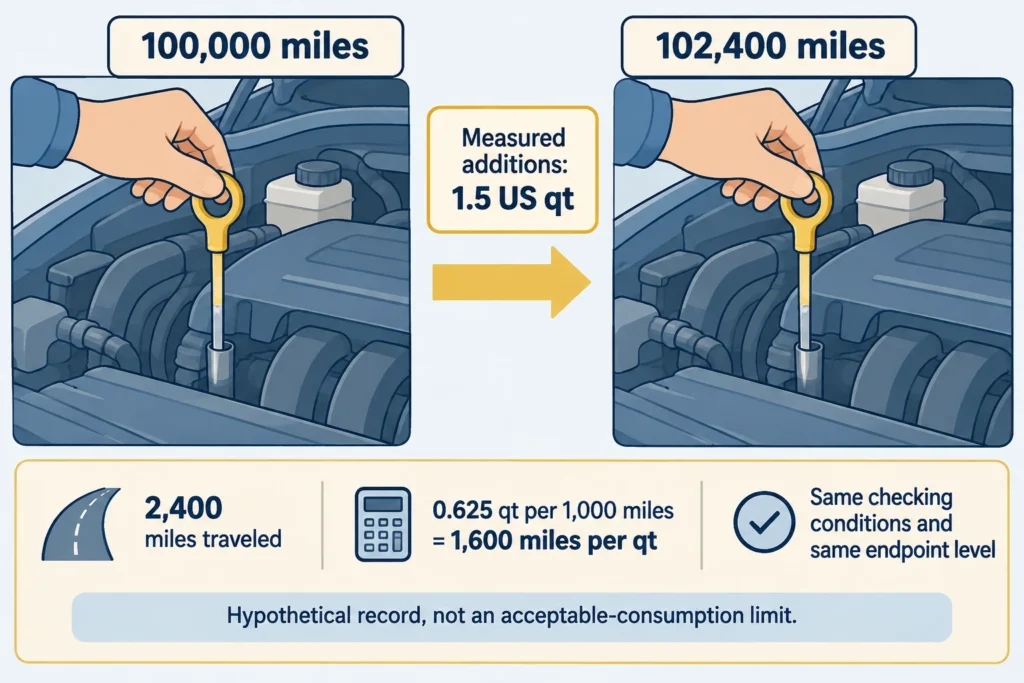
Simplify the calculation by beginning and ending at same level with the same checking conditions and including only measured additions. Include the final addition only if vehicle procedure permits it. If level differences occur after treatment, continue recording or have a shop account for the difference. Oil changes reset the interval.[1][4]
Let’s say your readings are at 100,000 and 102,400 miles, with 1.5 U.S. quarts added between them. The calculation is 1.5 ÷ 2,400 × 1,000 = 0.625 quart per 1,000 miles. Or, 2,400 ÷ 1.5 = 1,600 miles per quart. Now you can make a comparison to the applicable manufacturer criterion, and your car’s previous pattern, not just amass an empty bottle collection. You still don’t know where the oil went.[4]
A clean driveway leaves several explanations open
Cross leakage off the list just because your parking spot is clean. Oil can collect and/or escape while the car is running. The shop needs to check for leakage before they can conclude that oil is being burned. If you see anything (i.e. wet spots, burning smell, etc.) be sure to tell the shop, so they can investigate. Just because you don’t see anything doesn’t mean oil isn’t being burned. I’d want to see the findings from the leak and/or ventilation checks before accepting the answer that the engine is worn out.[4][6]
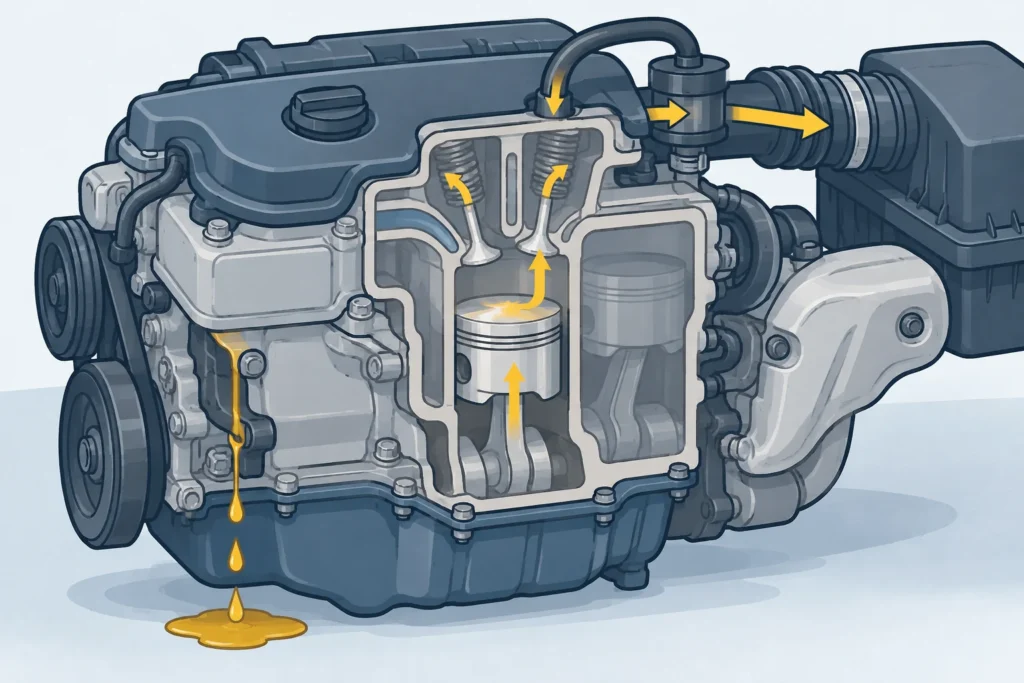
Oil can also be burned through the pistons and/or cylinders. In that case, you might see blue exhaust smoke. The shop can check the valve guides and the ventilation system. If the seals or gaskets are worn, it could also be causing the oil to burn. Blue exhaust smoke can also be caused from the oil leaking past the rings and pistons. A failed PCV valve can also cause blue exhaust smoke and oil to be burned. Other signs of oil burning include a loss of power, low mileage, and a tank of gas that doesn’t last long. No visible smoke doesn’t rule out oil burning. I’d want the findings of the other checks (i.e. ventilation and leak systems) before assuming the engine is worn out.[4][6]
Consider the context when reviewing oil consumption readings, even if they are trending up. GM’s guidance states that fuel and moisture can build up during short trips and cause the indicated level to rise. Evaporation of the fuel and moisture can later resemble oil consumption. Be mindful of changes in driving conditions while reviewing readings, but don’t use this possibility to rule out a failure, or drive aggressively to reproduce it.[4]
“Within spec” answers only part of your question
The published numbers actually are different. GM’s October 2024 bulletin states that light duty vehicles will consume one quart of oil every 2,000 miles, under warranty, maintenance, use and operating conditions. Volkswagen’s September 2024 bulletin states that the listed 2000-2025 models, excluding Routan and ID.4, will consume up to 0.5 US quart every 600 miles. That is 0.5 versus approximately 0.833 quart every 1,000 miles. Neither is a “blanket” allowance that you can apply to an older vehicle.[4][5]
The examples given are from the previous version of the policies, not the latest. Ask your local shop which version is applicable to your specific vehicle. I would also want my previous case taken into account. If you once did not need any additions and now regularly buy oil, “below the allowable limit” does not account for the change.[4][5]
There’s nothing wrong with monitoring your oil level as long as the recorded reading is stable, there are no warning signs of oil pressure issues, you can dependably keep the level in the acceptable range, and there aren't any symptoms of engine problems, like blue/white smoke.
In cases where the loss is steady, you can depend on monitoring how often you check. You must leave enough reserve so that the level doesn't go below the minimum during the time between checks, especially on long trips. I’d make a diagnosis for a new or increased rate of loss, repeated nearly empty readings, running or smoking problems, and/or top-ups that you can’t keep up with. It is better to keep oil in the engine, but it shouldn't be a second job where you cover up a worsening condition.[1][4][6]
Pay for a test that separates quantity from cause
There are multiple things that control the starting quantity, oil type, measuring technique, mileage interval and final measurement for a consumption test. That can help determine rate with better reliability than random dipstick checks. But, it isn't always possible to identify why the rate is elevated from random dipstick checks. For example, if a leak check is performed, and oil is found in the cylinder, that doesn't necessarily mean that the oil was burned.[4][5][6]
Before the test is performed, find out how the shop intends to document and measure the top-up oil. You shouldn't withhold oil to preserve a test. If the repair is approved, find out how the shop intends to check the oil loss and the rate going forward. Replacing oil with an additive or switching to a different oil weight aren't acceptable answers. Useful diagnostics should address both the lost oil and the reason for the proposed repair.[1][4][6]
Sources and references
- Ford Motor Company: 2025 E-Series Owner’s Manual, Engine Oil Check
- Toyota: Owner’s Manual OM35A40U, Emergency Warning Lights
- Toyota: 2025 Camry Owner’s Manual, Engine Compartment
- General Motors; hosted by NHTSA: Service Bulletin 01-06-01-011Q, Information on Engine Oil Consumption Guidelines (2024-10)
- Volkswagen; hosted by NHTSA: Technical Service Bulletin 17-18-06, Transaction 2017813/19, Oil Consumption Measurement (2024-09-18)
- Subaru of America; hosted by NHTSA: Service Bulletin 02-157-14R, Surface Treatment Change to Oil Control Piston Rings (2015-07-28)