

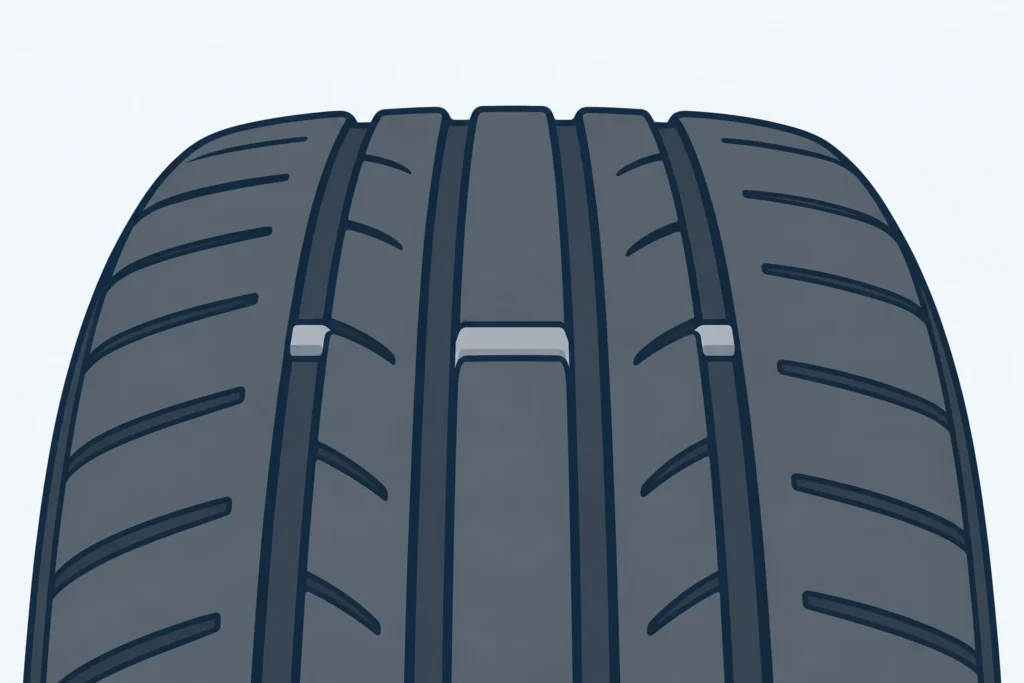
For wet traction performance, AAA recommends replacement at around 4/32" depth. For demanding snow conditions, Nokian recommends replacement at about 5/32-6/32" for winter tires. I wouldn’t go any lower than 2/32", as these are recommendations based on tests done by the tire manufacturers.[1][2][4]
You get a performance buffer for the weather, not just a wear check, by replacing tires earlier. You’d pay the cost and inconvenience for replacement more often based on the lowest localized tread depths, the tire’s construction, and the expected weather conditions. “You need tires” is an expensive sentence without those conditions.[1][5]
Wear bars answer a narrower question
NHTSA advises replacement of tires when tread depth reaches 2/32". Raised strips in the grooves (wear bars) indicate the tire is worn to its replacement limit. Wear bars are not designed or calibrated to give an early indication of loss of traction in adverse conditions.[1]
Safety guidance from NHTSA isn’t the only state law regarding safe tire treads. In Washington, for example, safe tire tread is less than 2/32" in two major grooves at three evenly-spaced locations around the tire. In addition, Washington has rules regarding approved traction tires that require at least 4/32" in the center tread, as well as construction or marking features. These Washington rules aren’t federal standards. So tread depth alone doesn’t necessarily satisfy a state's requirements.[6][7]
So “still legal” and “worth keeping for the weather ahead” can have different answers. I would like a shop to answer which question their recommendation is addressing, instead of just treating every tread number the same.
What the rain testing actually shows
Tread grooves are paths for water to flow through as the tire rolls through it. The shallower those grooves, the worse wet-road performance becomes. The compound and pattern also come into play, which means equal tread depths on two different tires do not mean equal performance.[5]
The 2018 AAA testing provides some substance to their 4/32nd recommendation. In a sample size of six, passenger-car, tires that were artificially worn to 4/32nd, on average, stopped 87 feet farther from a 60 mph stop on wet pavement, than the new tires in the test. It was performed using a 2017 Camry, a set of 215/55R17, all-season tires, and controlled asphalt, with approximately a 1 millimeter water film.[3]
The tires tested were, the Goodyear Eagle Sport All-Season, the Pirelli Cinturato P7 All-Season Plus, the Michelin Premier A/S, the Nexen Classe Premiere CP671, the Fuzion Touring, and the Kumho Ecsta 4X II. This testing was performed in the past and is not a prediction that your tires will need 87 more feet on the next soaking of the roads. Artificial wear doesn’t simulate all the effects of aging and irregular wear. I would like to think the testing provides a decent case to not use the wear bars for deciding when to change tires for wet road performance, and not to use as a stopping distance calculator.[2][3]
Snow calls for planning beyond today’s reading
Nokian’s estimates for their 5/32-6/32” tread depth tire guidance for winter conditions is much lower than Consumer Reports’ recommendation to retain at least 4/32” tread depth for winter use. Average those numbers, and you will still be over Nokian’s recommendation. Consumer Reports’ easy to read account of their snow and ice traction testing includes information from tests comparing three popular all-season models at both full tread (approximately 5/32-6/32”) and approximately half of that tread depth, and does not test for universal snow stopping distances.[4][8]
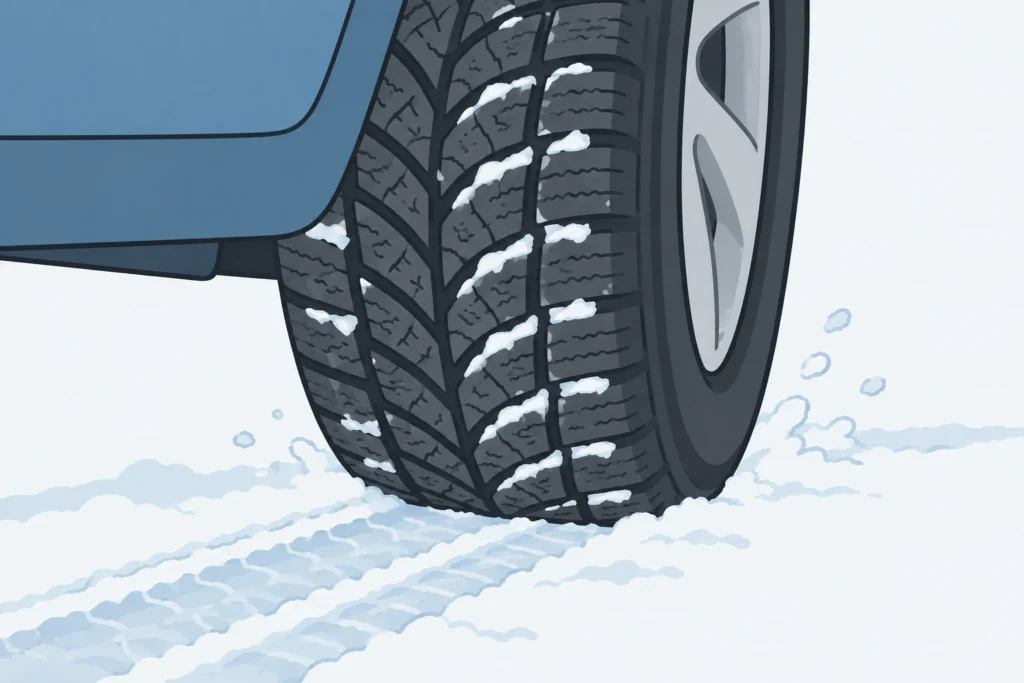
If you depend on your tires in the snow, I would also lean toward the more conservative guidance for winter usage, and review what is applicable for your model specifically. What’s important is having tread left for the entire winter, and not just on the day the tires are put on the vehicle. If your shop isn’t sure, ask which indicator they will be using to measure tread depth, as some winter tires do have separate indicators for winter performance.[4][5]
Tread depth can’t turn a summer tire into a winter tire. There are other factors such as the tire’s pattern and compound that come into play. Ask the shop to identify what the model’s published guidance is for winter use, and what is applicable for your model specifically, including any instructions in your vehicle manual. Without traveling with you, and knowing your specific situation and conditions, I can’t say what is applicable for you.[4][5]
Don’t let a good center reading hide a worn inner groove
Imagine I’m at the service counter, trying to fit a tire bill into a month that already includes an insurance renewal. The worksheet says “5/32,” and I’m ready to postpone. Then I ask for the readings across the tire: in this imagined example, the inner main groove is 3/32, while the center and outer grooves are 5/32. I’m annoyed that the first number hid the useful part, and I change my decision about keeping that tire for rain.
That’s why Continental recommends measuring at multiple locations and using the lowest depth. Take readings in relevant main grooves across the inner, center, and outer tread, then repeat around the circumference. The gauge base rests on the tread blocks, with its probe reaching the groove bottom, not a raised wear bar. An intentionally shallow decorative feature or sipe isn’t automatically a worn-out main groove.[5]
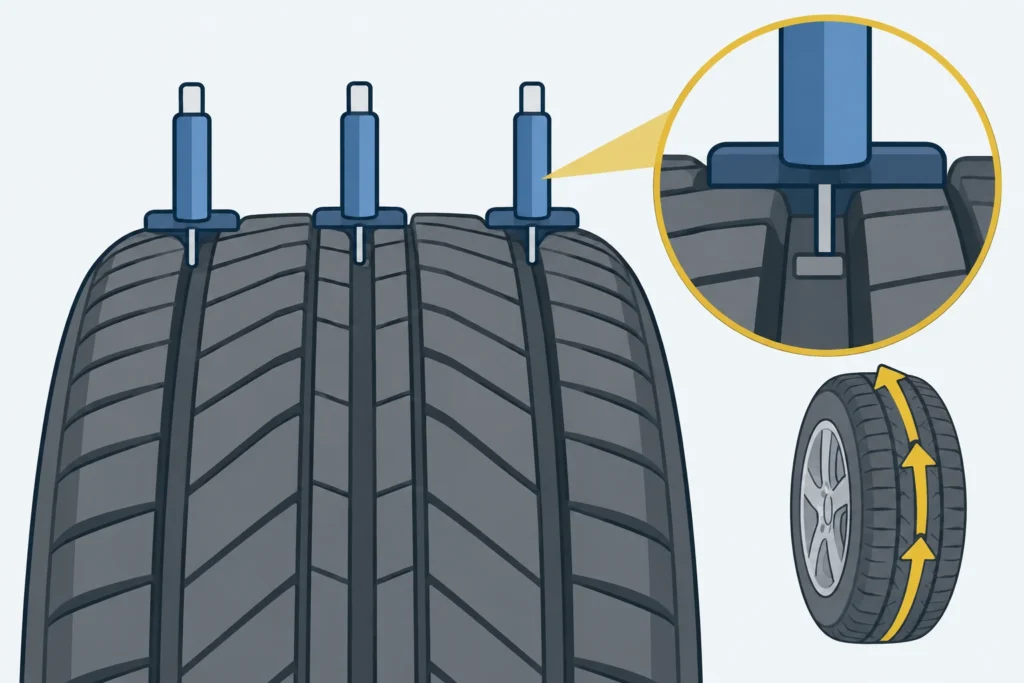
Confirm the shallow wear. I’d also want the cause of that uneven wear explained before paying for new tires that may also wear that way. It doesn’t mean you need an alignment. For more on the pressure side of the argument see our article on [checking tire pressure and preventing premature tire wear](https://dailycarcheck.com/how-to-check-tire-pressure-and-avoid-premature-tire-wear-4/).[5]
Merely having some tread doesn’t mean the tire is ok to drive or that it isn’t worn out beyond the useful life of the tire. A bulge or exposed cords means the tire has structural failure and it should be removed from service (take it to the shop if you have a good spare, or use roadside assistance/towing). Damage and a tire’s age are often interrelated and impact how the tire should be used. For example, a puncture can be repaired, but age, damage, and wear may indicate that the tire shouldn’t be repaired and driven. See our article on [whether a nail-punctured tire can be repaired](https://dailycarcheck.com/nail-puncture-tire-repair-or-replace/) for more.[1][6]
What to ask before paying, or waiting
I’d tell the shop: "Can you show me the lowest readings for each of the inner, center, and outer main grooves at several points around each tire, and record those readings for me? What makes replacement due now? Is it wear bars? Damage? Rain performance? Winter use? Is there some sort of mandate that requires replacement?" Judging replacement by total tread depth only gives you a false sense of security. There are good reasons to replace a tire before other tires reach that point. If replacement is warranted, please see our article on when to replace [one tire versus all four](https://dailycarcheck.com/replace-one-tire-or-all-four/).[1][2][4][5]
If the lowest confirmed readings show acceptable tire condition and there are no mandates for replacement, then we agree that waiting is reasonable. Record the readings, date, and odometer, and place a service due date in about a month, in accordance with NHTSA's recommendation. Bring the check forward if there is about to be a long trip, or if there is about to be winter use. Bring the check forward if wear is becoming ungainly, or is being made worse.[1][2][4][5]
I don’t find it prudent to leave based on a promise of “x thousand” miles. They don’t have a crystal ball and can’t tell you how much tread will be used in the next x thousand miles.
Sources and references
- National Highway Traffic Safety Administration: TireWise: Tire Safety Ratings and Awareness
- AAA: Tread Lightly: Worn Tires Put Drivers at Risk (2018-06-07)
- AAA and Automobile Club of Southern California Automotive Research Center: AAA All-Season Tire Testing (2018-06)
- Nokian Tyres: Winter Tire Tread Depth
- Continental Tires: Tire Tread
- Washington State Legislature: RCW 46.37.425: Tires, Unsafe, State patrol's authority, Penalty
- Washington State Legislature / Washington State Patrol: WAC 204-24-040: Traction devices
- Consumer Reports: Make Sure Your Tires Have Enough Tread for a Snowy Winter