

Some cars require battery registration or a battery-monitor reset after replacement. Others use different learning methods. An identical replacement battery doesn’t exempt your battery from this. I would authorize the task your exact vehicle manufacturer requires, but “programming” on an estimate doesn’t explain what that task is.[1][2][3]
Without your vehicle identification number (VIN) and your proposed battery specification, I cannot confirm whether your charge is necessary. However, you can transform that vague charge to a specific question by asking, “What battery replacement procedure is applicable to my vehicle, and is it included in this charge?”
What does the car need to learn?
Registration informs the battery management system, “This is a replacement battery.” Depending on the system, it resets tracked usage or aging information, and leaves the new battery managed as if it were the old battery. Coding or configuration informs a different question, have the approved characteristics, such as chemistry or amp-hour capacity, changed? I’d ask what information the procedure changes, because manufacturers don’t use these labels consistently.[1][3]
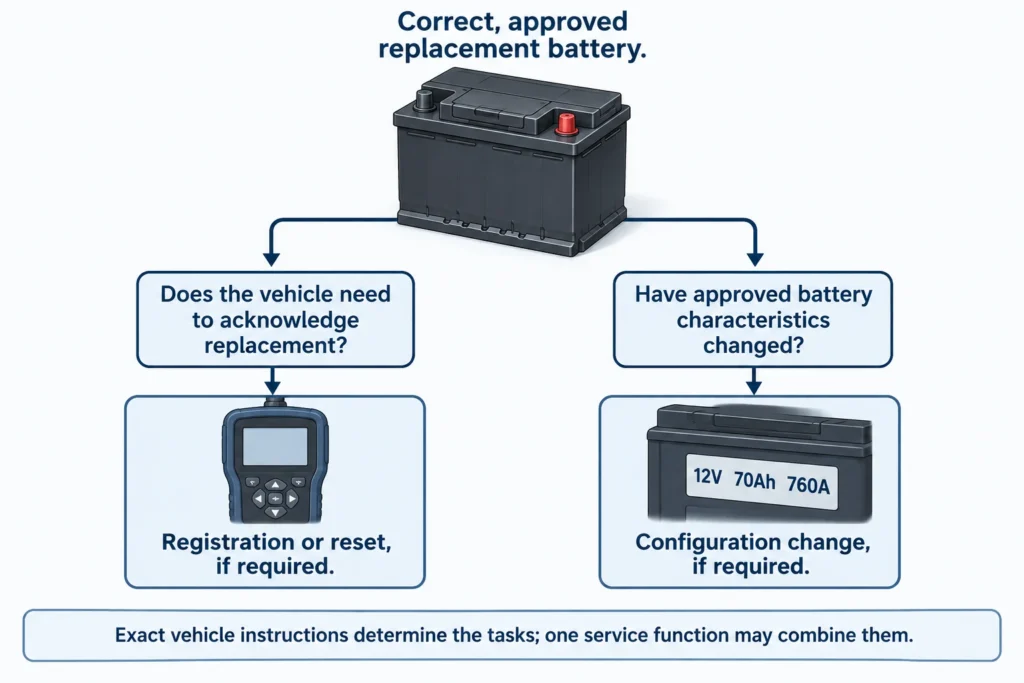
An example provided by BMW in their January 2019 replacement bulletin shows that a replacement of the same capacity still requires registration, and if replaced with a first capacity upgrade, additional retrofit programming would be required. This example is limited to the vehicles mentioned in the bulletin. It also shows why the statement, “same battery,” and “no electronic work” should not be assumed interchangeably.[1]
Learning can mean different things. The 2024 U.S./Canada Ford F-150 manual describes state of charge relearning as a battery sensor reset and a vehicle sleep of eight hours. That means “it learns automatically” and “it needs a reset” can be true at the same time.[2]
Check the vehicle and the battery separately
There are exceptions to why a battery registration check may be needed, and reasons to perform a battery sensor reset may be given, but that doesn’t necessarily prove registration is required. The best lookup is in the current manufacturer battery replacement procedure for your VIN and equipment. There may be exceptions based on model year, engine, production date, market, and which battery is being replaced. A broad list available on the Internet can’t help you.[1][2][3]
Then consider what you’re buying. Insist your installer compare the part number to the approved VIN-specific battery with respect to physical fit and hold-down, terminal arrangement, chemical composition, capacity and starting rating. The battery in the used car may not be the reference battery. Coding can’t change the chemistry of a battery to make it suitable for a given application, and a BMW bulletin states production date exceptions for capacity upgrades.[1][2]
Imagine I’m comparing two estimates on my phone, switching between PDFs that won’t fit on the screen. Both estimates offered the approved battery, but one of the estimates said the price included programming, and the other estimate said nothing. A price comparison isn’t really that easy. If a reset is required by the applicable instruction, I’d check both estimates to make sure each includes the reset before choosing the estimate, rather than crossing out the charge and assuming a software update is provided.
What I’d ask before paying the extra charge
- “Which manufacturer instruction calls for this on my VIN?” A procedure name or reference lets you check the requirement.
- What do you mean by “programming”? Is this a reference to replacement of registration or to a sensor reset? What do you mean by “battery specification”? Is this a reference to a firmware/software update? Extra work should be explained.
- Is this labor included in the install, and does your device perform the required function on my vehicle? Naming a scan tool brand isn’t sufficient.
- What will you document when complete? I’m referring to vehicle, date, mileage, battery part number, actual procedure, and completion.
I’m looking for your confirmation on the actual task, not an autogenic printout. There’s an example of a successful registration and replacement history on Autel’s website, BMW example, where a blank is shown and replaced. There’s also the example of the F-150, which says to reset the sensor by flashing the battery warning lamp three times. If your device can’t export a record, have the installer put the procedure and completion in writing.[2][4]
A passing battery test won’t tell you if registration occurred. You can save money by not replacing the battery. However, if the only explanation is “these cars require programming”, I’d ask for the actual procedure.
Sources and references
- BMW of North America; hosted by NHTSA: SI B61 30 14, BMW Maintenance Program: 12-Volt Battery Replacement Measure (2019-01-10)
- Ford Motor Company: 2024 Ford F-150 Owner’s Manual, U.S./Canada, August 2023 edition, pages 515-516 (2023-08)
- VARTA Automotive / Clarios: VARTA knowledge article collection, Different ways of battery coding
- Autel: Autel scan-tool user manual, Battery section, printed pages 86-93