

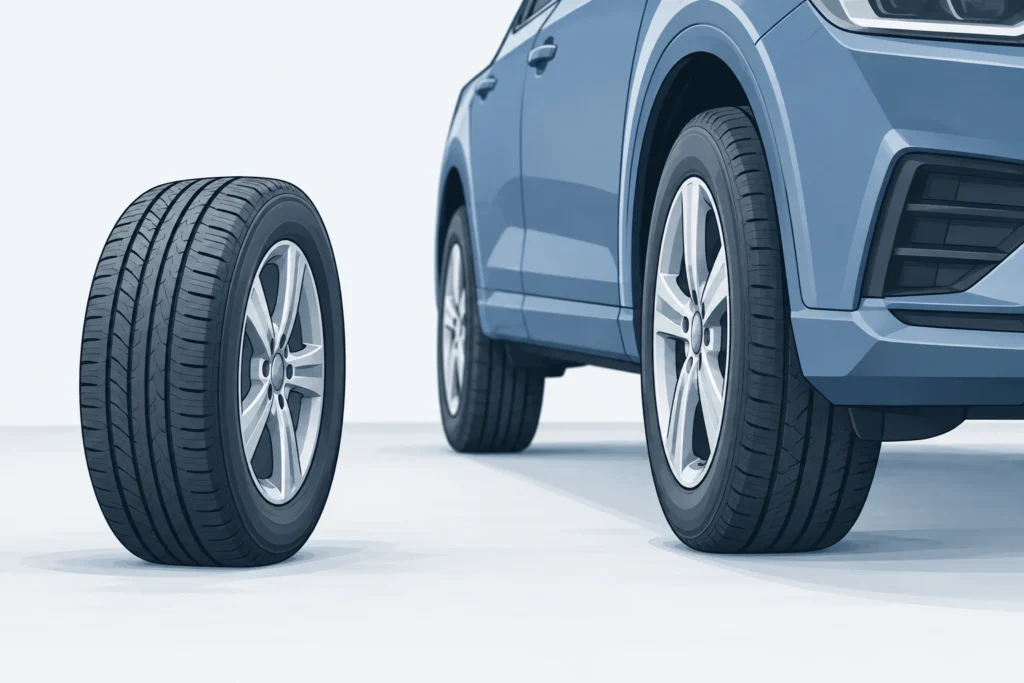
Replacing a single tire is possible, but there are other constraints beyond matching sidewall sizes. I would approve the smallest set of tires that satisfy your vehicle’s requirements and leave a combination that is serviceable. This could be one, two, or all four tires. AWD is not, by itself, a reason to replace all four tires.[1][2]
If the damaged tire is flat, has a bulge, or has exposed cords, don’t drive on it while comparing quotes; tire failure is the immediate concern. Use a permitted spare within its vehicle-specific limits or arrange a tow. If a puncture hasn’t yet been assessed for repair, settle that first. Here, we’re considering a tire that genuinely needs replacement.[1]
Imagine I’m at the counter with a full-set estimate and a ride home waiting outside. The explanation is just “It’s AWD.” I’m annoyed, not because four tires must be wrong, but because I still don’t know what I’m buying my way out of. Instead of arguing for one tire, I ask for the three remaining tread readings and the vehicle’s replacement requirement. Now there’s something useful to discuss.
What does your vehicle actually require?
Different diameters between rolling tires can result in differential speeds and cause concern in a generally closed system. Sensitivity to these stresses varies among AWD systems, so a rule used for another system can’t be relied upon to set yours.[1][5]
The shop should provide the owner’s manual or service information for your vehicle from the manufacturer that pertains to your model year and your tire fitment. Does it call for replacement in pairs? Matching all four tires? A particular maximum tread depth or a difference in circumference? A general statement that, for best performance, the tires should be replaced in pairs is not a restriction that would allow replacing only two tires on a vehicle.[1][3]
There is not a universal maximum allowable tread difference that I can quote you. If your manufacturer requires a specified tire circumference, the shop should analyze that using the appropriate method, not replace it with a tread depth requirement from a retailer. Tread depth and rolling circumference are somewhat related, but they are not the same.[1][5]
“Same size” is only the beginning
The proposed replacement should be identified by brand and model, nominal size, load index, speed rating, construction, and category, and any pertinent original equipment specification. Tires of the same size can have differing constructions and tread designs. A size label does not prove equivalent rolling circumference, and in fact, a new tire will likely be longer than the worn tire being replaced.[1][2][5]
I would be looking for the same brand and model tire, first, not the next best tire that is available. Factory specified staggered fitments allow for different tire sizes on the front and rear. “All four must match” should not be taken to mean that the tires should be of the same size that were on the vehicle when it was manufactured.[1][2][3]
One low reading can change the purchase
Get tread readings for each retained tire, including wheel position. Wear can be uneven. A single center reading can hide a worn inner shoulder. In one example, the 2020-2024 Model Y service procedure has the technician measure inner, center, and outer tread depths and advises against measuring on raised wear indicators. Additionally, the service procedure advises inspection of tires for damage and other condition concerns.[1][4]
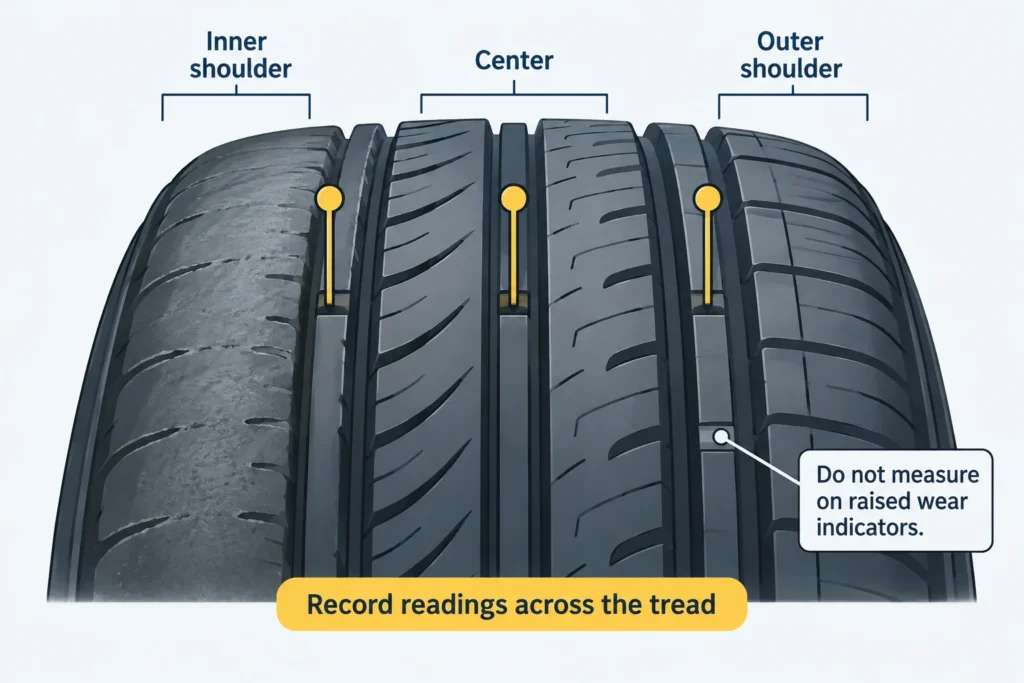
Here’s a hypothetical calculation using the cited US Model Y owner’s manual, not a general AWD limit. For early replacement, that manual recommends replacing tires in pairs unless the other tires are within 2/32 inch of the new tire, and it calls for matching the older tires’ brand and model. Suppose the matching new tire measures 9/32 inch and the three retained tires measure 8/32, 8/32, and 7/32. Their differences from the new tire are 1/32, 1/32, and 2/32 inch. Those readings fit the stated single-replacement exception, assuming condition and the other fitment requirements also check out.[3]
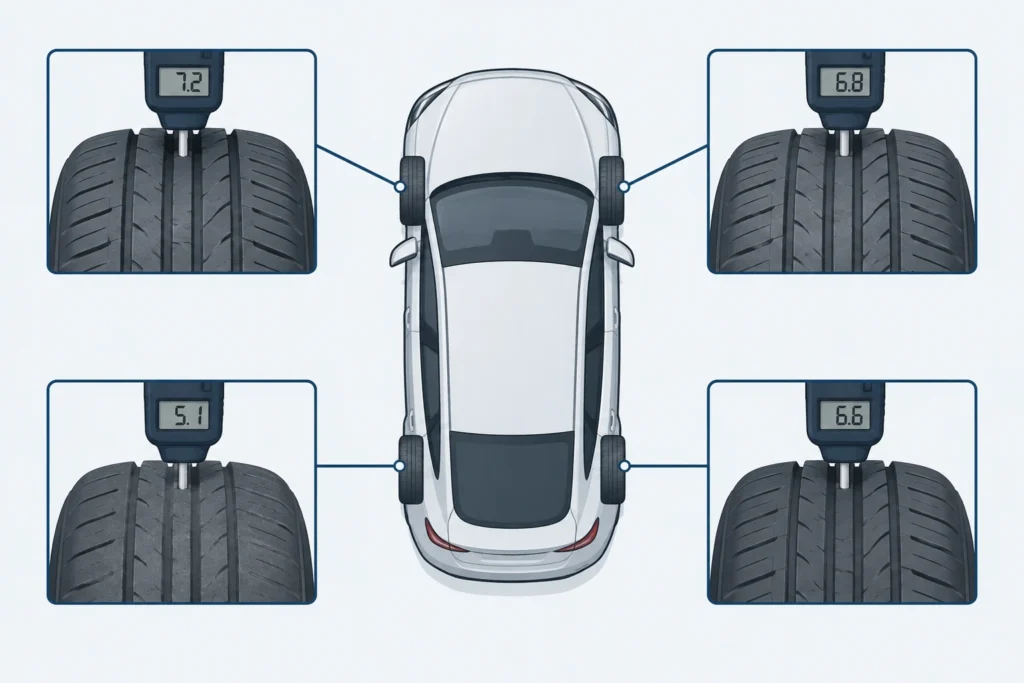
Change the last retained tire to 6/32 inch and the largest difference becomes 3/32 inch. The proposed single replacement no longer fits that exception. It doesn’t automatically follow that four are required: the next question is whether a permitted pair and placement solve the problem. Averaging the three readings would obscure the tire that changed the answer. Use your own vehicle’s applicable instructions; the cited service procedure covers 2020-2024 Model Y vehicles, while the live owner’s manual is a separate source.[3][4]
Compare the finished set, not just the tire count
| Proposed purchase | What would support it | What can rule it out |
|---|---|---|
| One matching new tire | Retained tires are serviceable; the finished set meets the specified matching limits and placement instructions. | Excessive mismatch, incompatible specifications, or a required pair/full-set replacement. |
| Two matching new tires | Pair replacement is permitted, and the new pair remains compatible with the retained pair. | An all-wheel matching requirement that the finished set still fails, or unserviceable retained tires. |
| Four new tires | A smaller set cannot satisfy the requirements, or all remaining tires also need replacement. | A full-set preference alone doesn’t prove that fewer tires are incompatible. |
| One professionally shaved new tire | The exact vehicle and tire requirements permit it; a documented target and finished measurements produce an accepted match. | No applicable approval, unsuitable retained tires, or an installer unwilling to accept the proposed combination. |
Placement is part of that comparison. USTMA generally recommends putting new pairs on the rear to reduce the risk of the rear losing wet-road grip first. If a single replacement is unavoidable, they recommend pairing it with the deepest-tread retained tire on the rear. That is general guidance. Replacing a tire with a different size can restrict moving tires between axles and reversing the direction of a directional tire can compromise handling.[1][3]
Ask about tread matching, with the conditions attached
Tire shaving is the process of removing a portion of the tread on a new tire to match a lower tread depth tire. Tire Rack offers this service for AWD/4WD matching. I think it’s valuable to have another methodology to analyze this issue, but the fact that a retailer offers it doesn’t mean they’ve approved the practice for every vehicle and tire. Be sure to check the specific vehicle and tire manufacturer’s requirements to make sure your match is correct, measure the finished matching tires, find out if the installer is okay with the match, and check your warranty if you have one.[1][5]
You are paying for a new tire and losing some tread life with that trade-off. If the other three are nearly replaced, that may not provide much added use. An old tire of the same tread depth is a different situation. You have a lot of unanswered questions about that tire. A tread gauge is not going to answer all of your questions about the tire.[5][6]
Before I approve the work, I’ll ask to get the current tread depths of the tires, when replacement is required, the model of the tire being replaced, the final position of the wheels, and an estimate of the mounting, balancing and any other work being done. I’ll want to see all this before authorizing the purchase of the tires. If the requirements are met by two tires, I will purchase the two. If only four tires meet the requirements, I’ll want to purchase those four before purchasing one tire.
Sources and references
- U.S. Tire Manufacturers Association: Care and Service of Passenger and Light Truck Tires (2017)
- Michelin: Can You Mix Tires? What to Know Before You Do
- Tesla: Model Y Owner's Manual: Tire Care and Maintenance
- Tesla: 2020-2024 Model Y Service Manual: Tire Rotation
- Tire Rack: Do All 4 Tires Need To Match On An All-Wheel Drive Or Four-Wheel Drive Vehicle?
- U.S. Tire Manufacturers Association: USTMA Efforts to Combat Unsafe Used Tires