

Don’t judge a line item by its position next to the main repair. Approve the main repair and vehicle-related work to complete it. Consider replacements for shared labor separately and verify scheduled maintenance against the service history. Recommendations are held for lack of justification. An item can be necessary and/or worthwhile even if it hasn’t failed.
An illustrative estimate, separated into decisions
The following estimate is fabricated. It is neither a real quote nor a pricing benchmark. Assume the shop has documented a leak and has replaced the water-pump assembly. The amounts shown are before taxes, and the $120 diagnostic charge was approved with no repair credit and is shown for illustration. These assumptions do not dictate what a particular vehicle needs.
| Estimate line | Amount | Purpose and supporting information | Timing and authorization |
|---|---|---|---|
| Cooling-system diagnosis | $120 | Pays for testing and identifying the leak, not replacing parts. | Already authorized; owed under the example's agreed terms. |
| Water-pump assembly | $380 | Corrects the documented fault; assembly replacement is supported in this example. | Approve for the repair. |
| Pump seal/gasket | $0 additional | Required for assembly installation; included in the quoted assembly price. | Include in the approved scope, without a second charge. |
| Removal, installation, and repair verification | $260 | Labor to complete and verify the stipulated pump repair. | Approve; clarify what verification is included. |
| Correct coolant, refill, and air removal | $60 | Restores coolant lost or drained during repair using the applicable specification and procedure. | Approve as repair-completion work. |
| Drive-belt replacement | $95 additional installed | Shared-access opportunity; no defect or replacement trigger documented. | Hold unless its condition or incremental value supports choosing it. |
| Brake-fluid service | $140 | Separate maintenance recommendation; schedule and last service initially unverified. | Hold pending records, then approve separately if confirmed due. |
| Fuel-system cleaning | $160 | No applicable requirement, symptom, or diagnostic finding supplied. | Do not authorize on the information provided. |
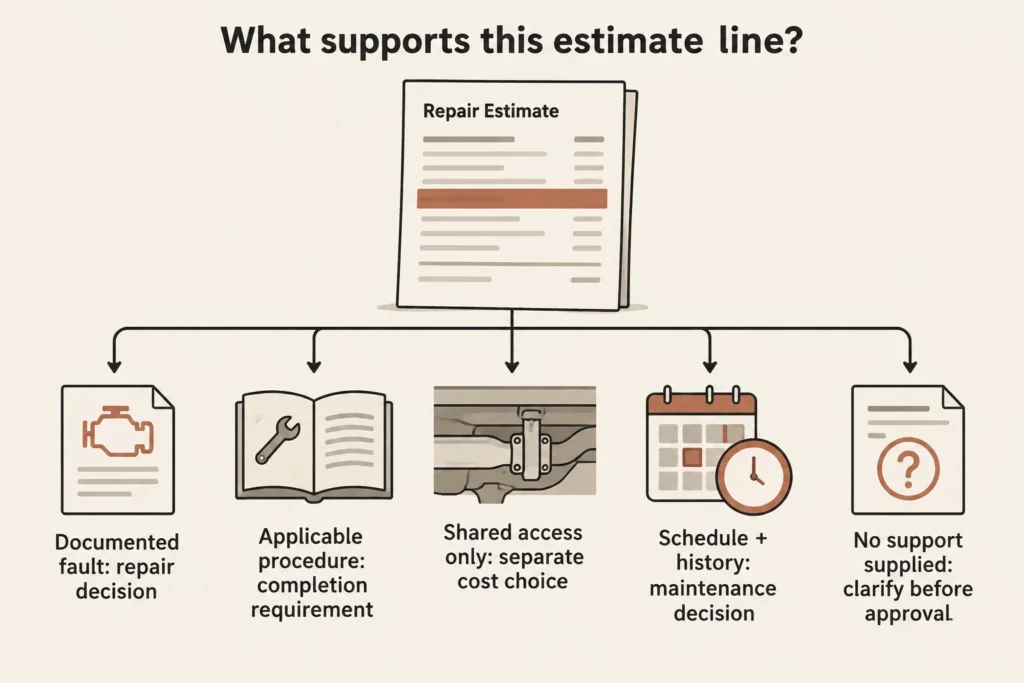
Removing all lines other than “water pump” does not eliminate the main repair. The main repair also includes the seal and the recharging of the coolant. The diagnosis and the repair add up to $820, of which the diagnosis was previously approved at $120. A belt replacement and a brake-fluid service and a cleaning should be considered and decided upon separately rather than accepting or rejecting the entire repair order.
What makes related work necessary?
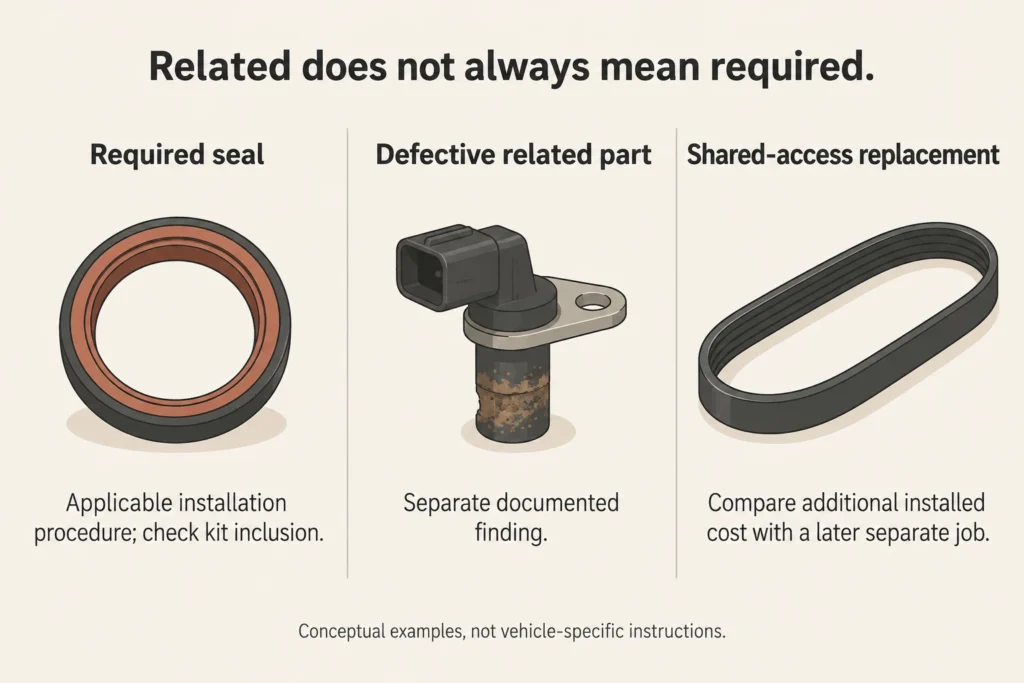
Required work should be supported by a repair procedure rather than proof that a failure has occurred. Seals which have been disturbed during removal may also need to be replaced in order to restore the integrity of the system. Ask which operation the part is required for, and confirm if the part is already included in the assembly or kit. Manufacturer instructions may direct a technician to follow additional service information for one-time-use parts.[4]
The fault itself also determines the repair scope. Subaru bulletin 09-83-21R, for specified 3.6-liter Legacy, Outback, and Tribeca applications, describes a condition-dependent path that can permit gasket-only replacement when the relevant groove can be cleared of residue; it also states that the pump assembly includes a new gasket. This historical example shows why “pump leak” alone does not settle assembly replacement or a separate gasket charge. Current instructions must match the vehicle and finding.[4]
Another defective part requires its own evidence, such as a leak, failed test, measurement out of specification, or identifiable damage. “Nearby” and “usually replaced together” do not identify a defect. If the shop also requires replacement of the part as a condition of its own warranty, ask the shop to explain how that situation is different from a manufacturer procedure or an inspector finding; this may warrant comparing another shop’s supported scope.
Concurrent access encourages an economic decision, not a diagnosis of failure. Consider the case of the illustrative belt. Compare the $95 additional cost, installed, to the price to replace it later. What labor is saved? Does the combined quote reflect savings? These, along with the condition and replacement trigger, impact the decision; access alone does not impact these.
Required fluid restoration is not the same as a preventative flush. The example given shows that the correct removal of coolant and air completes the repair. A separately charged flush should have an explanation of what additional work is completed by the flush, and why it is necessary. Likewise, a maintenance item to inspect a component is not an instruction to replace it. Manufacturer schedules usually specify what work is to be done, how often, what conditions trigger the work, and what exceptions apply.[5]
Diagnosis and teardown are separate commitments
Prior to testing, agree on the diagnostics fee or limit, the tests it covers, and whether any diagnostics fee will be charged to the customer. The diagnostics fee may remain payable should the customer take the vehicle for repair elsewhere, or should the customer refuse to have the repair done at the shop. Discuss the shop practice of using flat-rate times or actual times for the repair. A given labor amount need not equal the number of hours the car is in the shop.[1]
Sometimes an estimate remains conditional, and true costs cannot be determined until further disassembly. In these cases, know what will trigger the need for additional repairs, and know what these additional repairs will be. Before authorizing disassembly, know how much will be charged for inspection, what will be charged for reassembly should you decide against having the repair done, what parts will be consumed, and what the conditions will be for restoring the vehicle to its prior condition. Otherwise, “stop work” may leave a vehicle that cannot simply be driven away.[2]
Calif. regulators explicitly mention teardown costs, reassembly costs, commonly destroyed parts and when the original condition of the vehicle may not be restorable. Those are state-specific disclosures. However, the cost questions are useful everywhere. Ask for a stopping point after the inspection with findings and an adjusted estimate before continuing with the repairs.[2]
When a second opinion changes the decision
A second opinion may be warranted in case the repairs recommended have a high cost and/or a high level of complexity, the recommended repairs are beyond instructions for use, and/or the recommendations are vague. The FTC suggests obtaining a second opinion for repairs with a high cost and/or a high level of complexity. A second opinion, in the form of an independent diagnosis, may validate whether a recommended repair is justifiable.[1]
Bring an itemized estimate, the vehicle identification number and mileage, the original symptoms, a diagnostic report and/or codes, test conditions and results, inspection photos, recent service records and be clear about what tests are being repeated. Describe parts being replaced, the completion of repair operations and/or warranty terms and conditions, not just the repair cost totals. If safety of the vehicle has not been verified, or if the vehicle has been taken apart, be clear about recovery and reassembly arrangements.
Leave with an approved scope, not just a smaller total
Imagine the preference is to approve just the $820 diagnosis and complete pump repair. Based on the applicable maintenance schedule and dated service records, brake fluid replacement is due, making the $140 line an independently justified maintenance recommendation. Approval of that line results in a subtotal of $960, and the brake fluid replacement becomes part of the expense to repair the pump. The belt is a discretionary shared-access expense, and the pump still does not include the recommended cleaning.
Ask for a revised estimate to include the approved repair and brake fluid service, the previously approved diagnostic charge, and the belt and cleaning which are all unapproved. Verify the estimate includes the gasket, how diagnostic credit is given, parts descriptions, repair verification, warranty, every tax or fee, and each service charge. The subtotal of $960 is not an out-the-door approval, and the remaining charges must also be approved.
Just because a national rule allows a shop to exceed an estimate by 10% does not mean other state rules are the same. For example, in California, written authorization is required before any repair work can begin, and additional authorization is also required to permit a change in the scope of work. In New York, a written estimate is required upon request, and authorization is required to exceed the estimated price. In both of these cases, the shop is bound to follow the rules of the state, and not a national rule allowing for a 10% overrun.[2][3]
Use an approval boundary and clearly state: “Authorize only the listed pump repair, completion materials, and brake fluid service at the revised total. The diagnostic charge is already authorized. Do not perform the belt replacement, cleaning, or other work. If you find additional damage, send the report and the added work first for approval.” Keep a copy of the work order and approvals for a comparison to the final billing.
Sources and references
- Federal Trade Commission: Auto Repair Basics
- California Bureau of Automotive Repair: Write It Right: Documentation and authorization requirements for automotive repair dealers (2026-01)
- New York State Department of Motor Vehicles: Know Your Rights in Auto Repair
- Subaru of America; hosted by NHTSA: Subaru Service Bulletin 09-83-21R: 3.6L Water Pump, Design Change / Coolant Leaking (2022-03-07)
- American Honda Motor Co.: To Use Maintenance Minder, CR-V Hybrid 2026