

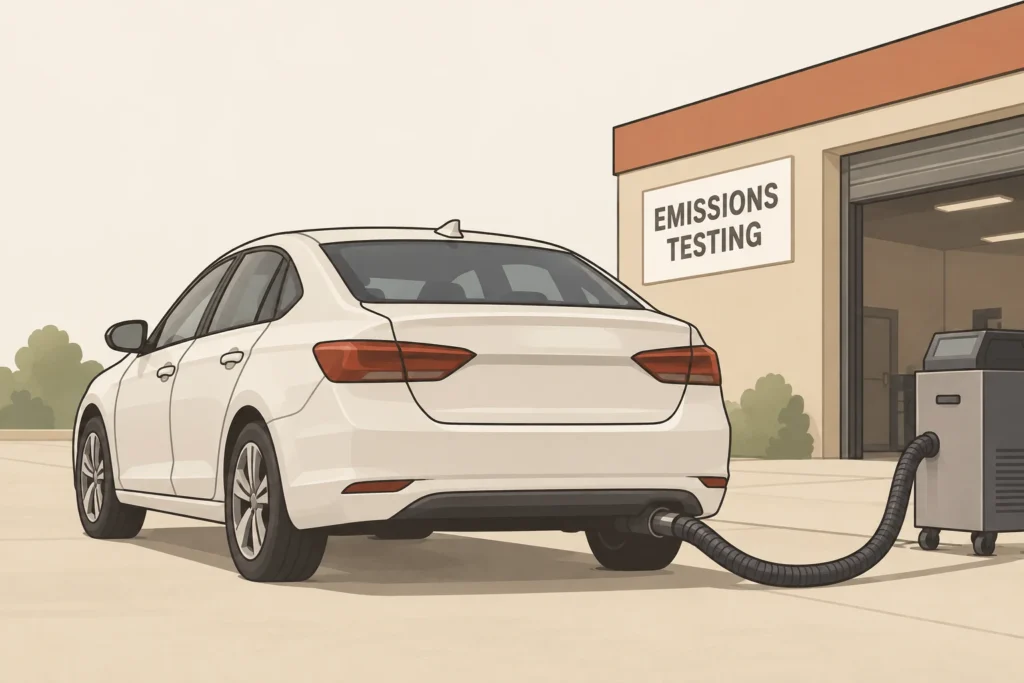
“Not ready” indicates an emissions self-check is in progress, but not complete. “Not ready” does not certify healthy emissions or excessive emissions and does not allow replacing the component named by the monitor. If the inspection program permits it, you may want to consider completing only those monitors that your inspection program requires.[1]
Read the report’s separate findings
- Not ready or incomplete: The vehicle has begun the check but not completed it.
- Ready or complete: The check has been run but completion of the check does not validate that no fault was found.
- Not applicable or unsupported: The check is not used by the vehicle, and this is different than an unfinished supported monitor.
- Fault information: Diagnostic trouble codes (DTCs) or check engine light (CEL) status are separate from incomplete readiness.
An incomplete readiness status with a dark CEL does not allow an inspection. Likewise, a report stating “Failed” or “Rejected” requires the reason for failure or rejection be decoded. An inspection report and, if available, a monitor status scan should be saved prior to any reset.[1][2]
Why more miles may not finish the checks
Battery disconnection, loss of battery power, or clearing of diagnostic codes can reset readiness. Repeating a reset can erase the progress you are attempting to make. Record when battery work or code clearing occurred. Do not clear codes to turn off the light before a retest.[2]
Not all monitors are set during an inspection. To test monitors, a car must be in certain conditions, and driving a car by itself does not guarantee those conditions will occur. The 2017 Ford E-Series Owner’s Manual states that the ignition must be turned off for a minimum of eight hours as part of their readiness procedure. This information helps explain why repeated driving does not always set monitors. It is not giving instruction on how to set monitors in other vehicles.[3][4]
Incomplete monitors can also be caused by a condition that prevents the monitor from being tested. The name of the monitor does not explain what part is bad. General Motors (GM) Bulletin 15-NA-010, for example, states that some of their new gasoline vehicles disable the oxygen-sensor diagnostics during the break-in of the calibrated catalyst. A technician must verify this before a test can be run, and it is not a general instruction to break in the catalyst on all vehicles.[3][5]
The monitor’s identity changes eligibility
Use the specific rules for your program that pertain to the vehicle’s model year, type of fuel and incomplete monitors. Do not solely depend on a scanner to indicate a vehicle is “inspection ready,” or rely on a one-monitor allowance.[2][3]
Consider a hypothetical 2015 gasoline vehicle, inspected a short time after battery replacement. The owner drove the vehicle 120 miles, and although the check engine light was out, the catalyst and EVAP monitors were still incomplete. The mileage driven does not make a difference; the dark light or driving does not prove monitors are complete. A reset of the monitors is a possibility, but the monitor status report does not indicate if that is the case.[1][2][3]
Assume a later scan reveals EVAP completion with catalyst incompleteness. NY’s published allowance for 2001 and newer vehicles states only one monitor can be incomplete. Therefore, the vehicle meets NY’s readiness standard. CA’s standard for 2000 and newer gasoline vehicles only allows EVAP to be incomplete; therefore the same result would not qualify the vehicle for readiness in CA. If catalyst completeness leaves EVAP incomplete, both examples would qualify for readiness, assuming no vehicle exceptions apply.[2][3]
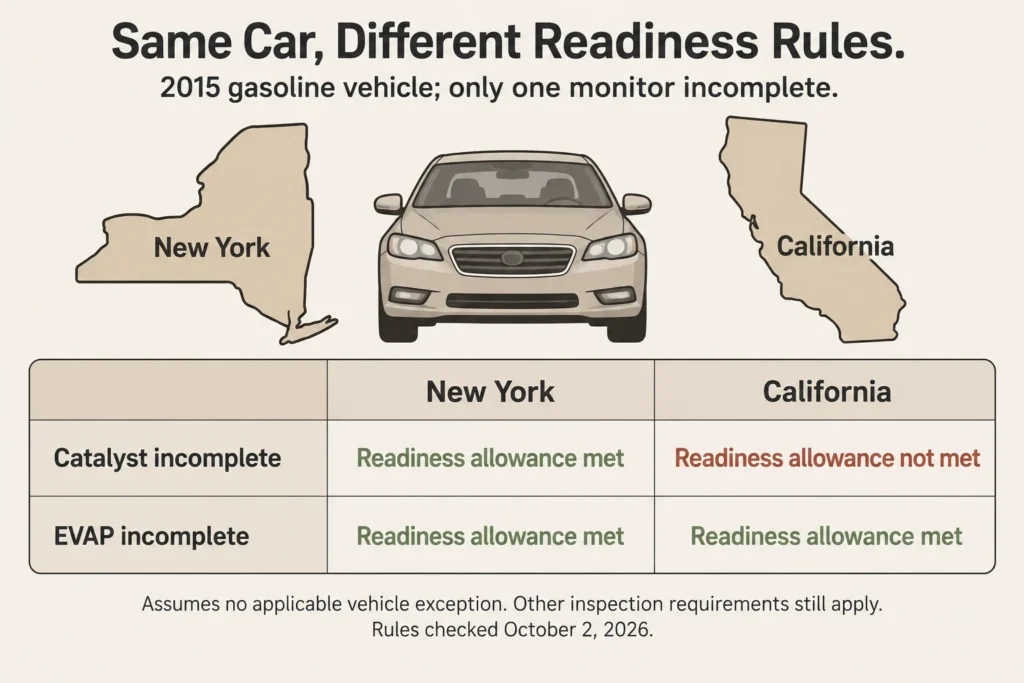
This is readiness eligibility, not an overall pass. Other findings still apply. CA also looks at permanent DTCs for vehicles which it has exceptions for. A scan tool reset or battery disconnection will not erase these DTCs.[3]
Choose a retest or targeted diagnosis
For the purposes of this discussion, we will assume the driver has already reset the monitors per the instructions, and the monitors are still showing incomplete. Refer to the readiness instructions for your specific model year, engine and emissions configuration. Check each individual monitor for completeness before proceeding to the next step. The retest criterion is that the remaining incomplete monitors are within the local allowance. Note that reinspection fees may be charged.[2][3][4]
If a monitor remains incomplete after its conditions have been met, or if readiness continually resets, request a monitor-specific diagnosis. Have the shop find unmet enable conditions and blocking codes, evidence of other resets, and relevant software updates and service bulletins. Authorize replacement of parts only if the diagnosis indicates it is warranted. Do not attempt drive-cycle maneuvers if they cannot be safely performed.[2][3]
There are some situations where a vehicle meets registration requirements, but is not mechanically safe for use. New York allows a conditional 10-day extension if the only thing preventing registration is the vehicle readiness inspection. This is not an extension to drive outside of New York. The extension does not change the appropriateness of additional driving if the vehicle is overheating, braking abnormally, or displaying a low oil pressure warning.[2]
Sources and references
- US Environmental Protection Agency: Performing Onboard Diagnostic System Checks as Part of a Vehicle Inspection and Maintenance Program (2001-06)
- New York State Department of Motor Vehicles: What Do You Mean My Car's Not Ready?
- California Bureau of Automotive Repair: On-Board Diagnostic Test Reference
- Ford Motor Company: 2017 E-Series Owner's Manual, Fuel and Refueling, Emission Control System
- General Motors; hosted by NHTSA: GM Service Bulletin 15-NA-010, Information for New Vehicles with Less than 1,000 Miles that May Not Pass California Smog Inspection or Smog Inspection in Other (2025-05)