

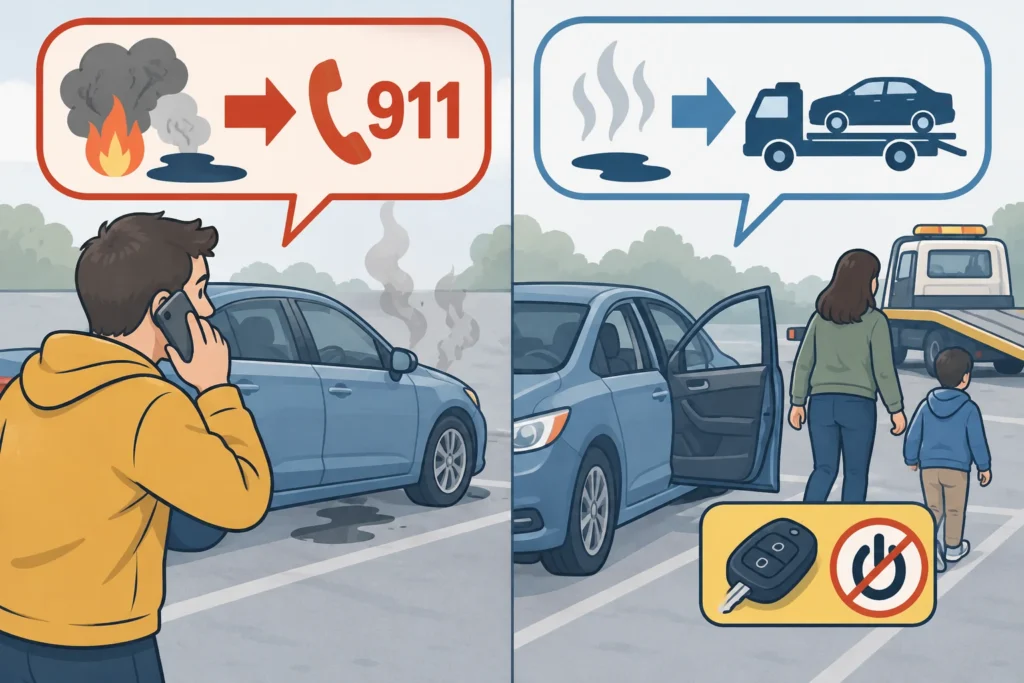
If you notice gas fumes in your car, or if the fumes come back, or if you notice gas fumes in the cabin, pull over to a safe location, shut off the engine, and get everyone to a safe location away from the road. Call for a tow to the shop, and don't risk driving there. Treat liquid that you suspect is gas like you treat gas fumes. If your car is already parked, turn it off, even if you need to move it.
If you are dealing with a visible fuel spill, or if the car is on fire, pull over to a safe location and call 911. The U.S. Fire Administration says if you are in a burning vehicle you should move at least 100 feet away, and keep away from other vehicles.
I’d rather you arrange another ride than gamble on an unexplained fuel smell. That’s a conservative judgment, not a diagnosis: nobody can measure the danger by how strong it smells to you. You don’t need to know which part failed before leaving a suspected leaking vehicle off.
“It started after refueling” is useful, not an all-clear
A strong gasoline odor can be present while fueling and is often present after fueling, as fumes are released while the tank is being filled. Fumes that remain in the cabin after fueling or come back are not "just" from the pump. There can be a leak even if you know exactly when you fueled, and there is no safe waiting time to determine it is safe to enter the cabin.
Picture me getting back in the car after filling up. I have groceries and the lingering smell of gasoline in the cabin. I have frozen food that needs to be kept below a certain temperature and I'm considering blaming the pump and heading home. Instead I shut off the engine, got out, and away from the car and called for help. The groceries are a hassle; they don't respond to whether the car is driveable.
Tell the shop if you topped off after the nozzle clicked. For example, the 2024 Ford Escape manual says to stop at the first automatic shut off and states that overfilling can lead to fuel leakage, spray and fire. That detail matters; it doesn't imply you've damaged a part or component.
Why a dry driveway doesn’t settle it
Dry driveways can be reported, but I wouldn’t use that as justification to start the car. Gasoline is a rapidly evaporating liquid, meaning that the vapor can easily escape without needing a liquid to pool. A small release of liquid can completely evaporate. The source can be from fuel leaking from the system, or it can be from the evaporative emissions control system. Dry pavement cannot tell you which.
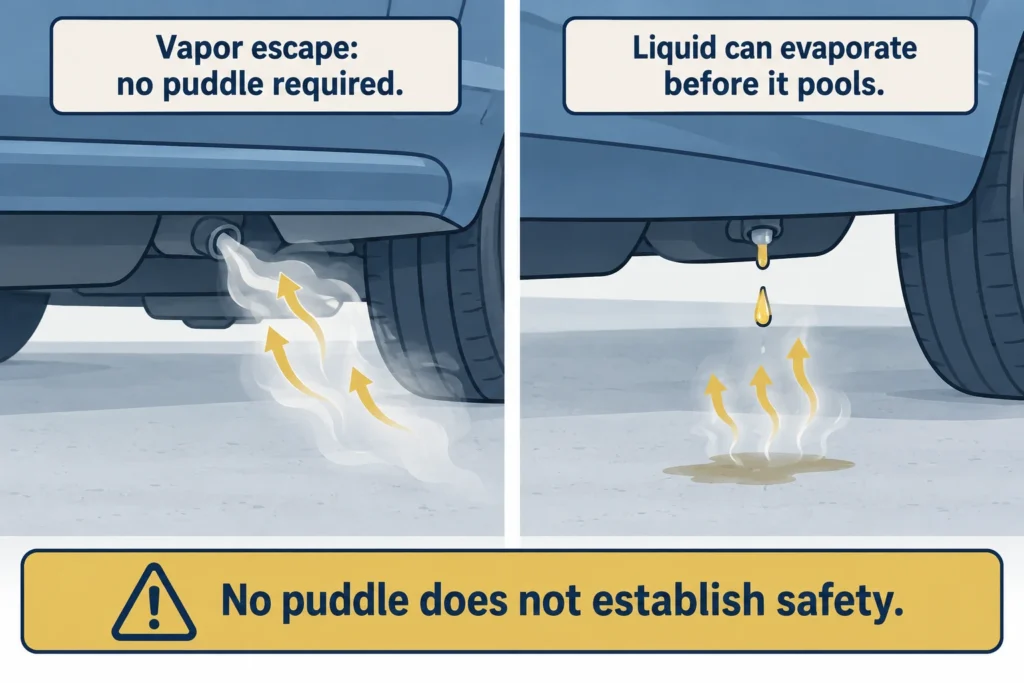
The location you smelled it plays a part in this as well, as the air flow can carry the odor away from its source. A Mazda specific bulletin describes a vent-related odor that is caused from previous driving, hot temperatures, wind and parking conditions. Cold temperatures can cause odor as well. Tell the shop the conditions you experienced, as opposed to giving a diagnosis, or thinking that an odor that goes away after warm up means it’s normal.
Also, the absence of a warning light doesn’t mean there isn’t a leak. Use the information you gathered, don’t restart the car, crawl under it, or do anything else to gather more information.
Give the shop conditions, not a guessed part
- When did it start: parked, starting from a cold start, while driving, or after stopping.
- Recent refueling, any known spill, and whether you topped off.
- Where did you notice it: inside the car (front, rear), outside the car (around the parked car).
- Warning lights, rough running or stalling
- Any liquids that were seen from a distance.
A technician can test for fuel system leaks and perform vehicle specific tests to locate an escape. I would ask what finding supports the repair: Nissan’s P0456 bulletin for certain vehicles says to confirm a vent valve O-ring leak and not to replace the valve for this condition. A code is not a parts order.
It is worth checking your VIN at NHTSA’s recall site, too. A zero-result search can miss some recent or older recalls and it tells you nothing about the car’s present condition. When the repair is done I would ask, “How did you check that the leak was corrected?” “Clearing a warning light” is not an acceptable answer.
Sources and references
- U.S. Fire Administration: Vehicle Fire Safety
- Ford Thailand: What should you do if your Ford vehicle is leaking fuel?
- Agency for Toxic Substances and Disease Registry: Gasoline, Automotive: Public Health Statement
- Mazda North American Operations: Mazda bulletin 01-002/22: Fuel Odor From Left / Rear Area of Vehicle at Idle (2022-03-01)
- Porsche Cars North America, filed with NHTSA: Part 573 Safety Recall Report 25V634 (2025-09-23)
- National Highway Traffic Safety Administration: NHTSA PE09-017 information request concerning Subaru fuel-line leakage (2009-03-23)
- Nissan: Nissan NTB17-082: DTC P0456 Caused by EVAP Leak at Vent Control Valve O-Ring (2017-07-21)
- Ford Motor Company: 2024 Ford Escape Owner's Manual, U.S./Canada edition
- National Highway Traffic Safety Administration: Check for Recalls