

It could be the case that the car isn’t restoring a charge to the battery, something is depleting the battery while the car is parked, or the charge isn’t recovering quickly enough while you drive. The battery could also be defective or damaged. I wouldn’t be approving a battery replacement just because the car needs a jump again. I have questions about the condition of the battery as well as why it became discharged.[1][4][5]
I’ll limit this to 12-volt starting batteries. If the case is compromised, charges should stop. Don’t try to jump-start a battery that is compromised. It is beyond normal troubleshooting.[3]
Picture me, in an imagined example, holding a nearly new battery receipt while the car clicks instead of starting. I’m already running late, and “another battery” sounds the quickest to get me on my way. But I’d change the request at the service counter to please tell me why this battery failed and what left it drained. I want the next battery to solve the problem.
“Discharged” isn’t the same as “worn out”
Charge is what the battery has available now. Condition is whether it can still store and deliver enough energy to do its job. A capable battery can be nearly empty, and a charged one can still struggle to start the engine. That’s the distinction I’d want the shop to explain before asking you to pay again, a voltage reading alone doesn’t settle it.[1]
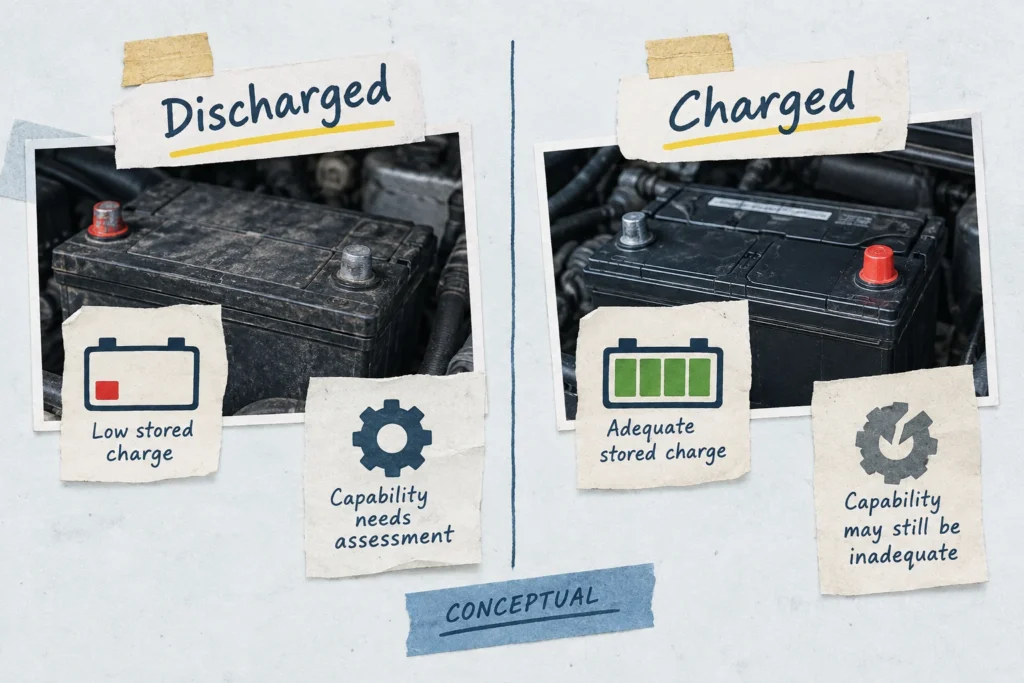
If the tester says “charge and retest,” the assessment isn’t finished. Proper charging and the specified retest help separate a battery that’s short of charge from one that can no longer perform. Not every tester or result requires that sequence, so ask what the actual result said rather than accepting “it tested low.” Also ask what was tested: Midtronics’ DSS-5000 reports cranking health and reserve capability separately, but not every quick check does. A starting-capability pass doesn’t explain an overnight discharge.[2][3]
It’s even possible the battery really should be replaced, however the condition that led to the battery being damaged remains unfixed. Battery Council International described sulfation that can occur with partially discharged battery storage or cycling that can resist recharging. Just because a battery became fully discharged once doesn’t mean your battery has, or that the last shop replaced a good battery. Recurrence doesn’t always mean a battery is bad.[7]
Give the shop the pattern, not just the symptom
When you say “dead after sitting,” I want to know whether that means one night or three weeks. Tell the shop how long it was parked, how long the recent trips were, if you used the accessories with the engine off, and if you recently had a dash camera, stereo, or alarm installed. Note if the engine turned slowly or not at all. You aren’t trying to diagnose a part yourself. Just give the shop conditions to investigate.[1][4][5]
Short trips are worth analyzing, but your mileage alone doesn’t justify a claim of “you don’t drive enough.” Starting a car uses stored energy, and during charging it must replace that energy and also supply for the other electrical loads of the car. BMW specifically takes unfavorable short-distance driving into account for their energy-diagnosis. How much driving would restore the charge depends on the starting condition of the battery and the loads, as well as the vehicle’s charging strategy. It can’t be generalized by a number of minutes.[1][4]
Four checks answer four different questions
| Check | What it can show | What it doesn’t settle |
|---|---|---|
| Battery-condition assessment | Whether the battery meets the tested capability criteria, with appropriate charge, connections, and tester inputs. | Why it became discharged; reserve capability unless the equipment assesses it. |
| Starting-system and connection checks | Whether battery energy reaches the starter properly and how the system behaves during cranking. | Whether charging or parked consumption causes later discharge. |
| Vehicle-specific charging tests | Whether charging performance and its controls meet the applicable procedure under tested loads and conditions. | An intermittent fault outside those conditions or abnormal consumption while parked. |
| Parked-current measurement and circuit isolation | Whether consumption is abnormal for the vehicle’s sleep/wake behavior and which circuit contributes. | The failed component merely from the circuit name, or the battery’s independent condition. |
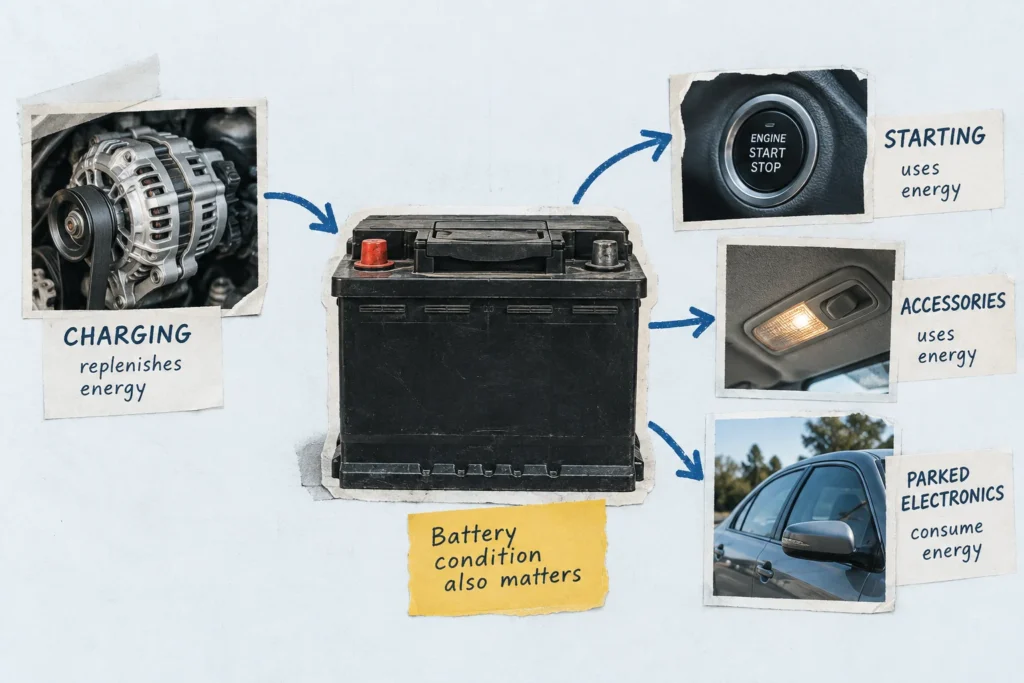
I’m not comfortable condemning an alternator with a single running-voltage number. Some cars can vary charging voltage, e.g. GM bulletin 07-06-03-009C describes listed models to vary from 12.6-13.1 volts in fuel economy mode. That’s not your car’s specification. It shows why an internet voltage rule sends you towards the wrong diagnosis and eventual purchase. Leave charging system tests, measurements, and circuit isolation for a professional to compare the results and diagnosis for your exact vehicle.[5][6]
The car can be off without being asleep
Not all modules go fully asleep when the ignition is turned off. Modules can enter a low-power state and also be activated to execute functions, e.g. a Subaru telematics diagnostic bulletin differentiates expected wake-ups from abnormal standby consumption and specifies test preparation for the technician. It can also be caught in a fully functional state, e.g. after being shut off and just before a normal wake-up event.[5]
The questions I have are "Was the consumption abnormal for this car, and did the test cover the parking time when the battery goes flat?" There's no hard-and-fast rule about acceptable levels of current draw or sleep time. A long-enough recording needs to be interpreted in the context of the vehicle's normal behavior to determine if the circuit is abnormal. Identifying an abnormal circuit does not prove a particular component on that circuit has failed.[5]
What I’d want before approving the next repair
In the absence of more info, you should ask the shop to compare the battery on the car to the correct type, size and rating for your year, model, and engine. Ask if the replacement requires registration (car initialized to your specific settings), and if so, what kind? Ford documentation speaks to a battery sensor reset and charge state relearn. The model may not apply to your car, and, in any case, the processes are likely not what you are needing to do for your car.[4][8]
I’d also like for useful diagnostic history to be saved before anything deletes it. BMW specifically warns that battery registration or programming deletes stored energy history, which is why their diagnostic order is important. Capture the diagnostic evidence where the vehicle procedure requires it; do not omit required registration.[4]
The recommendation should relate the proposed purchase to a supported battery failure, charging performance that does not conform to the applicable specification, or abnormal parked consumption that is attributed to the repaired component. If conditions permit, and a thorough diagnosis is performed, it could be worth more to have the defective component replaced. Agree on the procedure the shop will use to confirm the repair. A flat battery after two nights parked is not the desired outcome you’re paying for.[1][2][4][5]
Sources and references
- Midtronics: Battery Test Results That Can Be Misleading (2026-09-01)
- Midtronics: Common Battery Tester Errors and What They Mean
- Midtronics: DSS-5000 Instruction Manual
- BMW of North America; hosted by NHTSA: SI B61 13 05: Discharged Battery, Energy Diagnosis Must Be Performed, Revision 8 (2024-01-11)
- Subaru of America; hosted by NHTSA: 15-308-23R: Diagnostic Information, Testing Telematics Systems for Dark/Standby Current (2026-08-20)
- General Motors; hosted by NHTSA: 07-06-03-009C: Voltmeter Gauge Fluctuation Due to Regulated Voltage Control (2015-01)
- Battery Council International: Battery Glossary of Terms
- Ford Motor Company: Maintenance, Changing the 12V Battery