

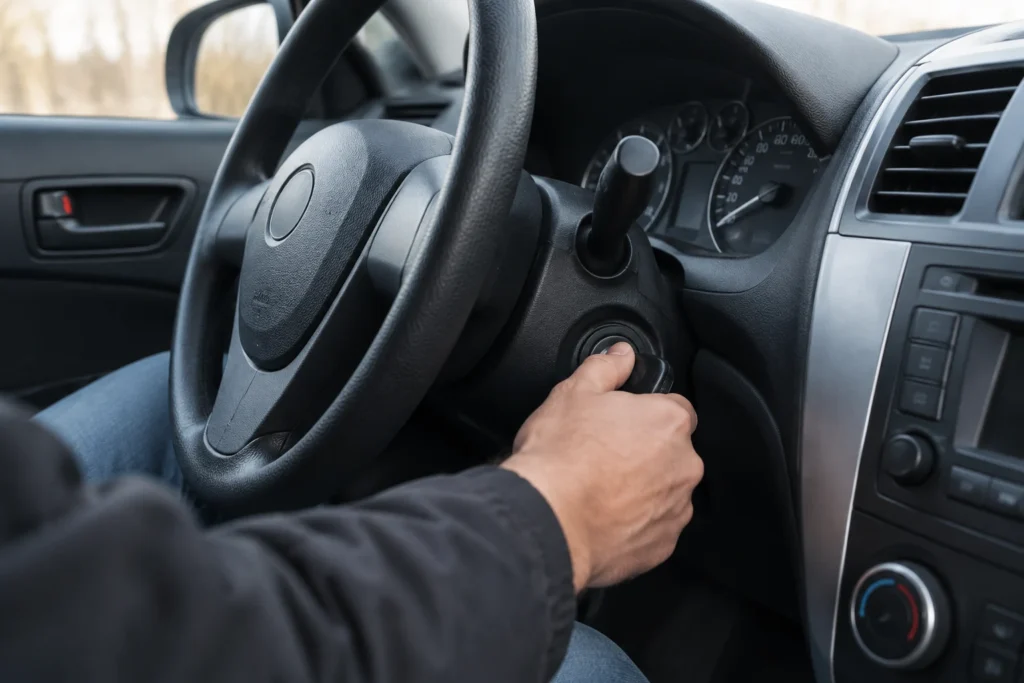
If the engine turns over normally but takes longer to catch, the problem may not be in the turning of the engine. It could be in the system that provides the right fuel, ignition, and engine position for combustion. I wouldn’t buy a battery based on that symptom alone. The most useful clue is when it happens: is it with a cold engine? After sitting? During a warm restart? After a recent change? Normal sounding cranking narrows the complaint; it doesn’t ID a part that’s bad.
This discussion is for gas engine start complaints, not diesel, carburetor, or hybrid detailed complaints. No, I won’t tell you the number of seconds it should take to start your engine. I also won’t give you a universal pressure spec without year, model, and engine.
A longer crank isn't the same as a slower crank
Extended cranking means the engine keeps turning before it starts. Slow cranking means it turns sluggishly, perhaps with an uneven, laboring sound. The second description points more strongly toward a battery, connection, or starting-system problem. With the first, a simple weak-battery explanation is less persuasive, but your ear isn't a voltage meter or an engine-speed measurement.
A technician will check the voltage and speed of the cranking against the vehicle’s standards to help with diagnostics. This is something they will always do, even if the starter sounds alright. What I don’t want to see is a shortcut from “starting trouble” to “new battery,” with no other findings to connect the two.
“First thing in the morning” contains two clues
When an engine has been given a long rest, it’s usually cooled down from sitting for a long time, especially if it has been parked in the shade or during the cooler parts of the day. Cooling and long resting may be interchangeable, but some engines may be designed to heat up and expand during starting, so they may act up during the cooler parts of the day. Long resting may indicate a fuel-pressure retention problem. During the cooler and longer resting parts of the day, an engine may start up fine, but give issues in the warmer parts of the day.
Picture me in an imagined service-visit scene: I've arranged a ride to work, but the car starts promptly at the shop after its morning drive. I'm irritated, the one thing I needed them to see has vanished. Instead of asking them to keep restarting it, I arrange an overnight drop-off and ask that nobody start it before the technician is ready.
| What you've already noticed | Why it's useful |
|---|---|
| Delay after sitting overnight | Both cooling and elapsed parked time changed. The shop needs the first start, not just a warm check. |
| Prompt immediate restart, delayed restart after an errand stop | The delay appears after some time parked while the engine is still warm, directing attention to that warm-soak condition. |
| Delay mainly in colder weather | Temperature-related fueling and vehicle-specific cold-start behavior deserve attention. |
| New delay after refueling, service, or another recent change | The timing gives the technician a more specific starting point; it doesn't prove the recent event caused the fault. |
There are exceptions to “longer means broken.” GM identifies some direct-injection engines where the mechanical high-pressure fuel pump takes some time to build up injection pressure. That can explain an observed characteristic of an engine covered under a particular document. It is not a reason for a newly longer start-up time of a vehicle equipped with direct injection.
For a delay that only happens when the engine is cold, a technician should check coolant and ambient temperature and see if the reported value is plausible. If it is not, the diagnosis should focus on the wiring or the supply that affects starting fuel and ignition. An implausible coolant temperature may reflect a bad sensor, but if it is, there should be a determination as to whether it is a bad sensor, or a bad circuit.
Keep the clues; skip the starting experiments
Repeated attempts can heat and damage the starter, and each successful start changes the temperature and parked-time conditions you're trying to preserve. Don't open fuel lines, use starting fluid, unplug sensors, or disconnect the battery to see whether things improve. Leave stored fault information intact for diagnosis.
For an ordinary starting attempt, use the exact vehicle's starting section for accelerator position, retry pauses, and automatic-cranking behavior. Some systems continue cranking after you release the control and impose a lockout after accumulated attempts. That's why a generic “crank for this many seconds” instruction isn't useful here, and a permitted maximum isn't a target.
A documented time limit, if stated, is a hard restriction and not a goal.
For a bulleted test, a note can mention how long the car was parked, if the engine was warm or recently run, the approximate delays noticed, any message center codes/warnings, and if the car drove normally after that. Recent fueling needs to be mentioned separately. Ford has a hard-start-after-refueling bulletin for certain Escape, Fusion, and MKZ vehicles, but that association doesn't make a purge valve the answer for all cases.
What would actually justify a repair?
The importance of this test is illustrated in Stellantis Bulletin 14-007-26, from July 8, 2026. It covers certain North American models for extended cranking due to fuel pressure loss. Under its prescribed pressure/leak-down test, if the loss is greater than 10 psi, the fuel pressure regulator needs to be repaired. The shop needs to first verify vehicle applicability and use the Service Library’s test set up and procedure; public bulletins don’t usually give a service interval.
Using the prescribed test, a 12-psi loss exceeds the limit and would authorize the fuel pressure regulator repair. A loss of 8 psi doesn’t authorize the repair. A 10-psi loss doesn’t authorize the repair. Those results don’t prove the whole fuel system is ok. Measuring those numbers on some other vehicle over some arbitrary time tells you something else, or tells you too little.
Reworking Bulletins matters, too. An older Stellantis Bulletin (published prior to the July 2026 Bulletin) had covered the same condition and authorized fuel pump module replacement; the July 2026 bulletin gives authorization for fuel pressure regulator replacement. Old screenshots can point to different repairs. This isn’t “preventive replacement” guidance. The thresholds in the July 2026 Bulletin don’t belong on a universal extended crank checklist.
There isn't much information about booking diagnostic time if the diagnosis is recurring or worsening. Smoothing things out after that doesn't ensure the next start, and no one can reliably tell you how many starts remain from this information. If your complaint is morning-only, ask for an overnight drop-off and preservation of the first start. Your service description can be simple: “It cranks at its usual sound, takes longer after sitting overnight, and starts promptly later in the day.” Include your vehicle specifics and recent changes.
Prior to authorizing repair work, obtain the measured result and the applicable specification and understand the conditions under which it was tested. Also, agree on how the shop will be able to verify the repair under the starting condition that is causing the trouble. An easy warm start in the morning isn't what you are looking for. A first start after the relevant parking time is more appropriate.
Sources and references
- Subaru: Subaru TechTIPS: Getting to the Bottom of Extended Cranking or Difficult or Hard Starting Concerns (2013-03)
- Ford: What should you do if your Ford vehicle is leaking fuel?
- Ford: Ford Owner's Manual: Starting a Gasoline Engine
- General Motors: PIP5179D: Extended Crank Cold With DI Engines (2018-03-27)
- HELLA: Crankshaft sensor: function and troubleshooting
- HELLA: Checking the coolant temperature sensor
- FCA US / Stellantis; manufacturer PDF mirrored by OEMDTC: Stellantis TSB 14-007-26: Extended Crank Condition Due To Loss of Fuel Pressure (2026-07-08)
- Ford: Ford TSB 16-0075: Hard Start After Refueling (2016-04-25)
- HELLA: Starter damage assessment
- FCA US / Stellantis: Superseded Stellantis TSB 14-004-25 Rev. A (2025-02-26)