


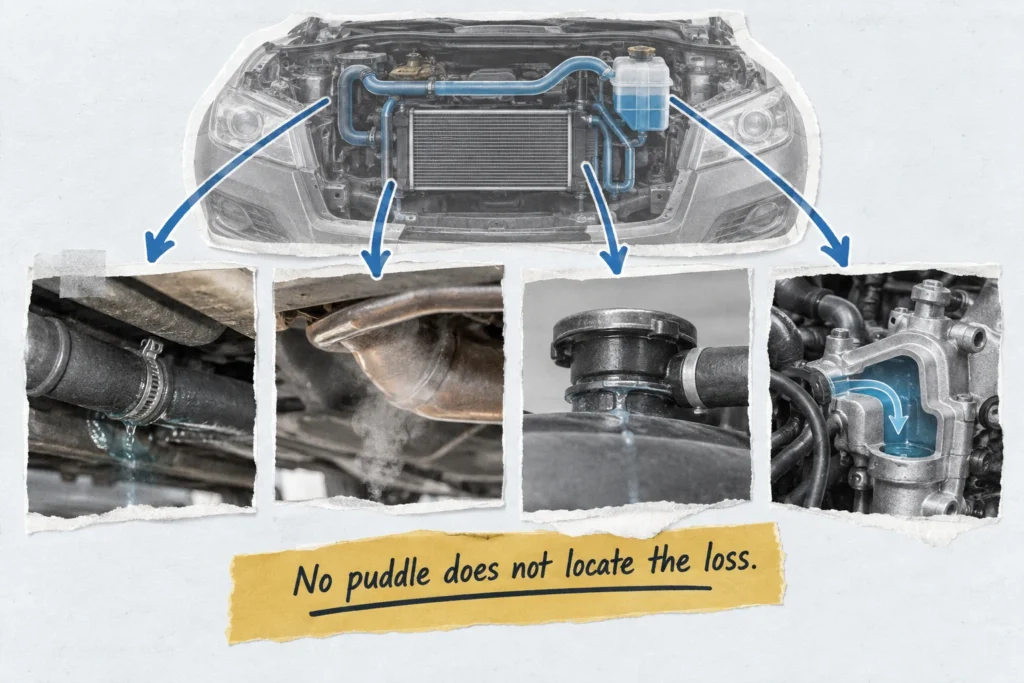
Just because there aren’t any puddles doesn’t mean there isn’t a leak. Coolant can disappear in multiple ways. If you have a persistent coolant leak, it’s worth investigating, but that doesn’t mean you have a blown head gasket. I’d first address two separate questions. One, can you safely keep driving the car, and two, what evidence will help find the loss?[3][4][7][8]
A low coolant alert is an overtemperature warning and should be responded to as such. Your vehicle's prescribed response determines what you do next, and without the year, model and engine, I can’t tell you what to do. Even if the system is topped off and there is no overheating, you should get it diagnosed as soon as possible. Again, I’d not treat it as if it were okay simply because you topped off the cooling system.[1][3]
First, compare cold readings, not yesterday’s hot level
Do a comparison of fully cold readings on level ground, preferably before the day’s first drive. Coolant expands as it heats up, and what was hot yesterday cannot tell you what disappeared last night. Use the correct reservoir and cold marks. On some vehicles there are multiple cooling circuits. The 2010 Ford Escape Hybrid has a separate engine cooling circuit and a separate cooling circuit for the motor and electronics. Knowing which one you are dealing with is important before you add anything.[1]
Picture me in an imagined Monday-morning scene: I’m holding a coolant jug, already late, and I can’t remember whether Friday’s level check was before or after driving. That uncertainty annoys me more than the dry driveway reassures me. Instead of another undocumented splash, I photograph the fully cold level, note the mileage, and record any measured addition. Now the next conversation has something better than “it keeps disappearing.”
At least then I can tell people, “It’s not missing, it’s being added.”
Compare parking conditions, take dated photos, and measure additions. Text and mileage indicate volume; a photo records level. If your vehicle allows it, you can add coolant that specifically meets the coolant specifications and cold fill target instead of over-filling the reservoir.[1]
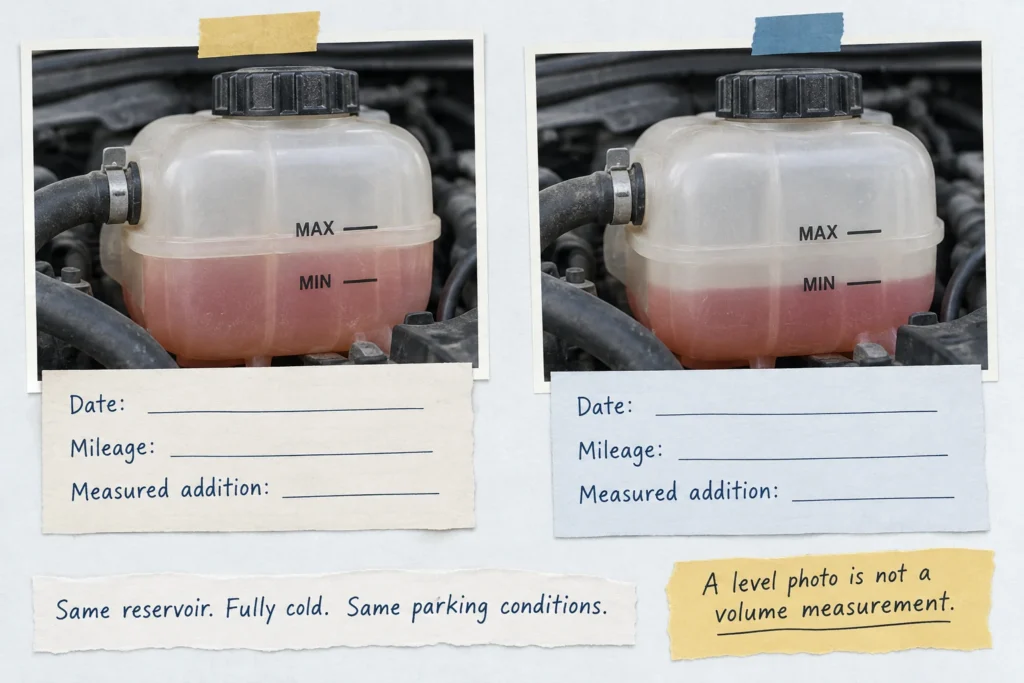
Recent work done to the cooling system changes how I look at the first drop. One adjustment and a stable cold level is different from a level that is continuously dropping. Tell the shop what work was done and not to say it’s “just settling” to explain away a loss.[2]
Dry pavement misses several escape routes
You could be looking in the right place at the wrong time. An external leak could be hidden behind other components or only occur when the system is hot and pressurized. Coolant will evaporate before it can reach a puddle if it makes contact with a hot surface. Look for residue or smell with the limitation that you may not be able to reach around or under the car.[4][8]
Deposits can certainly assist in diagnosis, but they shouldn’t be the reason for parts replacement. GM PI1041 gives examples of very small deposits caused by a leaking water pump, and states that such deposits should not be considered abnormal. I would agree with that, and not stretch it to mean “your coolant loss is normal.” Old stains and new leaks are different.[8]
A bad pressure cap can certainly allow coolant to escape, but residue around the cap does not necessarily mean the cap failed. It could mean something else is wrong, and caused coolant to be expelled. It’s more productive to test the cap and see if it truly failed, before replacing it, which is what many people like to do because it’s the least expensive option.[3][4]
"Internal" does not always mean "head gasket." It could mean that coolant is entering a cylinder, or, depending on the engine design, even a coolant-cooled component of the exhaust system. It has been documented that BMW’s diesel EGR coolers have been known to leak coolant, and the coolant can be routed through the exhaust system. This would explain why the oil was not mixed with coolant, and even though the oil appeared clean and the exhaust gases were roughly normal, there may have been a problem with the EGR cooler. Rough running, or other exhaust abnormalities, should be reported, but they don’t always mean there is a failed component.[6][7]
Ask what the test actually tested
Pressure tests are performed on cooling systems to check if the system holds the applied test pressure. If pressure drops during the test, connections and test set up need to be checked. Confirmed pressure drops can indicate a cooling system leak. However, a pressure drop doesn’t locate the leak or indicate head gasket failure. I’d want to know how long the test was run, the test temperature, and if the test cap was tested as well.[3][4][6]
| Professional finding | What it supports | What it doesn’t prove |
|---|---|---|
| System holds pressure | Pressure retention during that test’s conditions and duration | That hot-only, intermittent, or untested cap-related loss is absent |
| Cap test | Whether the cap behaves within the applicable specification | That the rest of the cooling system has no leak |
| Fresh coolant or approved fluorescent trace at a location | An external escape path that can be investigated directly | That every old stain represents an active failure |
| Valid combustion-gas test | Whether combustion gas is detected in the sampled cooling-system gas | Which component failed, or whether every possible internal coolant path was excluded |
It’s not difficult to overlook a few things. When a test adapter replaces the cap, the old cap isn’t tested on the circuit. Also, a combustion gas test is performed to check for gas in the coolant system; it doesn’t check for coolant in the combustion system. A negative test result can’t be the only thing relied on to accept a system is leak free.[3][5][6]
Test duration can matter considerably. Historical Ford SSM 48106 called for a five-hour pressure hold and borescope confirmation of cylinder intrusion before its stated repair conclusion on specified 2014-2019 Fusion and 2017-2019 Escape vehicles with the 1.5L EcoBoost. That’s not a recipe for every engine, the latest instruction for your VIN, or a coverage promise. It illustrates why a quick negative check may leave a documented coolant-loss complaint unresolved.[6]
When the first check finds nothing
A failed cold test and a cold level that drops and drops can both be real. I’d want both in the report. The next logical step in the investigation depends on what was not done: professional evaluation at operating temperature or during cooldown, external tracing, a separate cap test, or an engine-specific internal path test. Don’t purposely overheat the car or take a needless risk to reproduce the complaint.[3][4][6]
Provide the shop your year, model, engine, and recent service history. Give your cold level records, measured additions, and exact warning messages. For each complaint, the shop should give the test conditions, cap test results, and external traces. The shop should also provide results of any internal-path tests. With an expensive engine repair on the table, my question would be, “What finding connects this coolant loss to the repair you’re proposing?” Pressure tests and head gaskets both need conditions.
Sources and references
- Ford Motor Company: 2010 Ford Escape Hybrid Owner’s Guide, coolant checks and warnings
- Chrysler service documentation, hosted by NHTSA: Cooling, Standard Procedure: Filling
- Mityvac / SKF: Mityvac MV4560 Cooling System Test Kit instructions, Form 801625
- CDX Learning Systems: LO 11-08: Cooling-system maintenance and leak testing
- Block Tester: Block Tester operating instructions
- Ford Motor Company, hosted by NHTSA: Ford SSM 48106, 1.5L EcoBoost coolant consumption
- BMW, hosted by NHTSA: BMW EGR-cooler inspection service bulletin
- General Motors, hosted by NHTSA: GM PI1041, Information on Water Pump Replacement (2013-08)