

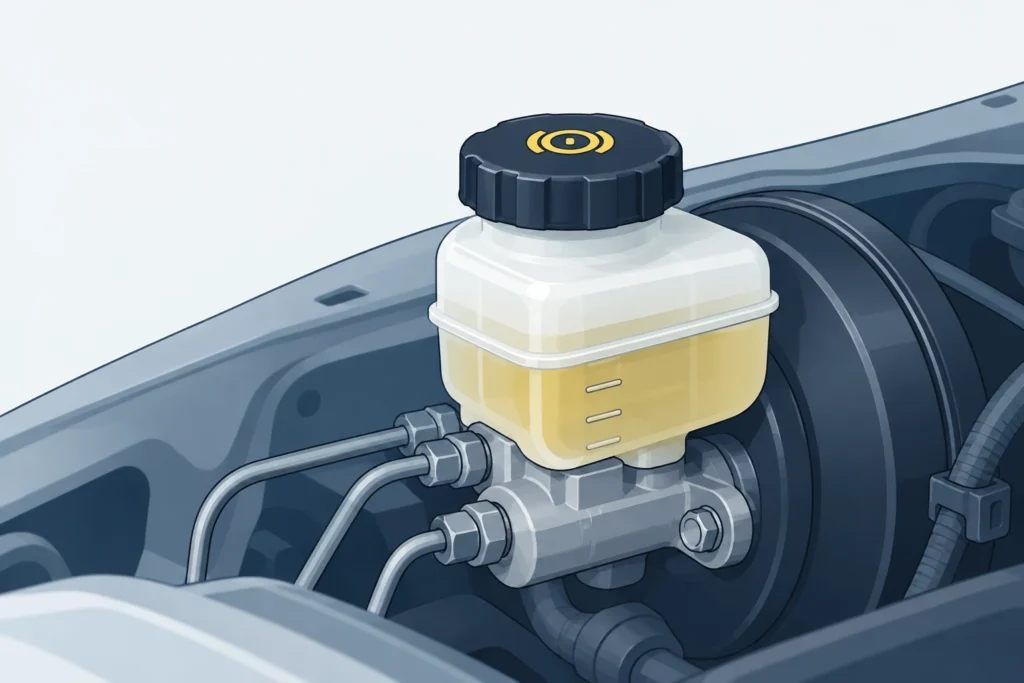
Obey a manufacturer brake-fluid replacement schedule if there is one; passing doesn't void that requirement. If the manufacturer specifies inspection/replacement as necessary, then that inspection is what governs. Don't base it on some arbitrary age or just because a tester says it's ok. Begin with what your vehicle says about fluid spec, maintenance language, and when it was last replaced.[1][3][4]
Replacement and inspection are different instructions
Align recommendations to the specific model year and market segment. The US 2026 Honda CR-V Hybrid's instructions, for instance, state that brake-fluid replacement is Maintenance Minder item 7 with a three-year backstop interval if that item isn't reached within 36 months after reset. Tesla's Model Y owner's manual instead instructs a fluid health check with replacement as needed. They're both not wrong, these are legitimately different maintenance schedules.[1][3]
“Inspect” also doesn’t mean any convenient test will do. Tesla’s 2020-2024 Model Y service procedure specifies a particular strip, sampling at a caliper, timed interpretation, and recorded results. A generic reservoir pen reading isn’t automatically a substitute for that procedure. Manufacturer-authorized condition-based maintenance differs from a shop using its own passing test to postpone required replacement.[4]
The fluid specification matters before interpreting a result or approving service. The US 2024 Accord, for instance, specifies Honda DOT 3 brake fluid and warns against incompatible DOT 5 fluid. DOT labels aren’t simply an upgrade ranking: the federal standard distinguishes silicone DOT 5 from nonsilicone DOT 5.1. The estimate should identify the fluid required for your vehicle, not just promise “premium brake fluid.”[2][7]
A test result answers only its own question
| Method | What it reports | Important limitation |
|---|---|---|
| Conductivity-based pen | Estimated moisture content inferred from an electrical property | The conversion depends on fluid formulation and instrument calibration; a displayed percentage isn’t a direct laboratory water measurement. |
| Direct boiling-point test | The sample’s measured boiling temperature | It addresses boiling performance, not every chemical, corrosion, or compatibility concern. |
| Chemical test strip | A named chemical indicator; some products measure copper | Identify the product and analyte. Different strips and manufacturer procedures don’t necessarily share chemistry or limits. |
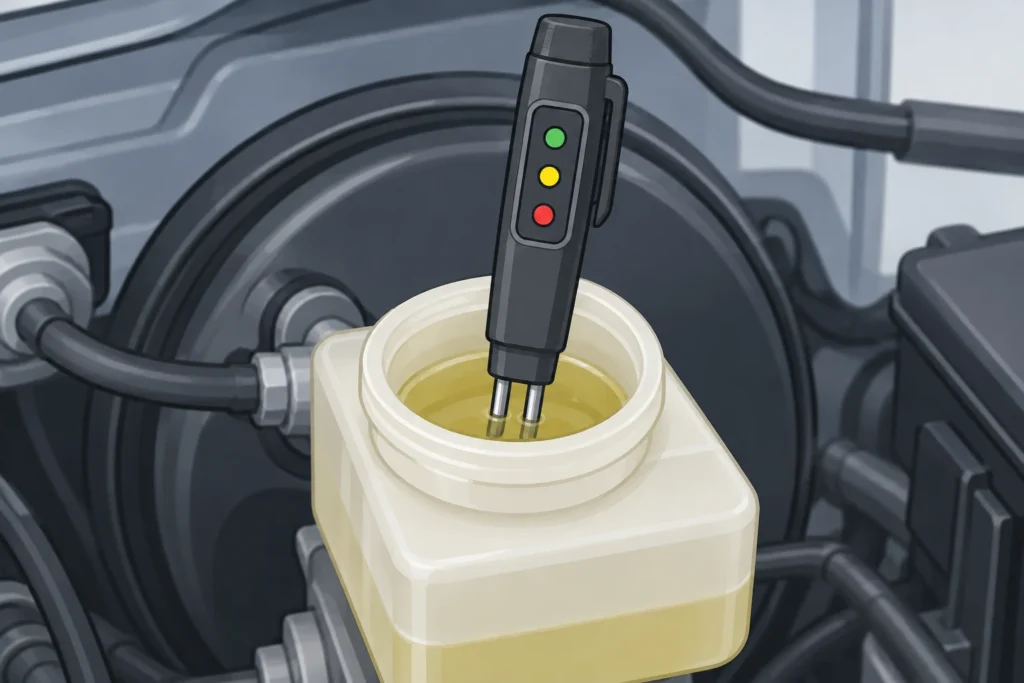
Condution testing may also have merit if it's applied only when the moisture estimate makes sense for the fluid being tested. Fluid maker Eurol identified formulation-dependent limitations with the devices it tested. (Eurol's comparison does not independently validate or refute each pen.) Moisture-pen and direct boiling-point measurements gave potentially discrepant service assessments in at least one small published vehicle study. The variation helps discredit the idea that the measurements are interchangeable, rather than proves there's a universal replacement cutoff.[5][6]
Similarly, a DOT wet-boiling minimum is not inherently an in-service discard temperature. FMVSS 116 qualifies fluids after testing in defined laboratory conditions, with criteria including boiling, corrosion, viscosity, etc. Accepting one qualification value as a blanket shop cut-off ignores the question of whether that parameter is relevant to your vehicle/application and test procedure.[7]
No amount of fluid color or single point measurement determines remaining useful life. A test result defines the characteristic evaluated in the sample removed; it is not designed to screen all fluid properties or troubleshoot a braking problem.[5][7][8]
What justifies paying now?
Think about a fictitious 2026 CR-V Hybrid that came in for a replacement invoice and reset maintenance light on April 10, 2026. As of April 10, 2029, without a prior item-7 reminder, this vehicle has earned three years of backstop that allows replacement even if a shop’s pen still reads green. Requiring a failed test to initiate replacement substitutes a shop policy for Honda's instruction. Replace ONE YEAR in the above example. Age by itself no longer qualifies that service is needed, and an interim recommendation must have another valid basis.[1]
Something like this for your early test recommendation: Have the shop write down the instrument/strip used, sample location, actual reading/units, and criterion that replacement is supported. "Contaminated" or a red light mean too little. A defensible, interpretable reading can support service prior to scheduled service interval; lack of confidence in an unidentifiable tester's calibration may warrant verification by an appropriate method.
Low fluid requires diagnosis, not just refill. Honda recommends checking for leaks or worn pads. Tesla instructs owners not to add additional fluid. Refilling the fluid will not determine cause of level dropping nor fix a brake issue.[2][3]
Request a service quote for the named fluid, the vehicle's exchange and bleeding process, and any necessary completion tests, not just new fluid in the top of the reservoir. Some systems have the technician follow electronic service programs, and Tesla's Model Y process even involves brake-stiffness testing. Sampling, bleeding, and fluid choice also follow vehicle-specific technician steps.[9]
Sources and references
- Honda: To Use Maintenance Minder, CR-V Hybrid 2026
- Honda: Brake Fluid, 2024 Accord
- Tesla: Maintenance Service Intervals, Model Y
- Tesla: Brake Fluid Check, 2020-2024 Model Y Service Manual
- Eurol: How can you measure the quality of brake fluids?
- Periodica Polytechnica Transportation Engineering: Operational Tests of Brake Fluid in Passenger Cars (2020-01-02)
- Electronic Code of Federal Regulations / NHTSA: 49 CFR 571.116, Motor vehicle brake fluids
- Phoenix Systems: BrakeStrip brake-fluid test product catalog
- Tesla: Brake Fluid Bleed/Flush, 2020-2024 Model Y Service Manual (2026-08-09)