

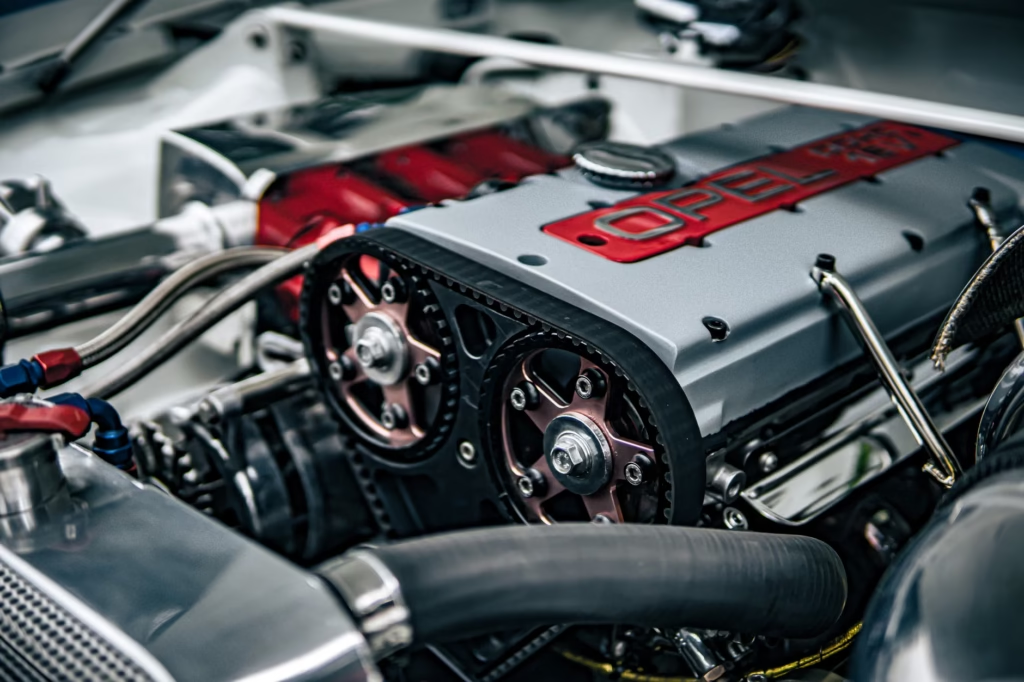
Allow a due timing-belt service when the engine you have installed calls for the belt in question and the interval for replacement is met with no reliable information showing that it was replaced at some recent point in time. Visual appearance will not prove belt life. Lack of records indicates an unknown time of last service, not a failure. Tensioners, idlers and the water pump require separate approval via procedure, condition or common labor.[3]
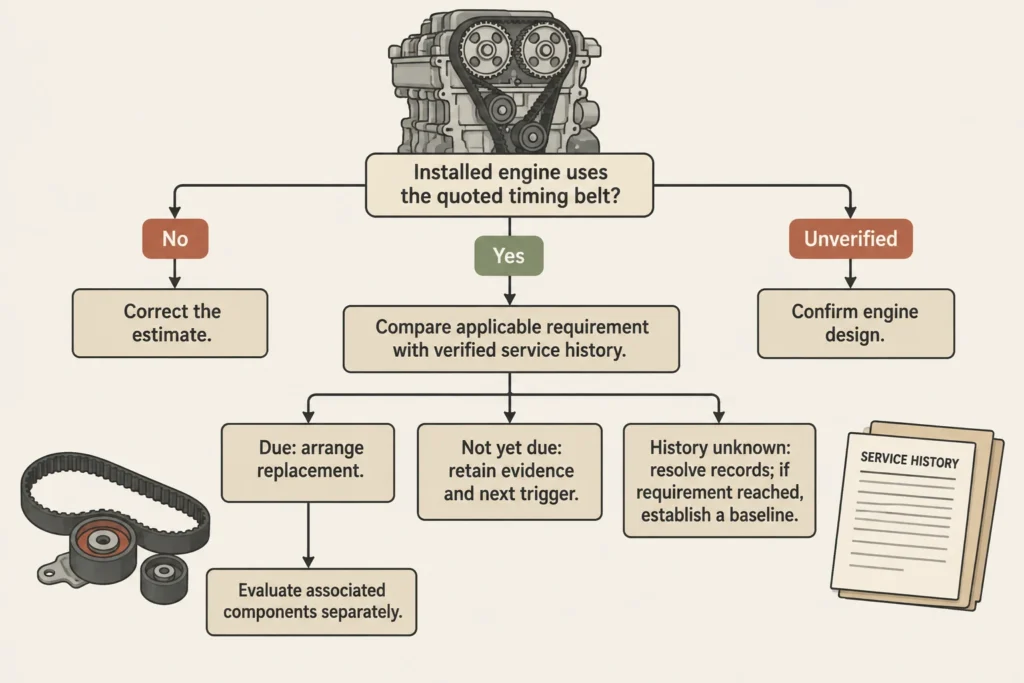
1. Verify the installed engine design
Ask the store to identify the engine you have installed and provide manufacturer information showing it utilizes a timing belt. Confirm the year, engine or cubic inch displacement and market it was built for and not just the model name. Manufacturer info tied to the VIN can be used, but if replacement engine info is available, verify the installed engine separately.
A note may take this service off your estimate. Toyota's Highlander from 2006 only lists timing belt replacement on the 3MZ-FE engine. It does not state what the other engines use. Verify with manufacturer information if it's belt or chain driven.[1]
Make sure you're distinguishing between a timing belt and an accessory/serpentine belt. Honda's information will show accessory drive belt inspection and timing belt replacement as separate services. This will be satisfied once your estimate and information line up with the same installed engine and belt type. Remove the timing belt service from your estimate if it's not applicable, then worry about meeting an interval.[5]
2. Locate the actual replacement trigger
Ask for the schedule item along with any notes and instructions. Some may be mileage or time dependent, tied to a maintenance minder item or based on certain operating conditions. If your schedule states mileage or time, whichever comes first, then it's due if either one is reached. Mileage may not be high enough to reach an interval, but if time has passed, it's still due. Do not apply a time interval to your engine that isn't listed on the applicable schedule item.
There are certain conditions that may cause your belt to be replaced sooner. Honda's 2026 Pilot information shows the timing belt under Maintenance Minder item 4. If operating in conditions over 110F, under 20F or towing a trailer, replace the belt every 60,000 miles. Use those conditions and intervals for that application.[2]
Have the store identify what triggered your belt replacement and what date/miles they started counting from. Once it's replaced, make sure to follow instructions on how often to replace it afterward. You should be able to identify that your belt is due or find out what information you need to make that determination.
3. Verify the last completed replacement
Ask for an invoice showing your vehicle, that the timing belt was replaced, the date and miles on the vehicle and what parts were installed. Ask the store to explain "belt replaced". A quote is only a quote, not an actual repair done. A sticker is information to look into and not the same as an itemized repair order.
A maintenance minder reset does not prove the belt was replaced. Honda will show you how to reset without actually doing the work. Visually inspecting has its limitations as well. Gates' timing system course goes into detail about why a belt can look fine on the outside but fail on the inside. Inspection can show bad condition and allow you to address your concern, but it will not tell you when it was installed or how long it has left on it. Inspecting timing systems will fall under your technician's job.[2][3]
Save your information if you can prove that your belt has not reached an interval. If your interval has been reached and you have no records of it being replaced previously, it's best to get it replaced to create that information, not to say your belt was bad but to have a reference point. Lack of records does not prove that your belt is overdue. None of this information will allow you to assume your belt will last longer than what is listed on your schedule.
4. Approve a justified component scope
Ask for a detailed estimate on all tensioners, idlers, water pump, seals and other items called for in the procedure. Know the difference between what is called for in the procedure to replace with your engine and items that you found to be bad or want to replace as a preventive measure. If it's called for in the procedure ask for the instruction. If it's a condition you want to address know what failed and what it should look like when new.
Replacing your belt does not always call for your water pump to be replaced. Hondas 2026 Pilot Owners Manual will call for your timing belt to be replaced and inspect your water pump. There may be a procedure that calls for more items to be replaced. VW used to have a repair procedure for their Golf R that would include removing and replacing your timing belt and certain clips that are not reusable. Your engine may differ.[2][4]
You may still want to replace items that aren't failing. Gates recommends replacing all wear items in your timing system to save labor down the road. Its not something your car company is telling you to do. Find out how much it will cost you now vs down the road and if you know they were recently replaced.[3]
Allow one name scope and get approval if more is found. The invoice should have the date miles on unit belts and other parts changed. And what would be next due. This will allow you to judge the next estimate.
Sources and references
- Toyota Motor Sales, U.S.A.: 2006 Highlander maintenance schedule
- American Honda Motor Co.: 2026 Pilot owner's manual, Maintenance Minder
- Gates: Introduction to Timing Belts and Systems 101
- Volkswagen Group of America; hosted by NHTSA: Volkswagen Service Action 19J5, 2012 and 2013 Golf R coolant pump (2014-03-18)
- American Honda Motor Co.: Honda owner's-manual excerpt, Drive Belt, Timing Belt