

Poor fuel economy usually is not mysterious. It tends to come from a short list of causes: speed, hard acceleration, short cold trips, unnecessary idling, low tire pressure, roof cargo, deferred maintenance, or a vehicle being asked to do a job it was never efficient at. The harder part is figuring out which cause matters most in your case, because EPA label values are a comparison tool, not a promise that every driver will match the sticker on every trip. (epa.gov)
- TL;DR
- First, decide whether the drop is normal variation or a real problem
- Use the easiest-first fuel economy audit
- Driving style and trip pattern usually dominate the loss
- Tires, drag, and extra weight can quietly erase highway MPG
- Real maintenance problems matter, but some tune-up advice is outdated
- Weather and vehicle type can make good habits look disappointing
- A practical 30-day plan to improve fuel economy
- Sometimes the vehicle is the real limit
- FAQ
- References
TL;DR
- Most disappointing MPG comes from use conditions and driving behavior first: speed, aggressive acceleration and braking, idling, short trips, weather, and tire condition usually matter more than obscure mechanical theories. (afdc.energy.gov)
- Underinflated tires hurt both safety and fuel economy. NHTSA says to check pressures monthly when the tires are cold, and TPMS is not a substitute because it usually warns only when a tire is significantly underinflated. (nhtsa.gov)
- Highway MPG is especially vulnerable to speed and drag. DOE says fuel economy at 80 mph is about 27% lower than at 60 mph, and a large roof box can cut highway fuel economy by 6% to 17%, or even more at interstate speeds. (energy.gov)
- Real maintenance faults matter, but some old advice does not. A modern fuel-injected car usually will not gain MPG from a fresh air filter alone, and premium gasoline usually offers little or no benefit in vehicles engineered for regular. (afdc.energy.gov)
- Do not diagnose from one tank. Track several fill-ups under similar conditions, then look for a pattern before buying parts or blaming the vehicle. (epa.gov)
First, decide whether the drop is normal variation or a real problem
A car can be perfectly healthy and still miss its headline MPG number on a particular commute. EPA fuel-economy estimates are based on standardized testing that includes city driving, highway driving, cold weather, air conditioning, and high-speed or aggressive driving so shoppers can compare vehicles on common ground. Real life adds variables the test cannot control for every driver, including traffic, hills, wind, temperature, trip length, and individual driving style. (epa.gov)
That is why the first question is not, “Why am I under the sticker?” It is, “Has something changed?” A gradual seasonal decline may be normal. A sharp drop across several tanks is more suspicious. The best quick check is to compare similar trips over several fill-ups rather than reacting to one bad week, one highway run into a headwind, or one tank spent mostly in stop-and-go traffic. If the vehicle has an instantaneous or average fuel-economy display, EPA specifically suggests using it to learn what conditions help or hurt MPG. (epa.gov)
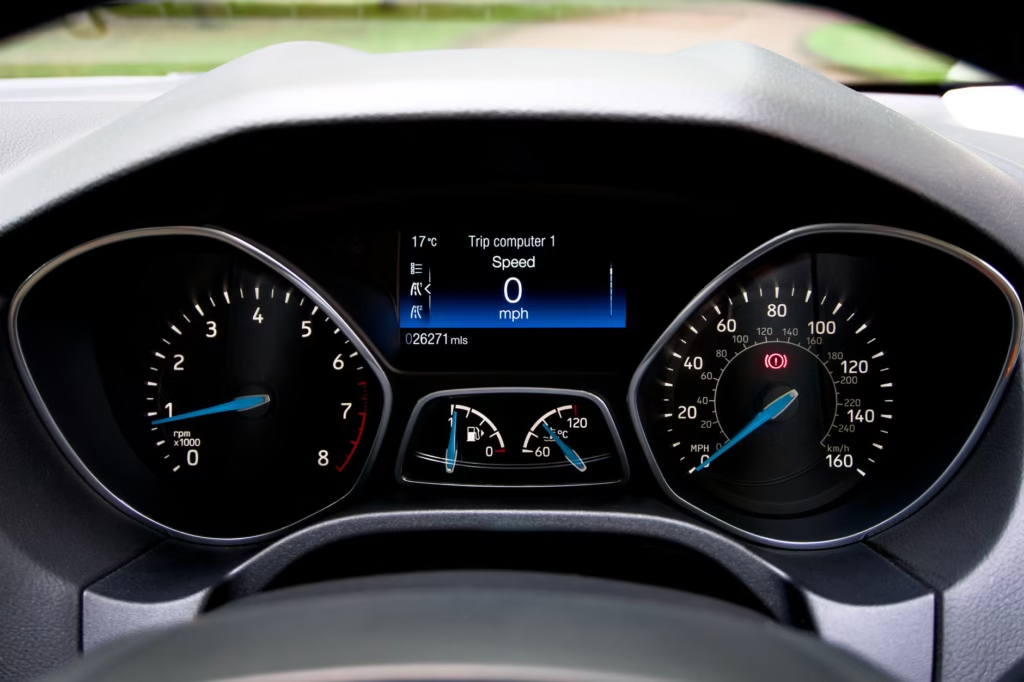
If fuel economy fell suddenly and the vehicle also has a check-engine light, rough idle, failed emissions test, hard starts, or a strong fuel smell, treat that as a repair problem first, not a driving-style experiment. Fixing a noticeable tune or emissions fault can restore lost MPG much faster than any eco-driving trick. (afdc.energy.gov)
Use the easiest-first fuel economy audit
A practical way to diagnose poor fuel economy is to start with the cheapest, easiest, most reversible causes and move outward from there. This article uses an original editorial method called the easiest-first fuel economy audit. It is not an industry standard; it is simply a decision rule that keeps drivers from replacing parts when the real losses are speed, tire pressure, drag, weather, or trip pattern.
- Compare like with like. Look for a pattern over several tanks and similar routes before deciding that the vehicle itself is malfunctioning. MPG naturally moves around with traffic, temperature, terrain, and A/C use. (epa.gov)
- Fix the free losses first. Smooth acceleration, gentler braking, lower highway speed, less idling, and fewer short cold trips usually cost nothing and can move the needle immediately. (afdc.energy.gov)
- Check rolling resistance and drag next. Cold tire pressures, roof boxes, roof racks, and unnecessary cargo can wipe out MPG without any warning light. (nhtsa.gov)
- Repair real faults, not imagined ones. Warning lights, failed emissions tests, and noticeable drivability problems deserve diagnosis. Random parts replacement usually does not. (afdc.energy.gov)
- Accept the vehicle’s ceiling. A heavier vehicle, AWD system, winter use, repeated short trips, or a job that involves towing or hauling may keep MPG below a best-case highway expectation even when nothing is wrong. (epa.gov)
Driving style and trip pattern usually dominate the loss
If a vehicle seems thirsty on the highway, speed is often the first culprit. DOE’s Alternative Fuels Data Center says aggressive driving, defined by speeding and rapid acceleration and braking, can lower fuel economy by 15% to 30% at highway speeds and 10% to 40% in stop-and-go traffic. DOE also says fuel economy for a light-duty vehicle traveling 80 mph is about 27% lower than at 60 mph. Those numbers are large enough that a car can feel mechanically fine while burning much more fuel than expected. (afdc.energy.gov)
City fuel economy often falls for a different reason: the vehicle spends too much time warming up, idling, and re-accelerating. DOE says idling can use roughly a quarter to a half gallon of fuel per hour, depending on engine size and A/C load. EPA also flags long idle periods and remote starter use as MPG killers, while DOE notes that combining errands helps because the engine runs more efficiently once it is warmed up. In other words, six one-mile trips can punish fuel economy far more than one six-mile trip. (energy.gov)
A realistic example helps. Suppose a family crossover normally feels acceptable around town but disappoints on vacation. On the road trip it is loaded with a large roof box, cruising near 78 mph, and spending long stretches on the interstate. In that situation, lower MPG does not automatically point to a bad sensor or injector. Based on DOE guidance, speed plus aerodynamic drag are already enough to explain a meaningful loss. That is a good example of why pattern recognition matters more than panic. (energy.gov)
Tires, drag, and extra weight can quietly erase highway MPG
Tire pressure is the simplest high-value check. DOE says keeping tires at the proper pressure can improve gas mileage by about 0.6% on average, and underinflated tires can lower gas mileage by 0.2% for every 1 psi drop in pressure across all four tires. NHTSA says proper tire pressure affects safety, durability, and fuel consumption, and it recommends checking all tires at least once a month when they are cold. The correct number is on the driver-side placard or in the owner’s manual, not the maximum pressure molded into the tire sidewall. (afdc.energy.gov)
Aerodynamic drag is the other quiet highway penalty. DOE says a large, blunt roof-top cargo box can reduce fuel economy by 2% to 8% in city driving, 6% to 17% on the highway, and 10% to 25% at interstate speeds. Extra weight matters too, though usually less dramatically; DOE says an extra 100 pounds can reduce fuel economy by around 1%, with a larger effect on smaller vehicles. If tire replacement is coming anyway, NHTSA says low-rolling-resistance tires can improve fuel economy, but tire choice is always a tradeoff with other priorities such as traction, durability, handling, and ride comfort. (afdc.energy.gov)

| What you notice | Most likely causes | Check first | What usually helps |
|---|---|---|---|
| Highway MPG is much worse than usual | Cruising speed, roof cargo, low tire pressure, extra drag | Average speed, tire pressures, roof rack or cargo box | Slow down, remove roof cargo, set cold tire pressures |
| Short-errand MPG is awful but long-trip MPG is decent | Cold starts, short trips, idling, winter driving | Trip length, remote-start habits, outside temperature | Combine errands, cut idle time, accept some winter loss |
| MPG dropped everywhere at once | Underinflation, maintenance fault, drivability issue | Tire pressures, warning lights, rough running, failed emissions test | Repair the fault, then recheck over several tanks |
| A hybrid seems great in town but disappointing on the freeway | Often normal behavior rather than a failure | Compare city and highway use separately | Use the vehicle where regenerative braking and reduced idling help most |
| One tank was terrible after a busy week or road trip | Traffic, weather, speed, route, or measurement variation | The next several fill-ups under similar conditions | Do not buy parts based on one bad tank |
The point of this table is not to diagnose the car from a screen. It is to choose the first sensible check. If poor MPG is concentrated on fast highway travel, look at speed and drag before spark plugs. If it arrived suddenly on every route, look at tires and maintenance before blaming the season. (energy.gov)
Real maintenance problems matter, but some tune-up advice is outdated
Maintenance still matters. DOE says fixing a car that is noticeably out of tune or has failed an emissions test can improve gas mileage by an average of about 4%, and a serious problem such as a faulty oxygen sensor can cause a much larger penalty. DOE also notes that using the manufacturer’s recommended motor-oil grade can improve fuel economy by roughly 1% to 2%. These are worthwhile gains, but they come from correcting real faults or using the right fluids, not from buying every product labeled fuel saver. (afdc.energy.gov)
One of the most persistent myths is the air-filter myth. DOE says replacing a clogged air filter on modern fuel-injected, computer-controlled gasoline vehicles and diesels does not improve fuel economy, though it may improve acceleration. Another costly myth is premium fuel for a car built for regular. DOE says vehicles engineered for regular gasoline likely see little or no benefit from premium, and vehicles that list premium as recommended rather than required usually do not gain enough fuel economy to offset the added price. (afdc.energy.gov)
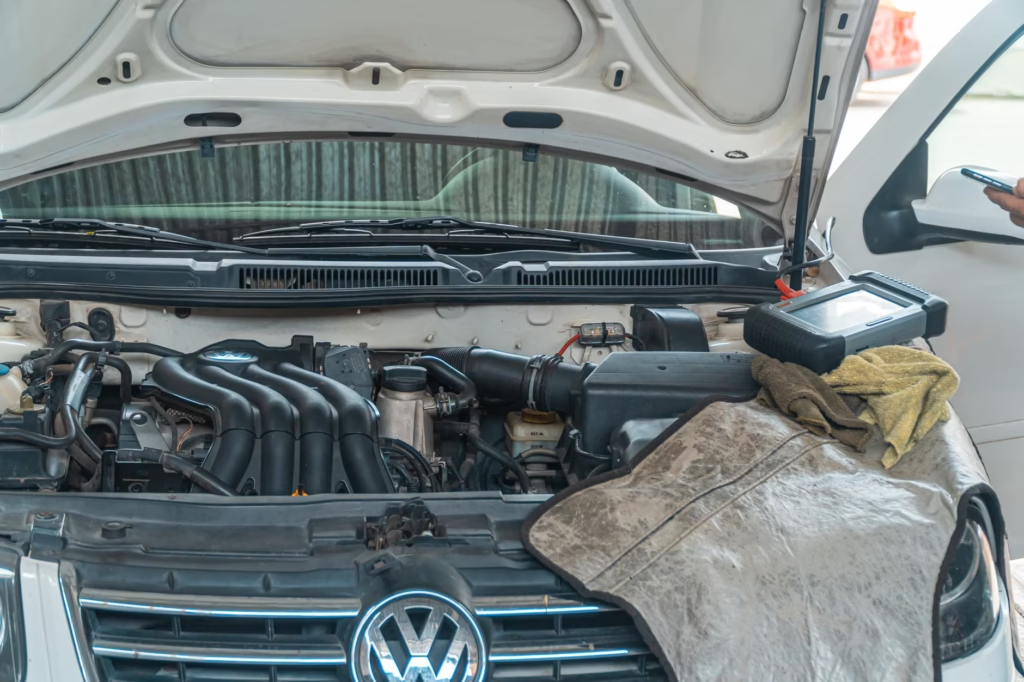
Do not chase MPG with unsafe shortcuts. Inflate tires to the vehicle manufacturer’s recommended cold pressure, not the tire sidewall maximum. And if the vehicle has a warning light or a failed emissions condition, diagnose it instead of trying to mask it with additives or wishful thinking. (nhtsa.gov)
Weather and vehicle type can make good habits look disappointing
Some fuel-economy losses are normal even when nothing is broken. DOE says a conventional gasoline vehicle’s fuel economy at 20°F in city driving is about 15% lower than at 77°F. EPA also notes that cold weather, hot weather with A/C use, mountainous driving, congestion, and rough roads can all lower MPG. This is why a careful driver can still see worse winter numbers or a summer dip in heavy A/C conditions. (energy.gov)
Vehicle design matters too. EPA notes that hybrids may be more efficient in town than on the highway because they can recapture energy from braking and reduce idling. EPA also says start-stop systems can improve fuel economy by about 4% to 5%, with the biggest benefit in stop-and-go driving. So if a hybrid shines in urban use but feels merely average on a long freeway trip, that may be normal behavior. And if a conventional vehicle has auto stop-start, turning it off all the time can give back some city efficiency. (epa.gov)
A practical 30-day plan to improve fuel economy
- Week 1: Check and set all tire pressures cold, including the spare if appropriate, using the driver-door placard or owner’s manual as the target. (nhtsa.gov)
- Week 1: Remove any empty roof rack accessories, roof box, or unnecessary cargo that has been living in the trunk for months. (afdc.energy.gov)
- Week 2: Pick one regular highway route and drive it 5 to 10 mph slower than usual for a few trips. Watch average MPG, not just your arrival time. (energy.gov)
- Week 2: Cut idle time. Avoid extended warm-ups, remote-start idling, and long waits with the engine running when the vehicle can safely be shut off. (epa.gov)
- Week 3: Combine errands when possible so the engine spends less of its day in cold-start mode. (afdc.energy.gov)
- Week 3: If the vehicle has a check-engine light, failed inspection, rough running, or a recent MPG cliff, schedule diagnosis rather than experimenting with fuel additives. (afdc.energy.gov)
- Week 4: Review the results over several tanks. If MPG still seems abnormally low, ask for a professional inspection and describe the pattern clearly: highway only, city only, winter only, or everywhere. (epa.gov)
This plan matters because it separates reversible losses from built-in limitations. If tire pressure, speed, drag, and idle habits improve MPG, the diagnosis is basically done. If nothing changes and the vehicle still shows a persistent drop across several tanks, that is better evidence for a maintenance problem. Either way, the driver ends up with cleaner information and fewer wasted purchases.
Sometimes the vehicle is the real limit
There is a point where the best fuel-economy fix is not a trick but a different tool for the job. EPA’s label and online fuel-economy resources are meant to help compare vehicles, and DOE notes that improving a low-MPG vehicle produces the biggest fuel savings. For example, DOE says moving from 10 mpg to 15 mpg saves far more fuel over a fixed distance than moving from 30 mpg to 35 mpg. If the current vehicle regularly tows, hauls, or spends its life on short trips, honest expectations may matter as much as maintenance. (epa.gov)
Poor fuel economy is easiest to fix when it is treated as a pattern, not a mystery. Start with the big, ordinary losses: speed, idling, tire pressure, drag, cargo, trip length, weather, and obvious maintenance faults. That approach is less exciting than miracle products, but it is usually where the real savings are.
FAQ
Is premium gasoline a good way to improve fuel economy?
Usually no. DOE says vehicles engineered for regular gasoline likely see little or no benefit from premium. If premium is only recommended, not required, any fuel-economy gain is usually too small to offset the higher price. (energy.gov)
Does replacing a dirty air filter improve gas mileage?
On most modern fuel-injected cars, not usually. DOE says a clogged air filter on modern gasoline vehicles may hurt acceleration but does not improve fuel economy when replaced. Older carbureted vehicles are the main exception. (afdc.energy.gov)
Why does my MPG fall so much in winter?
Cold weather lowers fuel economy even when the car is healthy. DOE says a conventional gasoline vehicle can see city fuel economy about 15% lower at 20°F than at 77°F, and EPA also lists cold temperatures as a common reason real-world mileage drops. (energy.gov)
Should I warm up the car by idling before driving?
Extended idling usually hurts fuel economy more than it helps. DOE says idling for as little as 10 seconds can use more fuel than stopping and restarting, and Argonne research distributed through DOE and AFDC says the vehicle warms up faster when driven than when idling. Remote starters with long idle periods also reduce MPG. Short idling for visibility, defrosting, or safety is a different question, but as a fuel-saving habit, long warm-ups are usually counterproductive. (energy.gov)
Can I rely on the tire-pressure warning light instead of checking pressures myself?
No. NHTSA says TPMS typically warns only when a tire is significantly underinflated. It is helpful, but it is not a replacement for a monthly cold-pressure check with a gauge. (nhtsa.gov)
Is one bad tank enough to prove a mechanical problem?
Usually not. EPA emphasizes that mileage varies with driving style and conditions, so one bad tank may reflect weather, route, traffic, speed, or A/C use. A persistent drop across several similar fill-ups is more meaningful. (epa.gov)
References
- US EPA – Discover Fuel-Saving Tips – https://www.epa.gov/greenvehicles/discover-fuel-saving-tips
- US EPA – Your Mileage May Vary – https://www.epa.gov/greenvehicles/your-mileage-may-vary
- US EPA – Fuel Economy and EV Range Testing – https://www.epa.gov/greenvehicles/fuel-economy-and-ev-range-testing
- US EPA – Learn More about the Fuel Economy Label (Text Only) – https://www.epa.gov/greenvehicles/learn-more-about-fuel-economy-label-text-only
- U.S. Department of Energy Alternative Fuels Data Center – Efficient Driving to Conserve Fuel – https://afdc.energy.gov/conserve/driving-behavior
- U.S. Department of Energy Alternative Fuels Data Center – Fuel Economy Tips PDF – https://afdc.energy.gov/files/u/publication/gas-saving_tips.pdf?fbb3c63ad5=
- National Highway Traffic Safety Administration – Tire Safety Ratings and Awareness – https://www.nhtsa.gov/vehicle-safety/tires
- U.S. Department of Energy – The Effect of Cold Temperatures on Fuel Economy – https://www.energy.gov/cmei/vehicles/articles/fotw-1164-december-14-2020-effect-cold-temperatures-fuel-economy
- U.S. Department of Energy – Slow Down to Save Fuel – https://www.energy.gov/cmei/vehicles/articles/fotw-1240-may-30-2022-slow-down-save-fuel-fuel-economy-decreases-about-27
- U.S. Department of Energy – Twenty-Two Percent of Model Year 2022 Light-duty Vehicle Models Require Premium Fuel – https://www.energy.gov/cmei/vehicles/articles/fotw-1243-june-20-2022-twenty-two-percent-model-year-2022-light-duty-vehicle
- US EPA – Advanced Gasoline and Diesel Vehicles – https://www.epa.gov/greenvehicles/advanced-gasoline-and-diesel-vehicles
- U.S. Department of Energy – Tips For Your Tank This Summer Driving Season – https://www.energy.gov/articles/tips-your-tank-summer-driving-season